The $3.4 Billion Ethereum Graveyard: Understanding Lost Ether and How to Protect Your Digital Assets

Over $3.4 billion in Ethereum lost forever due to user errors and bugs

Author: everythingcryptoitclouds.com
Published: July 24, 2025

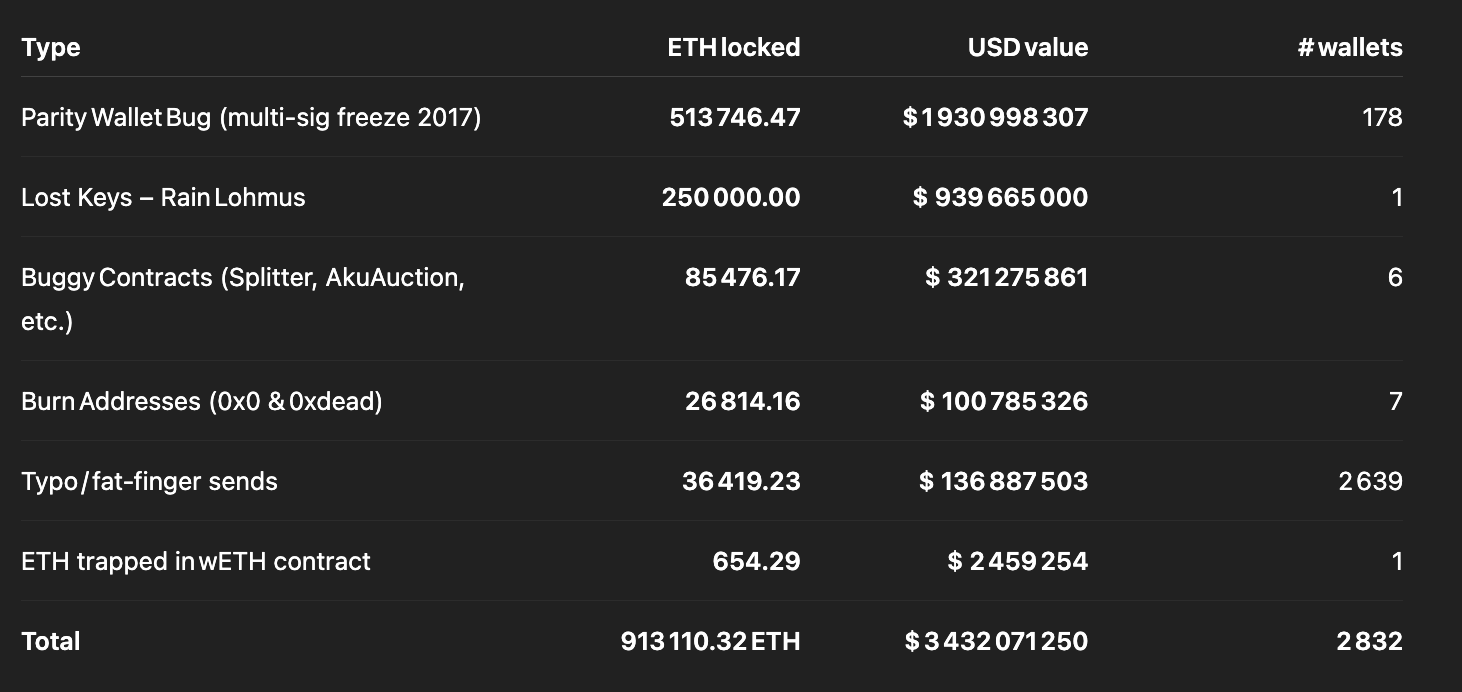
In the unforgiving digital landscape of blockchain technology, there exists a sobering reality that every cryptocurrency holder must confront: the permanent loss of digital assets. While Bitcoin’s lost coins have garnered significant attention over the years, Ethereum’s ecosystem presents an equally dramatic tale of irreversible losses that would make even the most seasoned investors pause. According to recent research by Coinbase’s head of product, Conor Grogan, over 913,111 ETH—worth approximately $3.4 billion at current market prices—has been lost forever due to user errors, smart contract bugs, and various technical mishaps [1].

This staggering figure represents more than just numbers on a blockchain explorer; it embodies the dreams, investments, and financial futures of countless individuals and organizations who fell victim to the unforgiving nature of decentralized technology. Unlike traditional banking systems where transactions can be reversed and funds can be recovered through customer service interventions, the blockchain operates under the principle of immutability—what is done cannot be undone.

The scale of this digital graveyard becomes even more profound when we consider that the $3.4 billion figure represents only the tip of the iceberg. As Grogan himself acknowledges, this amount “significantly undershoots the actual lost/inaccessible ETH amount” because it only covers instances where Ethereum is provably locked forever [2]. The calculation excludes the potentially massive amounts of ETH trapped behind lost private keys, forgotten Genesis wallets, and other forms of inaccessible storage that cannot be definitively quantified.

To put this loss into perspective, the 913,111 ETH represents approximately 0.76% of Ethereum’s current circulating supply of 120.7 million tokens [3]. When we include the 5.3 million ETH that has been intentionally burned through Ethereum Improvement Proposal 1559 (EIP-1559) since 2021, the total amount of ETH removed from circulation reaches 6.2 million tokens, or roughly 5% of the total supply [4]. This deflationary pressure, while unintentional in the case of lost funds, has significant implications for Ethereum’s long-term economics and scarcity dynamics.

The phenomenon of lost ether is not merely a recent development but rather a persistent challenge that has plagued the Ethereum ecosystem since its inception. The research reveals that the amount of lost ETH has surged by 44% since March 2023, growing from 636,000 ETH to the current figure of over 913,000 ETH [5]. This acceleration in losses suggests that despite increased awareness and improved tooling, the fundamental risks associated with blockchain technology continue to claim victims at an alarming rate.

Understanding the mechanics of how ether becomes permanently lost requires delving into the technical architecture of the Ethereum blockchain and the various ways in which human error, software bugs, and malicious attacks can result in irreversible asset loss. Unlike traditional financial systems where regulatory frameworks and institutional safeguards provide multiple layers of protection, the decentralized nature of Ethereum places the entire burden of security and asset protection on individual users and smart contract developers.

The implications of this massive loss extend far beyond the immediate financial impact on affected individuals and organizations. Each lost ETH represents a reduction in the liquid supply available for trading, staking, and participation in the broader Ethereum ecosystem. This artificial scarcity, while potentially beneficial for remaining holders from a price perspective, also highlights the significant barriers to mainstream adoption that continue to plague cryptocurrency technology.

Moreover, the concentration of losses in specific categories—such as the 513,746 ETH trapped in Parity wallet bugs or the 60,000 ETH lost in the Quadriga exchange collapse—reveals systemic vulnerabilities in the infrastructure and tooling that supports the Ethereum ecosystem [6]. These incidents serve as stark reminders that the promise of decentralized finance comes with unprecedented risks that traditional financial systems have spent centuries learning to mitigate.

As we embark on this comprehensive exploration of lost ether, we will examine the various mechanisms through which ETH becomes permanently inaccessible, analyze the most significant loss events in Ethereum’s history, and investigate the evolving landscape of prevention strategies and recovery mechanisms. This analysis is not merely an academic exercise but a critical examination of the challenges that must be addressed for blockchain technology to achieve its transformative potential while protecting the assets and interests of its users.

The Anatomy of Lost Ether: Understanding How Digital Assets Disappear Forever

The permanent loss of Ethereum represents a multifaceted phenomenon that encompasses various technical, human, and systemic factors. To comprehend the full scope of this digital tragedy, we must examine the distinct categories through which ETH becomes irretrievably lost and the underlying mechanisms that make recovery impossible within the current blockchain paradigm.

Smart Contract Vulnerabilities: The Technical Achilles’ Heel

The largest single category of lost ether stems from vulnerabilities in smart contracts—self-executing programs that run on the Ethereum blockchain. These digital agreements, while revolutionary in their potential to automate complex financial transactions without intermediaries, have proven to be fertile ground for catastrophic losses when their code contains bugs or design flaws.

The most prominent example of this category is the Parity wallet incident, which has resulted in the permanent freezing of 513,746 ETH worth nearly $925 million at current prices [7]. This loss occurred not through a single event but through two separate incidents that highlighted the fragility of smart contract security. The first incident in July 2017 saw attackers exploit a vulnerability in Parity’s multisig wallet version 1.5+, resulting in the theft of 150,000 ETH worth approximately $30 million at the time [8].

However, it was the second incident in November 2017 that created the more devastating and permanent loss. In an attempt to fix the vulnerability from the first attack, Parity released an updated version of their multisig wallet contract. Unfortunately, this fix introduced a new vulnerability that was accidentally triggered by a GitHub user known as “devops199” [9]. This individual, apparently unaware of the consequences of their actions, called the “suicide” function on the library contract that served as the foundation for all Parity multisig wallets created after July 20, 2017.

The technical details of this incident reveal the subtle but catastrophic nature of smart contract vulnerabilities. The Parity multisig wallets were designed using a library pattern where multiple wallet contracts would delegate calls to a shared library contract containing the core functionality. When the library contract was destroyed through the suicide function, all dependent wallet contracts became permanently frozen, unable to execute any transactions including withdrawals [10]. The affected wallets contained funds belonging to various organizations and individuals, with the Web3 Foundation alone having 306,000 ETH trapped in this incident [11].

The Parity incident exemplifies a broader challenge in smart contract development: the tension between code efficiency and security. The library pattern used by Parity was intended to reduce gas costs and improve code maintainability by allowing multiple contracts to share common functionality. However, this architectural decision created a single point of failure that, when exploited, affected hundreds of wallets simultaneously.

Beyond Parity, the research identifies 85,476 ETH lost to various buggy contracts, representing $153.8 million in current value [12]. These losses span a wide range of contract types and failure modes, from decentralized exchange contracts with withdrawal bugs to token contracts with flawed transfer mechanisms. Each incident represents a unique combination of coding errors, insufficient testing, and the immutable nature of blockchain deployment that prevents post-deployment fixes.

The Akutars NFT collection provides another instructive example of how smart contract bugs can result in permanent losses. During the minting process for this non-fungible token collection, a bug in the contract code resulted in 11,500 ETH becoming permanently locked within the contract [13]. The funds were intended to be withdrawable by the project team after the minting process, but a coding error made this withdrawal impossible, effectively burning the ETH forever.

These incidents highlight a fundamental challenge in the Ethereum ecosystem: the irreversible nature of smart contract deployment. Unlike traditional software where bugs can be patched through updates, smart contracts deployed on Ethereum are immutable by design. While this immutability provides security benefits by preventing unauthorized modifications, it also means that any bugs present at deployment time become permanent features of the contract.

Human Error: The Persistent Vulnerability

While smart contract bugs represent the largest category of lost ether by value, human error constitutes the most diverse and persistent source of losses. The research identifies 12,619 ETH lost to typos alone, representing over $22.7 million in current value across 2,638 affected wallets [14]. This category encompasses a wide range of user mistakes, from simple transcription errors to fundamental misunderstandings of how Ethereum addresses work.

The most common form of human error involves mistakes in Ethereum address entry. Ethereum addresses are 42-character hexadecimal strings that begin with “0x” and are case-sensitive when using the optional checksum format. A single character error in an address can result in funds being sent to an uncontrolled address, effectively burning them forever. Unlike traditional banking systems where account numbers are validated and incorrect transfers can be reversed, the Ethereum blockchain executes all valid transactions irreversibly.

The prevalence of address-related errors has led to various mitigation strategies within the Ethereum ecosystem. The Ethereum Improvement Proposal 55 (EIP-55) introduced a checksum format that uses mixed case letters to help detect transcription errors [15]. However, adoption of this format is not universal, and many users continue to work with non-checksummed addresses that provide no error detection capabilities.

Another significant source of human error involves the misunderstanding of smart contract interactions. Many users have lost funds by sending ETH directly to token contracts or other smart contracts that are not designed to handle direct ETH transfers. When ETH is sent to a contract that lacks a payable fallback function or proper handling mechanisms, the funds become permanently trapped within the contract with no mechanism for retrieval.

The research also identifies 24,187 ETH that has been deliberately sent to burn addresses, representing $43.5 million in current value [16]. While some of these transactions may have been intentional burns for various purposes, many likely represent user errors where individuals mistakenly sent funds to known burn addresses. The most commonly used burn address is 0x0000000000000000000000000000000000000000, which is easily recognizable but apparently not universally understood as a destination that will permanently destroy any sent funds.

The psychological factors contributing to human error in cryptocurrency transactions cannot be understated. The irreversible nature of blockchain transactions creates a high-stress environment where users must be perfect in their execution of financial operations. Unlike traditional banking where customers can call customer service to reverse mistaken transactions, blockchain users bear the full responsibility for transaction accuracy with no safety net for errors.

Exchange Failures and Custodial Losses

The collapse of cryptocurrency exchanges represents another significant category of lost ether, with the Quadriga exchange serving as the most prominent example. Initially, Quadriga announced in June 2017 that they had lost 14 million CAD worth of Ethereum due to a smart contract error [17]. However, subsequent investigations revealed that this loss was part of a much larger pattern of mismanagement and potential fraud that ultimately resulted in the permanent loss of approximately 60,000 ETH [18].

The Quadriga case illustrates the risks associated with centralized custody of cryptocurrency assets. When users deposit funds on an exchange, they are essentially trusting the exchange operators to maintain proper security practices and financial controls. The death of Quadriga’s founder, Gerald Cotten, in December 2018 revealed that the exchange had been operating with significant security vulnerabilities, including the storage of private keys on a single individual’s encrypted laptop [19].

The investigation into Quadriga’s collapse revealed that Cotten had been using customer funds to cover trading losses totaling approximately $115 million [20]. This practice, known as commingling of funds, is prohibited in traditional financial services but was apparently common in the early cryptocurrency exchange industry due to lack of regulatory oversight and proper auditing procedures.

The Quadriga incident highlights the broader risks associated with centralized cryptocurrency services. While exchanges provide convenience and liquidity for cryptocurrency trading, they also represent single points of failure that can result in massive losses when they fail. The phrase “not your keys, not your coins” has become a rallying cry in the cryptocurrency community, emphasizing the importance of self-custody for long-term asset security.

Beyond Quadriga, numerous other exchange failures have contributed to the overall tally of lost ether. The Mt. Gox collapse, while primarily affecting Bitcoin, also resulted in the loss of various altcoins including early Ethereum holdings. More recent incidents, such as the FTX collapse, have demonstrated that exchange failures remain a persistent risk in the cryptocurrency ecosystem despite increased regulatory attention and improved security practices.

The DAO Hack: A Defining Moment in Ethereum History

No discussion of lost ether would be complete without examining The DAO hack of June 2016, an incident that not only resulted in significant financial losses but also fundamentally shaped the development trajectory of the Ethereum ecosystem. The Decentralized Autonomous Organization (DAO) was an ambitious experiment in decentralized governance and investment, raising approximately $150 million worth of ETH through a token sale [21].

The DAO operated through smart contracts that allowed token holders to propose and vote on investment decisions. However, the contract code contained a critical vulnerability known as a reentrancy bug, which allowed an attacker to repeatedly withdraw funds from the contract before the balance was updated [22]. On June 17, 2016, an anonymous attacker exploited this vulnerability to drain approximately 3.6 million ETH, worth about $70 million at the time [23].

The DAO hack presented the Ethereum community with an unprecedented crisis. The attacker had not technically broken any rules of the blockchain protocol; they had simply exploited a vulnerability in a smart contract according to the code’s logic. This raised fundamental questions about the nature of smart contracts and whether “code is law” should be the ultimate principle governing blockchain-based systems.

The response to The DAO hack was highly controversial and ultimately led to a hard fork of the Ethereum blockchain. The majority of the Ethereum community supported a fork that would reverse the effects of the hack and return the stolen funds to their original owners. However, a minority faction argued that this intervention violated the immutability principles of blockchain technology and continued to support the original chain, which became known as Ethereum Classic [24].

While the hard fork successfully recovered the funds stolen in The DAO hack, it established a precedent that the Ethereum blockchain could be modified to reverse the effects of smart contract exploits under extreme circumstances. This precedent has been invoked in subsequent incidents, such as the Parity wallet freeze, but the Ethereum community has generally been reluctant to implement additional hard forks for fund recovery purposes.

The DAO incident serves as a watershed moment that highlighted both the potential and the risks of smart contract technology. It demonstrated that even well-funded and extensively reviewed smart contracts could contain critical vulnerabilities, and that the decentralized nature of blockchain governance could make it difficult to respond quickly to security incidents.

Technical Infrastructure Failures

Beyond user errors and smart contract bugs, the Ethereum ecosystem has also experienced losses due to failures in the technical infrastructure that supports the network. These incidents, while less common than other categories, have resulted in significant losses and highlight the complex interdependencies within the blockchain ecosystem.

One category of infrastructure failure involves issues with wallet software and key management systems. Early Ethereum wallets often had poor user interfaces and inadequate backup mechanisms, leading to situations where users could lose access to their funds due to software bugs or data corruption. The transition from the original Ethereum wallet software to more modern alternatives like MetaMask and hardware wallets has reduced but not eliminated these risks.

Another source of infrastructure-related losses involves issues with the Ethereum network itself during periods of high congestion or protocol upgrades. While the Ethereum protocol is designed to be robust against such issues, the complexity of the system means that edge cases and unexpected interactions can sometimes result in transaction failures or other problems that may lead to fund losses.

The research also identifies 654 ETH trapped in WETH (Wrapped Ethereum) contracts, representing $1.2 million in current value [25]. WETH is a tokenized version of ETH that allows it to be used in decentralized applications that require ERC-20 token interfaces. While WETH is generally considered safe and widely used, the trapped funds likely represent instances where users sent ETH directly to WETH contracts without properly calling the deposit function, or where bugs in WETH-related contracts prevented proper unwrapping of tokens.

These infrastructure-related losses underscore the importance of robust testing and quality assurance in the development of blockchain-related software and services. As the Ethereum ecosystem continues to evolve and mature, the focus on infrastructure reliability and user experience improvements becomes increasingly critical for preventing future losses.

Chronicles of Catastrophe: Major Historical Incidents That Shaped Ethereum’s Loss Landscape

The history of lost ether is punctuated by several major incidents that not only resulted in significant financial losses but also served as defining moments in the evolution of the Ethereum ecosystem. These events provide valuable insights into the various failure modes that can affect blockchain-based systems and the lessons learned from each catastrophe.

The Parity Multisig Saga: A Tale of Two Disasters

The Parity wallet incidents represent the most significant source of permanently lost ether in Ethereum’s history, with the story unfolding across two separate but related events that collectively demonstrate the cascading effects of smart contract vulnerabilities.

The First Strike: July 19, 2017

The initial Parity incident occurred on July 19, 2017, when an attacker exploited a vulnerability in the Parity multisig wallet contract version 1.5 and higher. The attack was sophisticated and targeted, focusing on three specific Ethereum Initial Coin Offering (ICO) projects: Aeternity, Edgeless, and Swarm City [26]. The attacker managed to steal approximately 150,000 ETH, worth around $30 million at the time, by exploiting a flaw in the wallet’s initialization process.

The technical details of this attack reveal the subtle nature of smart contract vulnerabilities. The Parity multisig wallet used a library pattern where the main wallet contract would delegate calls to a shared library contract containing the core functionality. However, the library contract itself could be initialized as if it were a regular wallet, allowing the attacker to become its owner and then use the wallet’s functionality to transfer funds from other wallets that relied on the same library [27].

The attack sequence was methodical and devastating. The attacker first identified vulnerable wallets by scanning the blockchain for contracts that used the affected Parity library. They then called the initialization function on the library contract to become its owner, followed by systematic draining of funds from the dependent wallets. The entire attack was completed within a matter of hours, demonstrating both the speed at which blockchain-based attacks can unfold and the difficulty of implementing real-time defensive measures.

The immediate response to this attack involved Parity releasing a security advisory and urging users to move their funds to secure wallets. However, the damage was already done for the affected projects. Aeternity lost approximately 37,000 ETH, Edgeless lost around 82,000 ETH, and Swarm City lost about 44,000 ETH [28]. These losses represented significant portions of these projects’ treasuries and had lasting impacts on their development and operations.

The Fatal Flaw: November 6, 2017

The second Parity incident, occurring on November 6, 2017, was even more devastating in its scope and permanence. In response to the July attack, Parity had released a new version of their multisig wallet that was intended to address the vulnerabilities that had been exploited. However, this fix introduced a new and more catastrophic vulnerability that would result in the permanent freezing of over 500,000 ETH.

The November incident was triggered not by a malicious attacker but by a GitHub user operating under the handle “devops199” who appeared to be experimenting with the Parity contract code [29]. This individual called the initWallet function on the library contract, making themselves the owner, and then immediately called the kill function, which executed the contract’s self-destruct mechanism.

The consequences of this action were immediate and irreversible. Because all Parity multisig wallets created after July 20, 2017, relied on the now-destroyed library contract, they became permanently frozen. Users could see their funds in the wallets but could not execute any transactions, including withdrawals. The affected wallets contained a total of 513,746 ETH, worth approximately $280 million at the time and over $900 million at current prices [30].

The technical architecture that enabled this catastrophic failure illustrates a fundamental tension in smart contract design between efficiency and security. The library pattern used by Parity was intended to reduce deployment costs and improve code maintainability by allowing multiple contracts to share common functionality. However, this design created a single point of failure that, when compromised, affected hundreds of wallets simultaneously.

Among the most significant victims of this incident was the Web3 Foundation, the organization behind the Polkadot blockchain project, which had 306,000 ETH frozen in affected wallets [31]. This loss represented a substantial portion of the foundation’s treasury and significantly impacted their ability to fund development activities. Other affected parties included various ICO projects, individual investors, and organizations that had chosen Parity’s multisig solution for its perceived security benefits.

The aftermath of the November incident sparked intense debate within the Ethereum community about potential recovery mechanisms. Parity and affected parties lobbied for a hard fork similar to the one that had been implemented to recover funds from The DAO hack. However, the community’s appetite for such interventions had diminished significantly since 2016, and the proposal for a recovery fork was ultimately rejected [32].

The Quadriga Collapse: When Centralization Meets Catastrophe

The collapse of QuadrigaCX, once Canada’s largest cryptocurrency exchange, represents a complex case study in the risks associated with centralized custody and the potential for both technical failures and fraudulent activity to result in permanent asset losses.

The Initial Technical Failure

Quadriga’s problems first became publicly apparent in June 2017 when the exchange announced that it had lost approximately 14 million CAD worth of Ethereum due to a smart contract error [33]. According to the exchange’s public statements, the loss occurred when they attempted to upgrade their Ethereum storage system and encountered a bug in the smart contract code that made the funds inaccessible.

At the time, this incident was treated as an unfortunate but isolated technical failure. Quadriga assured customers that the loss would not affect their operations and that they were working to improve their security procedures to prevent similar incidents. The exchange continued operating normally for over a year following this announcement, processing customer deposits and withdrawals without apparent difficulty.

However, subsequent investigations would reveal that this initial loss was likely part of a much larger pattern of mismanagement and potential fraud that had been ongoing for years. The smart contract error may have been genuine, but it occurred in the context of an exchange that was already experiencing significant financial difficulties due to other factors.

The Founder’s Death and the Unraveling

The true scope of Quadriga’s problems became apparent in December 2018 when the exchange’s founder and CEO, Gerald Cotten, died suddenly while traveling in India [34]. Cotten’s death initially appeared to be a tragic but straightforward event—a young entrepreneur who had succumbed to complications from Crohn’s disease while on his honeymoon.

However, Cotten’s death created an immediate crisis for Quadriga because he had apparently been the sole individual with access to the exchange’s cold storage wallets containing the majority of customer funds. According to his widow, Jennifer Robertson, Cotten had stored the private keys for these wallets on an encrypted laptop, and he had not shared the encryption passwords with anyone else [35].

The exchange filed for creditor protection in January 2019, claiming that approximately 190 million CAD worth of cryptocurrency was inaccessible due to Cotten’s death. This included not only Bitcoin but also significant amounts of Ethereum and other altcoins. The initial assumption was that this represented a tragic case of poor key management practices that had resulted in the permanent loss of customer funds.

The Investigation and Revelations

As investigators began examining Quadriga’s operations more closely, a much more disturbing picture emerged. The Ontario Securities Commission conducted a comprehensive review of the exchange’s activities and published their findings in April 2020 [36]. The investigation revealed that Quadriga had been operating as a Ponzi scheme for years, with Cotten using new customer deposits to pay withdrawal requests from existing customers.

The investigation found that Cotten had been conducting unauthorized trading activities using customer funds, resulting in losses of approximately 115 million CAD [37]. These trading losses were hidden from customers and covered up through various accounting manipulations and the use of new customer deposits. The exchange’s claimed cold storage reserves were largely fictitious, with most customer funds having been lost through Cotten’s trading activities long before his death.

The 60,000 ETH that appears in the lost ether statistics likely represents a combination of the initial smart contract error and funds that were lost through Cotten’s unauthorized trading activities. While some of these losses may be recoverable through bankruptcy proceedings, the complex nature of the fraud and the international jurisdictional issues involved make full recovery unlikely.

The Quadriga case highlights the risks associated with centralized cryptocurrency services and the importance of proper regulatory oversight. Unlike traditional financial institutions, which are subject to strict capital requirements and regular audits, early cryptocurrency exchanges operated with minimal oversight and often lacked basic financial controls.

The DAO Hack: Ethereum’s Existential Crisis

The DAO hack of June 2016 stands as perhaps the most consequential incident in Ethereum’s history, not only because of the immediate financial losses but also because of its lasting impact on the platform’s governance philosophy and technical development.

The Vision and the Vulnerability

The Decentralized Autonomous Organization (DAO) was conceived as a revolutionary experiment in decentralized governance and investment. Launched in April 2016, The DAO raised approximately 12.7 million ETH (worth about $150 million at the time) through a token sale, making it one of the largest crowdfunding efforts in history [38]. The project aimed to create a decentralized venture capital fund where token holders could propose and vote on investment decisions without traditional intermediaries.

The DAO’s smart contract was complex, implementing sophisticated governance mechanisms that allowed for proposal submission, voting, and fund allocation. However, this complexity also created numerous potential attack vectors that were not fully understood or tested before deployment. The contract had undergone some security review, but the nascent state of smart contract auditing practices meant that critical vulnerabilities remained undetected.

The specific vulnerability that led to The DAO hack was a reentrancy bug in the contract’s withdrawal mechanism. When a user requested to withdraw their funds from The DAO, the contract would first send the ETH to the user’s address and then update the user’s balance in the contract’s internal accounting system. However, if the recipient address was itself a smart contract, it could call back into The DAO’s withdrawal function before the balance update occurred, allowing for multiple withdrawals of the same funds [39].

The Attack Unfolds

On June 17, 2016, an anonymous attacker began exploiting this vulnerability in a systematic and devastating manner. The attack was not a quick smash-and-grab operation but rather a methodical draining process that continued for several hours. The attacker deployed a malicious smart contract that would repeatedly call The DAO’s withdrawal function, each time extracting more ETH before the balance could be properly updated.

The Ethereum community watched in horror as The DAO’s balance steadily decreased throughout the day. Developers and security researchers quickly identified the nature of the attack and began working on potential countermeasures, but the decentralized nature of the blockchain meant that there was no central authority that could simply halt the attack in progress.

By the time the attack was complete, the attacker had drained approximately 3.6 million ETH from The DAO, representing about one-third of the total funds raised [40]. The stolen ETH was moved to a child DAO contract, where it would be subject to a 28-day holding period before the attacker could access it. This holding period provided a crucial window of opportunity for the Ethereum community to consider response options.

The Community Response and Hard Fork Decision

The DAO hack created an unprecedented crisis for the Ethereum community. The attack had not violated any rules of the Ethereum protocol itself; the attacker had simply exploited a vulnerability in a smart contract according to the code’s programmed logic. This raised fundamental questions about the principle of “code is law” and whether the Ethereum blockchain should be modified to reverse the effects of the hack.

The debate that followed was intense and divisive. Supporters of intervention argued that The DAO represented such a significant portion of the Ethereum ecosystem that its failure could undermine confidence in the entire platform. They also pointed out that the attack exploited a bug rather than a legitimate feature, making it morally justifiable to reverse its effects.

Opponents of intervention argued that modifying the blockchain to reverse the hack would violate the immutability principles that made blockchain technology valuable in the first place. They contended that smart contract bugs were a risk that users had accepted when participating in The DAO, and that bailing out failed projects would create moral hazard and undermine the credibility of the platform.

After extensive community discussion and debate, the Ethereum Foundation and core developers decided to implement a hard fork that would reverse the effects of The DAO hack. The fork was designed to move all ETH from The DAO and its child contracts to a recovery contract where original investors could withdraw their funds [41].

The Split and Ethereum Classic

While the hard fork had majority support within the Ethereum community, a significant minority opposed the intervention and continued to mine the original chain. This chain became known as Ethereum Classic (ETC), and it maintained the original transaction history including The DAO hack [42].

The existence of Ethereum Classic created a permanent reminder of the controversy surrounding The DAO hard fork. While Ethereum (ETH) became the dominant chain and continued to develop new features and improvements, Ethereum Classic maintained a more conservative approach focused on immutability and resistance to protocol changes.

The DAO incident and its aftermath had lasting effects on the Ethereum ecosystem. It demonstrated both the potential and the risks of smart contract technology, leading to improved development practices and security tools. It also established precedents for community governance and decision-making that continue to influence Ethereum’s development today.

Akutars and the NFT Minting Disaster

The Akutars incident of April 2022 represents a more recent example of how smart contract bugs can result in permanent fund losses, this time in the context of the non-fungible token (NFT) boom that characterized much of 2021 and 2022.

The Project and the Promise

Akutars was an NFT project created by artist Micah Johnson, featuring 15,000 unique digital collectibles. The project gained significant attention due to Johnson’s reputation as a former professional baseball player turned artist and the high-quality artwork featured in the collection. The NFT mint was structured as a Dutch auction, where the price would start high and gradually decrease until all tokens were sold.

The smart contract for the Akutars mint was designed to include several advanced features, including a refund mechanism for users who paid more than the final clearing price and a withdrawal function that would allow the project team to access the raised funds after the mint was complete. These features were intended to create a fair and transparent minting process that would benefit both collectors and the project creators.

The Fatal Flaw

However, the smart contract contained a critical bug in the interaction between its refund mechanism and withdrawal function. The contract was designed to track the total amount of refunds that needed to be paid out and prevent the project team from withdrawing funds until all refunds had been processed. Unfortunately, the logic for calculating the refund amount was flawed, creating a situation where the contract believed it owed more in refunds than it actually did.

When the mint concluded, the contract had raised approximately 11,539 ETH from the sale of the NFTs. However, due to the bug in the refund calculation, the contract’s internal accounting showed that it owed more in refunds than the total amount raised. This created a deadlock situation where neither refunds nor team withdrawals could be processed, effectively trapping all 11,539 ETH within the contract permanently [43].

The technical details of this bug illustrate the subtle ways in which smart contract logic can fail. The contract used a complex system of mappings and calculations to track individual user contributions and refund amounts. However, the developers failed to account for certain edge cases in the refund calculation, leading to an overflow condition that made the contract’s internal state inconsistent with reality.

The Aftermath and Lessons Learned

The Akutars incident was particularly tragic because it affected not only the project creators, who lost access to the funds they had legitimately raised, but also the NFT collectors who were unable to receive their promised refunds. The bug was discovered shortly after the mint concluded, but the immutable nature of smart contracts meant that no fix could be implemented.

Various attempts were made to recover the funds, including proposals for community-driven recovery mechanisms and potential protocol-level interventions. However, unlike The DAO hack, the Akutars incident did not generate sufficient community support for a hard fork or other extraordinary measures.

The incident highlighted the continued risks associated with smart contract development, even years after the early disasters like The DAO and Parity incidents. Despite the availability of better development tools, security auditing services, and educational resources, complex smart contracts continued to contain critical vulnerabilities that could result in permanent fund losses.

The Akutars case also demonstrated the particular risks associated with the NFT boom, where rapid development cycles and competitive pressure to launch projects quickly sometimes led to insufficient testing and security review. The incident served as a wake-up call for the NFT community about the importance of proper smart contract security practices.

Lessons from the Graveyard

These major incidents, while devastating for those directly affected, have provided valuable lessons that have shaped the development of the Ethereum ecosystem. Each disaster has contributed to improved development practices, better security tools, and enhanced user education about the risks associated with blockchain technology.

The Parity incidents led to widespread adoption of more rigorous smart contract auditing practices and the development of formal verification tools that can mathematically prove the correctness of contract code. The DAO hack established important precedents for community governance and highlighted the need for careful consideration of the trade-offs between intervention and immutability.

The Quadriga collapse reinforced the importance of proper key management and regulatory oversight for centralized cryptocurrency services. The Akutars incident demonstrated that smart contract risks persist even as the ecosystem matures and that continued vigilance is required in the development and deployment of complex contracts.

Despite these lessons, the continued growth in lost ether statistics suggests that the fundamental challenges of blockchain security remain unsolved. As the ecosystem continues to evolve and new use cases emerge, the potential for novel failure modes and unexpected vulnerabilities remains a persistent concern that requires ongoing attention and innovation to address.

Fortress of Digital Assets: Comprehensive Prevention Strategies and Security Best Practices

The sobering reality of permanently lost ether underscores the critical importance of implementing robust security measures and following established best practices when handling cryptocurrency assets. Unlike traditional financial systems where regulatory frameworks and institutional safeguards provide multiple layers of protection, the decentralized nature of Ethereum places the entire burden of security on individual users and developers. This section provides a comprehensive guide to protecting your digital assets from the various threats that have claimed billions of dollars worth of ETH throughout Ethereum’s history.

Wallet Security: Your First Line of Defense
Best Bitcoin & Ethereum Wallets for Secure Storage

The foundation of Ethereum security begins with proper wallet selection and management. The choice between different wallet types represents a fundamental trade-off between convenience and security, with each option presenting distinct advantages and risks that must be carefully considered based on your specific use case and risk tolerance.

Hardware Wallets: The Gold Standard for Long-Term Storage

Hardware wallets represent the most secure option for storing significant amounts of ETH, particularly for long-term holdings that are not frequently accessed. These devices store private keys in specialized secure hardware that is isolated from internet-connected computers, making them virtually immune to remote attacks and malware [44].

The two leading hardware wallet manufacturers, Ledger and Trezor, have established strong reputations for security and reliability within the cryptocurrency community. Ledger devices use a proprietary secure element chip that provides hardware-level protection for private keys, while Trezor devices use an open-source approach that allows for community security review and verification [45].

When using hardware wallets, several critical security practices must be followed to maintain their effectiveness. First, hardware wallets should only be purchased directly from the manufacturer or authorized resellers to avoid the risk of receiving compromised devices. There have been documented cases of attackers intercepting hardware wallets during shipping and modifying them to steal funds [46].

The setup process for hardware wallets requires careful attention to seed phrase generation and backup procedures. The seed phrase, typically consisting of 12 or 24 words, serves as the master key that can regenerate all private keys associated with the wallet. This phrase must be written down on paper and stored in multiple secure locations, as losing the seed phrase while the hardware device is damaged or lost will result in permanent fund loss [47].

Physical security of hardware wallets is equally important as their digital security features. The devices should be stored in secure locations when not in use, and users should be aware that physical access to a hardware wallet may allow sophisticated attackers to extract private keys through side-channel attacks or other advanced techniques [48].

Software Wallets: Balancing Convenience and Security

Software wallets, such as MetaMask, MyEtherWallet, and various mobile applications, provide greater convenience for frequent transactions but require additional security measures to protect against the broader attack surface of internet-connected devices. These wallets store private keys on the user’s device, making them vulnerable to malware, phishing attacks, and other forms of digital compromise.

The security of software wallets depends heavily on the security of the underlying device and operating system. Users should ensure that their computers and mobile devices are kept up to date with the latest security patches and are protected by reputable antivirus software. The use of dedicated devices or virtual machines for cryptocurrency activities can provide additional isolation from potential threats [49].

Browser-based wallets like MetaMask face particular security challenges due to their integration with web browsers, which are frequent targets for malicious attacks. Users should be extremely cautious about the websites they visit while their wallet is unlocked and should consider using separate browser profiles or dedicated browsers for cryptocurrency activities [50].

The backup and recovery procedures for software wallets are critical for preventing permanent fund loss. Like hardware wallets, software wallets typically use seed phrases for backup and recovery. These phrases should be stored securely offline and never entered into any digital device except when performing legitimate recovery operations [51].

Multi-Signature Wallets: Distributed Security Through Consensus

Multi-signature (multisig) wallets represent an advanced security approach that requires multiple private keys to authorize transactions, distributing the risk of fund loss across multiple parties or devices. While the Parity multisig incidents demonstrate that these wallets are not immune to smart contract vulnerabilities, properly implemented multisig solutions can provide significant security benefits for organizations and high-value individual holdings [52].

The most common multisig configurations include 2-of-3 setups, where any two of three authorized parties can approve transactions, and 3-of-5 setups for larger organizations. These configurations provide redundancy against the loss of individual keys while maintaining security against unauthorized access. The threshold should be chosen carefully to balance security against the risk of losing access due to unavailable signers [53].

Modern multisig implementations, such as Gnosis Safe, have learned from the failures of earlier solutions like Parity and implement more robust security practices. These include formal verification of smart contract code, extensive security auditing, and the use of battle-tested contract patterns that minimize the risk of critical vulnerabilities [54].

Transaction Security: Preventing Costly Mistakes

The irreversible nature of Ethereum transactions makes transaction security practices critically important for preventing permanent fund loss. Unlike traditional banking systems where transactions can be reversed or corrected, every Ethereum transaction must be executed with perfect accuracy to avoid irreversible mistakes.

Address Verification: The Critical First Step

Address verification represents the most fundamental aspect of transaction security, as sending funds to an incorrect address is one of the most common causes of permanent loss. Ethereum addresses are 42-character hexadecimal strings that are not human-readable, making them prone to transcription errors and other mistakes [55].

The Ethereum community has developed several tools and practices to reduce the risk of address-related errors. The EIP-55 checksum format uses mixed-case letters to encode error detection information directly into the address, allowing wallets to detect many common transcription errors [56]. However, not all wallets and services support checksum validation, and users should verify that their chosen tools implement this protection.

Visual verification tools, such as identicons and address avatars, provide additional protection against address errors by generating unique visual representations of addresses that are easier for humans to verify than long hexadecimal strings. Many wallets display these visual identifiers alongside addresses to help users confirm that they are sending funds to the intended recipient [57].

For high-value transactions, the practice of sending small test amounts before transferring larger sums provides an additional layer of protection. While this approach incurs additional transaction fees, the cost is minimal compared to the potential loss from sending funds to an incorrect address [58].

Smart Contract Interaction Safety

Interacting with smart contracts presents additional security challenges beyond simple ETH transfers, as users must understand the implications of the contract functions they are calling and the permissions they are granting. The complexity of modern DeFi protocols and other smart contract applications makes it increasingly difficult for users to fully understand the risks associated with their transactions.

Transaction simulation tools, such as those provided by Tenderly and other services, allow users to preview the effects of their transactions before execution. These tools can help identify potential issues such as failed transactions, unexpected token approvals, or interactions with malicious contracts [59].

The practice of limiting token approvals to specific amounts rather than granting unlimited permissions can help reduce the impact of smart contract vulnerabilities or malicious behavior. Many DeFi protocols request unlimited token approvals for convenience, but users should consider the security implications of granting such broad permissions [60].

Regular review and revocation of token approvals is an important maintenance practice that many users overlook. Services like Revoke.cash allow users to view and revoke previously granted token approvals, reducing the ongoing risk from contracts that may have been compromised or are no longer trusted [61].

Exchange and Service Security: Minimizing Custodial Risks

While self-custody represents the most secure approach for long-term cryptocurrency storage, many users rely on exchanges and other custodial services for trading and convenience. The Quadriga incident and numerous other exchange failures demonstrate the risks associated with custodial services, but proper practices can help minimize these risks.

Exchange Selection Criteria

The selection of cryptocurrency exchanges should be based on multiple security and reliability factors rather than simply choosing the platform with the lowest fees or most convenient features. Established exchanges with strong regulatory compliance, transparent operations, and robust security practices generally present lower risks than newer or less regulated alternatives [62].

Regulatory compliance serves as an important indicator of exchange reliability, as regulated exchanges are subject to capital requirements, regular audits, and other oversight mechanisms that reduce the risk of fraud or mismanagement. Exchanges operating in jurisdictions with strong financial regulations, such as the United States, European Union, and Japan, generally provide better protection for customer funds [63].

Security practices such as cold storage of customer funds, regular security audits, and bug bounty programs indicate that an exchange takes security seriously. Exchanges should be transparent about their security practices and should provide regular proof-of-reserves reports that demonstrate their ability to meet customer withdrawal demands [64].

Minimizing Exchange Exposure

Even when using reputable exchanges, users should minimize their exposure to custodial risks by following the principle of “not your keys, not your coins.” This means keeping only the minimum amount necessary for active trading on exchanges and regularly withdrawing funds to self-custody wallets [65].

The practice of dollar-cost averaging withdrawals can help reduce the impact of exchange failures by ensuring that funds are not concentrated on a single platform at any given time. Users who regularly trade should establish withdrawal schedules that balance convenience against security risks [66].

Two-factor authentication (2FA) should be enabled on all exchange accounts, preferably using hardware-based authenticators rather than SMS-based systems that are vulnerable to SIM swapping attacks. Withdrawal whitelisting, where available, provides additional protection by restricting withdrawals to pre-approved addresses [67].

Smart Contract Security: Due Diligence for Developers and Users
Blockchain Security - Types, Importance and Its Testing Tools

The numerous smart contract vulnerabilities that have resulted in permanent fund losses highlight the critical importance of security practices for both developers creating contracts and users interacting with them. The immutable nature of deployed contracts means that security must be built in from the beginning rather than added as an afterthought.

Development Best Practices

Smart contract development requires adherence to established security patterns and extensive testing to identify potential vulnerabilities before deployment. The use of well-tested libraries and frameworks, such as OpenZeppelin’s contract library, can help reduce the risk of introducing common vulnerabilities [68].

Formal verification techniques, which use mathematical proofs to verify the correctness of contract code, represent the gold standard for smart contract security. While formal verification is not practical for all contracts due to complexity and cost considerations, it should be considered for high-value contracts that will hold significant amounts of funds [69].

Security auditing by reputable firms provides an additional layer of protection against contract vulnerabilities. Multiple independent audits can help identify issues that might be missed by a single review, and the audit process should include both automated analysis tools and manual code review by experienced security professionals [70].

User Due Diligence

Users interacting with smart contracts should perform appropriate due diligence to understand the risks associated with the contracts they are using. This includes reviewing audit reports, understanding the contract’s functionality, and assessing the reputation and track record of the development team [71].

The age and usage history of smart contracts provide important indicators of their reliability. Contracts that have been deployed for extended periods and have processed significant transaction volumes without issues are generally safer than newly deployed contracts that have not been battle-tested [72].

Community sentiment and expert opinions can provide valuable insights into the security and reliability of smart contracts. Platforms like DeFiSafety and other rating services provide systematic evaluations of DeFi protocols and other smart contract applications [73].

Backup and Recovery: Preparing for the Unexpected

Comprehensive backup and recovery planning is essential for protecting against the various ways that access to cryptocurrency funds can be lost. Unlike traditional financial accounts where customer service can help recover access, cryptocurrency users must be prepared to handle recovery scenarios independently.

Seed Phrase Management

The secure storage and management of seed phrases represents the most critical aspect of cryptocurrency backup and recovery. Seed phrases should be written down on paper or engraved on metal plates that can withstand fire, water, and other environmental hazards. Digital storage of seed phrases should be avoided due to the risk of malware and other digital threats [74].

Multiple copies of seed phrases should be stored in geographically distributed locations to protect against localized disasters such as fires or floods. However, the number of copies should be limited to reduce the risk of unauthorized access, and each storage location should be secured against physical intrusion [75].

The use of passphrases (also known as the 25th word) can provide additional security for seed phrases by adding an extra layer of protection that is not written down with the seed phrase itself. However, users must be careful not to forget their passphrases, as this will result in permanent fund loss even if the seed phrase is recovered [76].

Estate Planning and Inheritance

The permanent nature of cryptocurrency losses makes estate planning particularly important for cryptocurrency holders. Without proper planning, cryptocurrency assets may become permanently inaccessible upon the holder’s death or incapacitation, effectively removing them from circulation forever [77].

Various approaches to cryptocurrency inheritance have been developed, ranging from simple sharing of seed phrases with trusted family members to more sophisticated solutions involving multi-signature wallets and time-locked contracts. The chosen approach should balance security against the risk of permanent loss due to the unavailability of the holder [78].

Professional estate planning services that specialize in cryptocurrency assets can help develop comprehensive inheritance plans that account for the unique challenges of digital asset management. These services can help structure inheritance mechanisms that provide appropriate security while ensuring that beneficiaries can access funds when needed [79].

Emerging Security Technologies and Future Developments

The Ethereum ecosystem continues to evolve with new security technologies and approaches that aim to address the fundamental challenges that have led to billions of dollars in lost funds. While these developments show promise, they also introduce new complexities and potential failure modes that must be carefully considered.

Account Abstraction and Social Recovery

Account abstraction, formalized in EIP-4337, represents a significant evolution in Ethereum wallet architecture that could help address many of the security challenges that have led to fund losses. This technology allows for more flexible wallet designs that can implement features like social recovery, spending limits, and other security mechanisms at the protocol level [80].

Social recovery mechanisms allow users to designate trusted contacts who can help recover access to funds if the primary authentication method is lost. This approach provides a middle ground between the security of self-custody and the convenience of custodial services, potentially reducing the risk of permanent fund loss due to lost private keys [81].

Hardware Security Modules and Institutional Solutions

The development of more sophisticated hardware security modules (HSMs) and institutional custody solutions provides additional options for securing large amounts of cryptocurrency. These solutions often combine the security benefits of hardware-based key storage with the convenience and reliability features required by institutional users [82].

Multi-party computation (MPC) technology allows for the distribution of private key material across multiple parties or devices without any single party having access to the complete key. This approach can provide security benefits similar to multi-signature wallets while avoiding some of the smart contract risks that have affected traditional multisig solutions [83].

Regulatory and Insurance Developments

The development of regulatory frameworks for cryptocurrency custody and the emergence of cryptocurrency insurance products provide additional layers of protection for users and institutions. While these developments do not eliminate the fundamental risks associated with cryptocurrency, they can help provide recourse in cases of loss due to custodial failures or other covered events [84].

The maturation of the cryptocurrency insurance market has led to the development of more sophisticated coverage options that can protect against various types of losses, including exchange failures, custody errors, and certain types of smart contract vulnerabilities. However, users should carefully review policy terms to understand what is and is not covered [85].

The Path Forward: Building a More Secure Ecosystem

The billions of dollars in permanently lost ether serve as a stark reminder of the challenges that must be overcome for cryptocurrency to achieve mainstream adoption. While the decentralized and immutable nature of blockchain technology provides significant benefits, it also places unprecedented responsibility on users and developers to implement and maintain proper security practices.

The continued development of better tools, educational resources, and security technologies offers hope for reducing future losses, but the fundamental trade-offs between security, convenience, and decentralization will likely persist. Users must remain vigilant and informed about the risks associated with cryptocurrency, while developers must continue to prioritize security in the design and implementation of new systems and applications.

The lessons learned from each major loss incident have contributed to the overall security posture of the Ethereum ecosystem, but the continued growth in lost funds suggests that more work remains to be done. The path forward requires continued innovation in security technologies, improved user education, and the development of more robust and user-friendly tools that can help protect users from the various threats that have claimed so many digital assets throughout Ethereum’s history.

The Recovery Paradox: Exploring Options and Limitations in Ethereum Asset Recovery

The permanent nature of blockchain transactions creates a fundamental paradox in cryptocurrency recovery: while the technology’s immutability provides security and trust, it also makes recovery from errors and attacks extremely difficult or impossible. This section examines the various recovery methods that have been attempted or proposed for lost ether, their limitations, and the ongoing debate about the appropriate balance between immutability and user protection.

Technical Recovery Approaches

Hard Forks: The Nuclear Option

Hard forks represent the most dramatic form of recovery mechanism available in blockchain systems, involving changes to the protocol rules that can effectively reverse or modify historical transactions. The Ethereum community has used this approach only once, in response to The DAO hack of 2016, and the controversy surrounding that decision continues to influence discussions about recovery mechanisms today [86].

The DAO hard fork was implemented through a coordinated effort by the Ethereum Foundation and core developers, who created a new version of the Ethereum client software that would redirect funds from The DAO and its child contracts to a recovery contract. Users who supported the fork upgraded their software, while those who opposed it continued running the original version, ultimately creating the Ethereum Classic split [87].

The technical implementation of the DAO hard fork was relatively straightforward because it involved modifying the state of specific contracts at a predetermined block height. However, the social and political challenges of achieving consensus for the fork were immense, requiring extensive community discussion and debate about the appropriate response to the attack [88].

Subsequent proposals for hard forks to recover lost funds, such as the EIP-999 proposal to restore the Parity multisig library contract, have been rejected by the Ethereum community. The rejection of EIP-999 reflected a shift in community sentiment away from interventionist approaches and toward acceptance of immutability as a fundamental principle of the platform [89].

The practical challenges of implementing recovery hard forks have grown significantly as the Ethereum ecosystem has matured. The increased number of stakeholders, the complexity of the network, and the existence of numerous derivative projects and layer-2 solutions make coordinated changes much more difficult to implement than they were in Ethereum’s early days [90].

Smart Contract-Based Recovery Mechanisms

Various proposals have been made for smart contract-based recovery mechanisms that could help users recover lost funds without requiring protocol-level changes. These approaches typically involve the creation of specialized contracts that can implement recovery logic for specific types of losses.

One proposed approach involves the creation of “recovery tokens” that would be distributed to holders of lost funds at a 1:1 ratio with their lost ETH. These tokens could potentially be traded or used in DeFi applications, providing some economic value to holders of otherwise worthless claims [91]. However, the practical implementation of such systems faces significant challenges in terms of verification, governance, and economic sustainability.

Time-locked recovery mechanisms represent another approach that could be built into smart contracts to provide recovery options for users who lose access to their funds. These systems could allow users to designate recovery addresses that would gain access to funds after a specified time period if the primary owner does not interact with the contract [92].

Social recovery systems, which are being implemented in some modern wallet designs, allow users to designate trusted contacts who can help recover access to funds through a consensus mechanism. While these systems show promise for preventing future losses, they cannot help recover funds that are already lost in existing contracts [93].

Professional Recovery Services

The cryptocurrency industry has spawned a specialized sector of professional recovery services that attempt to help users regain access to lost funds. These services employ various techniques ranging from password cracking to blockchain analysis, with varying degrees of success depending on the specific circumstances of each case [94].

Password recovery services, such as those offered by companies like KeychainX and Wallet Recovery Services, specialize in helping users who have forgotten passwords or passphrases for encrypted wallet files. These services use sophisticated brute-force techniques and social engineering to reconstruct likely passwords based on information provided by the user [95].

The success rates for password recovery services vary significantly depending on the strength of the original password and the amount of information the user can provide about their likely password choices. Services typically charge a percentage of recovered funds, with rates ranging from 10% to 20% of the total recovery amount [96].

Blockchain analysis services can sometimes help trace lost funds and identify potential recovery opportunities, particularly in cases involving exchange failures or other custodial losses. However, these services are generally ineffective for funds lost due to smart contract bugs or user errors that result in funds being sent to uncontrolled addresses [97].

Legal and Regulatory Recovery Mechanisms

Bankruptcy and Insolvency Proceedings

Traditional legal mechanisms such as bankruptcy and insolvency proceedings can sometimes provide recovery options for cryptocurrency losses, particularly in cases involving failed exchanges or other custodial services. The Quadriga bankruptcy proceedings, while ultimately unsuccessful in recovering most customer funds, demonstrate both the potential and limitations of legal recovery mechanisms [98].

The complexity of cryptocurrency assets creates significant challenges for traditional bankruptcy proceedings. Courts must grapple with questions about the classification of different types of digital assets, the valuation of volatile cryptocurrencies, and the technical challenges of actually recovering and distributing digital assets to creditors [99].

International jurisdictional issues further complicate legal recovery efforts, as cryptocurrency businesses often operate across multiple countries with different legal frameworks. The global nature of cryptocurrency markets means that assets may be held in jurisdictions that do not recognize or enforce judgments from other countries [100].

Regulatory Intervention and Consumer Protection

The development of regulatory frameworks for cryptocurrency businesses has created new avenues for consumer protection and potential recovery mechanisms. Regulatory agencies in various jurisdictions have begun implementing requirements for customer fund segregation, insurance coverage, and other protections that could help prevent or mitigate losses [101].

The European Union’s Markets in Crypto-Assets (MiCA) regulation and similar frameworks in other jurisdictions establish requirements for cryptocurrency service providers that could help reduce the risk of custodial losses. However, these regulations typically do not provide retroactive protection for losses that occurred before their implementation [102].

Insurance requirements for cryptocurrency businesses represent another regulatory approach that could provide recovery options for certain types of losses. However, the nascent state of the cryptocurrency insurance market means that coverage is often limited and expensive, with many exclusions for common types of losses [103].

The Economics of Lost Ether: Market Implications and Deflationary Effects

The permanent loss of over 913,000 ETH represents more than just individual tragedies; it has significant implications for the broader Ethereum ecosystem and the economics of the ETH token itself. Understanding these economic effects is crucial for assessing the long-term impact of lost funds on the network and its participants.

Supply Reduction and Scarcity Dynamics

The permanent removal of ETH from circulation through various loss mechanisms creates artificial scarcity that can have significant effects on the token’s value and market dynamics. Unlike traditional currencies where lost or destroyed money can be replaced by central banks, lost cryptocurrency is permanently removed from the total supply [104].

The 913,000 ETH currently identified as permanently lost represents approximately 0.76% of the current circulating supply, but this figure likely understates the true extent of lost funds. When combined with the 5.3 million ETH burned through EIP-1559 since 2021, the total reduction in available supply reaches approximately 5% of the total ETH supply [105].

This supply reduction has deflationary effects that benefit remaining ETH holders by increasing the scarcity of the remaining tokens. However, the uneven distribution of losses means that the benefits are not equally shared among all participants in the ecosystem. Large institutional holders with sophisticated security practices are less likely to lose funds than individual users with limited technical expertise [106].

The concentration of losses in specific categories, such as the Parity multisig incident, also creates uneven effects across different segments of the Ethereum ecosystem. The Web3 Foundation’s loss of 306,000 ETH, for example, has had lasting impacts on the development of the Polkadot ecosystem and related projects [107].

Market Efficiency and Price Discovery

The permanent loss of ETH affects market efficiency and price discovery mechanisms by removing tokens from active trading and circulation. Lost funds cannot respond to market signals or participate in price discovery, potentially leading to increased volatility and reduced market liquidity [108].

The psychological effects of known lost funds on market participants can also influence trading behavior and price formation. The knowledge that significant amounts of ETH are permanently lost may create a perception of increased scarcity that affects investor behavior and valuation models [109].

However, the impact of lost funds on market dynamics is complicated by the fact that many lost funds were already inactive before being lost. Funds held in long-term storage or forgotten wallets may have had minimal impact on active trading markets even before becoming permanently inaccessible [110].

Network Security and Staking Implications

The transition of Ethereum to a proof-of-stake consensus mechanism through “The Merge” in September 2022 has created new implications for lost ETH, as the network’s security now depends on the amount of ETH staked by validators rather than computational power [111].

Lost ETH cannot be staked to secure the network, effectively reducing the total amount of ETH available for staking and potentially affecting the network’s security properties. However, the impact of this reduction is likely minimal given the large amount of ETH that remains available for staking [112].

The staking rewards mechanism in proof-of-stake Ethereum creates ongoing incentives for ETH holders to actively participate in network security, potentially reducing the likelihood of funds becoming lost through neglect or forgotten storage. However, staking also introduces new risks, such as slashing penalties for validator misbehavior [113].

Innovation and Development Funding

The loss of significant amounts of ETH by organizations and projects has had direct impacts on innovation and development within the Ethereum ecosystem. The Web3 Foundation’s loss of 306,000 ETH in the Parity incident, for example, significantly affected their ability to fund development of the Polkadot ecosystem [114].

Similarly, the various ICO projects that lost funds in smart contract bugs and exchange failures have had reduced resources available for development and operations. These losses have contributed to the failure of some projects and have reduced the overall level of innovation and experimentation within the ecosystem [115].

The concentration of losses among early adopters and technically sophisticated users may have disproportionately affected the most innovative and experimental segments of the Ethereum community. These users were often the first to adopt new technologies and participate in experimental projects, making them more vulnerable to the various failure modes that have resulted in permanent losses [116].

Future Implications and Systemic Risks

Scaling and Layer-2 Considerations

The development of layer-2 scaling solutions and other advanced Ethereum technologies introduces new potential sources of fund loss while also providing opportunities for improved security and recovery mechanisms. Layer-2 solutions such as Optimism, Arbitrum, and Polygon operate their own smart contract systems that may contain vulnerabilities similar to those that have affected the main Ethereum network [117].

The bridging mechanisms that allow funds to move between Ethereum and layer-2 networks represent new potential points of failure that could result in significant losses. Several high-profile bridge hacks have already demonstrated the risks associated with these systems, and the increasing complexity of multi-chain interactions may create new categories of permanent loss [118].

However, layer-2 solutions also provide opportunities for implementing more sophisticated recovery mechanisms and security features that may not be practical on the main Ethereum network due to gas costs and other constraints. Some layer-2 systems are experimenting with features like transaction reversibility windows and enhanced security monitoring that could help prevent or mitigate losses [119].

Institutional Adoption and Custody Solutions

The increasing institutional adoption of Ethereum and other cryptocurrencies is driving the development of more sophisticated custody solutions and security practices that may help reduce future losses. Institutional custody providers typically implement multiple layers of security and redundancy that can help prevent the types of losses that have affected individual users and smaller organizations [120].

However, institutional adoption also creates new systemic risks, as the failure of a major custody provider or institutional holder could result in losses that dwarf the individual incidents that have occurred to date. The concentration of large amounts of ETH in institutional custody solutions creates new single points of failure that could have significant impacts on the broader ecosystem [121].

The development of regulatory frameworks for institutional cryptocurrency custody is helping to establish minimum standards for security and risk management, but the rapidly evolving nature of the technology means that regulations often lag behind the latest developments and potential risks [122].

Long-Term Sustainability and User Experience

The continued growth in lost ETH raises questions about the long-term sustainability of systems that place such high security burdens on individual users. While the principle of self-custody provides important benefits in terms of censorship resistance and financial sovereignty, the practical challenges of secure key management may limit mainstream adoption [123].

The development of more user-friendly security solutions, such as social recovery wallets and hardware security modules, represents important progress toward making cryptocurrency more accessible to mainstream users. However, these solutions often involve trade-offs between security and convenience that must be carefully balanced [124].

The ongoing evolution of user interface design and security practices in the cryptocurrency space suggests that future systems may be able to provide better protection against the types of losses that have occurred historically. However, the fundamental challenges of balancing security, usability, and decentralization are likely to persist as the ecosystem continues to evolve [125].

Conclusion: Lessons from the Digital Graveyard

The $3.4 billion worth of permanently lost ether represents more than just a statistical curiosity; it embodies the fundamental challenges and trade-offs inherent in decentralized financial systems. Each lost ETH tells a story of human error, technical failure, or malicious attack that highlights the unforgiving nature of blockchain technology and the immense responsibility placed on users and developers in this new financial paradigm.

The analysis of lost ether reveals several critical insights that extend far beyond the immediate financial impact on affected individuals and organizations. First, the diversity of loss mechanisms—from smart contract bugs to user errors to exchange failures—demonstrates that no single security measure or approach can provide complete protection against all potential threats. The Ethereum ecosystem’s complexity creates multiple attack vectors and failure modes that require comprehensive and layered security approaches.

Second, the concentration of losses in specific incidents, such as the Parity multisig freeze and The DAO hack, reveals the systemic risks that can emerge from widely-used infrastructure and the cascading effects that can result from single points of failure. These incidents have shaped the development of the Ethereum ecosystem and influenced the design of subsequent systems and protocols.

Third, the persistent growth in lost funds despite increased awareness and improved tooling suggests that the fundamental challenges of blockchain security remain unsolved. The 44% increase in lost ETH since March 2023 indicates that new users and applications continue to fall victim to the same categories of errors and vulnerabilities that have plagued the ecosystem since its inception.

The economic implications of lost ether extend beyond the immediate impact on affected parties to influence the broader dynamics of the Ethereum ecosystem. The artificial scarcity created by permanently lost funds affects token economics, market dynamics, and network security in ways that are still being understood and analyzed. The deflationary pressure from lost funds, combined with the intentional burning of ETH through EIP-1559, creates complex economic dynamics that will continue to evolve as the ecosystem matures.

The prevention strategies and security best practices outlined in this analysis represent the current state of knowledge about protecting cryptocurrency assets, but they also highlight the significant burden placed on users to maintain perfect security practices in an unforgiving environment. The development of more user-friendly security solutions and the maturation of institutional custody services offer hope for reducing future losses, but the fundamental trade-offs between security, convenience, and decentralization will likely persist.

The recovery mechanisms explored in this analysis demonstrate both the potential and limitations of various approaches to addressing permanent fund loss. While technical solutions such as hard forks and smart contract-based recovery systems offer theoretical possibilities for fund recovery, the practical and political challenges of implementing such solutions have proven to be significant barriers. The rejection of recovery proposals like EIP-999 reflects the Ethereum community’s commitment to immutability principles, even at the cost of accepting permanent losses.

Looking forward, the continued evolution of the Ethereum ecosystem presents both new opportunities and new risks for fund security. The development of layer-2 scaling solutions, account abstraction, and other advanced technologies may provide new tools for preventing and mitigating losses, but they also introduce new complexities and potential failure modes that must be carefully managed.

The institutional adoption of Ethereum and the development of regulatory frameworks for cryptocurrency custody represent important developments that may help reduce certain categories of losses while potentially introducing new systemic risks. The balance between innovation and security will continue to be a central challenge as the ecosystem evolves and matures.

Perhaps most importantly, the story of lost ether serves as a reminder that the promise of decentralized finance comes with unprecedented responsibilities and risks. The elimination of traditional financial intermediaries and safety nets places the burden of security and asset protection directly on users and developers, requiring a level of technical sophistication and security awareness that may be challenging for mainstream adoption.

The lessons learned from each major loss incident have contributed to the overall security posture of the Ethereum ecosystem, but the continued growth in lost funds suggests that more work remains to be done. The path forward requires continued innovation in security technologies, improved user education, and the development of more robust and user-friendly tools that can help protect users from the various threats that have claimed so many digital assets throughout Ethereum’s history.

As the Ethereum ecosystem continues to evolve and mature, the challenge of balancing the benefits of decentralization with the need for user protection will remain a central concern. The billions of dollars in lost ether serve as a sobering reminder of the stakes involved and the importance of continued vigilance and innovation in the pursuit of a more secure and accessible decentralized financial system.

The digital graveyard of lost ether will likely continue to grow as new users enter the ecosystem and new technologies introduce novel failure modes. However, the lessons learned from past losses and the ongoing development of better security practices and tools offer hope that future losses can be minimized while preserving the fundamental benefits that make decentralized finance revolutionary.

In the end, the story of lost ether is not just about the funds that have been permanently lost, but about the ongoing evolution of a financial system that places unprecedented power and responsibility in the hands of its users. The challenge for the Ethereum community and the broader cryptocurrency ecosystem is to continue innovating and improving while learning from the mistakes and tragedies that have marked the path to this new financial frontier.


References

[1] Cointelegraph. (2025, July 21). “Human Error Causes $3.4B Ether Loss, Says Coinbase Exec.” https://cointelegraph.com/news/3-4b-ether-lost-forever-user-error-coinbase-conor-grogan

[2] GitHub – jconorgrogan/Lost-ETH. (2025). “Compilation of Ethereum typos, user errors, and buggy contracts.” https://github.com/jconorgrogan/Lost-ETH

[3] TradingView. (2025, July 21). “Ether lost forever hits $3.4B due to user error, Coinbase exec warns.” https://www.tradingview.com/news/cointelegraph:43025d7d6094b:0-ether-lost-forever-hits-3-4b-due-to-user-error-coinbase-exec-warns/

[4] Ethereum.org. (2024). “Ethereum Improvement Proposal 1559 (EIP-1559).” https://ethereum.org/en/developers/docs/gas/#eip-1559

[5] The Block. (2023, March 21). “Over $1 billion of ether has been lost forever due to bugs and human error.” https://www.theblock.co/post/221453/over-1-billion-of-ether-lost-forever-bugs-human-error

[6] Digital Watch Observatory. (2025, July 23). “Over $3 billion of Ethereum lost forever.” https://dig.watch/updates/over-3-billion-of-ethereum-lost-forever

[7] CNBC. (2017, November 8). “‘Accidental’ bug froze $280 million worth of ether in Parity wallet.” https://www.cnbc.com/2017/11/08/accidental-bug-may-have-frozen-280-worth-of-ether-on-parity-wallet.html

[8] OpenZeppelin Blog. (2017, July 19). “The Parity Wallet Hack Explained.” https://blog.openzeppelin.com/on-the-parity-wallet-multisig-hack-405a8c12e8f7

[9] CCN. (2021, March 4). “‘I Accidentally Killed It’: Parity Wallet Bug Locks $150 Million in Ether.” https://www.ccn.com/i-accidentally-killed-it-parity-wallet-bug-locks-150-million-in-ether/

[10] BBC. (2017, November 9). “Code bug freezes $150m of Ethereum crypto-cash.” https://www.bbc.com/news/technology-41928147

[11] The Guardian. (2017, November 8). “‘$300m in cryptocurrency’ accidentally lost forever due to bug.” https://www.theguardian.com/technology/2017/nov/08/cryptocurrency-300m-dollars-stolen-bug-ether

[12] Coinspeaker. (2025, July 21). “Lost Ether Supply Reaches Over 913000 ETH, Worth Billions.” https://www.coinspeaker.com/lost-ether-supply-reaches-over-913000-eth-worth-billions/

[13] Ainvest. (2025, July 22). “Ethereum Faces $3.4 Billion Loss Due to User Errors and Technical Bugs.” https://www.ainvest.com/news/ethereum-news-today-ethereum-faces-3-4-billion-loss-due-user-errors-technical-bugs-2507/

[14] Medium – Consensys. (2018, March 9). “Over 12000 Ether Are Lost Forever Due to Typos.” https://medium.com/consensys-media/over-12-000-ether-are-lost-forever-due-to-typos-f6ccc35432f8

[15] Ethereum Improvement Proposals. (2016). “EIP-55: Mixed-case checksum address encoding.” https://eips.ethereum.org/EIPS/eip-55

[16] Ethereum Stack Exchange. (2017, September 5). “How can I reverse or cancel a transaction or recover lost ethers?” https://ethereum.stackexchange.com/questions/25866/how-can-i-reverse-or-cancel-a-transaction-or-recover-lost-ethers

[17] Wikipedia. “Quadriga (company).” https://en.wikipedia.org/wiki/Quadriga_(company)

[18] Norton Rose Fulbright. “Quadriga bankruptcy: C$190 million may have turned into digital dust.” https://www.nortonrosefulbright.com/en/knowledge/publications/168bc350/quadriga-bankruptcy

[19] CNN. (2019, February 5). “Quadriga CEO Gerald Cotten dies, leaving $145 million of cryptocurrency inaccessible.” https://www.cnn.com/2019/02/05/tech/quadriga-gerald-cotten-cryptocurrency

[20] Ontario Securities Commission. (2020, April 14). “QuadrigaCX: A Review by Staff of the Ontario Securities Commission.” https://www.osc.gov.on.ca/quadrigacxreport/

[21] Gemini Cryptopedia. “What Was the DAO Hack?” https://www.gemini.com/cryptopedia/the-dao-hack-makerdao

[22] Chainlink Blog. (2022, August 31). “Reentrancy Attacks and The DAO Hack Explained.” https://blog.chain.link/reentrancy-attacks-and-the-dao-hack/

[23] Wikipedia. “The DAO.” https://en.wikipedia.org/wiki/The_DAO

[24] CoinDesk. (2023, May 9). “CoinDesk Turns 10: 2016 – How The DAO Hack Changed Ethereum and Crypto.” https://www.coindesk.com/consensus-magazine/2023/05/09/coindesk-turns-10-how-the-dao-hack-changed-ethereum-and-crypto

[25] Ethereum Stack Exchange. (2017, November 7). “Explanation of Parity Library Suicide.” https://ethereum.stackexchange.com/questions/30128/explanation-of-parity-library-suicide

[26] Medium – web3author. (2023, June 29). “PARITY Wallet Hack: What, When and How?” https://medium.com/@web3author/parity-wallet-hack-demystified-all-you-need-to-know-91b8dcb5b81

[27] Proskauer. (2017, December 22). “When Smart Contracts are Outsmarted: The Parity Wallet ‘Freeze’ and Software Liability in the Internet of Value.” https://www.proskauer.com/blog/when-smart-contracts-are-outsmarted-the-parity-wallet-freeze-and-software-liability-in-the-internet-of-value

[28] The Defiant. “Victims of $30M Parity Wallet Hack Offer Attacker $60M ‘Bounty’.” https://thedefiant.io/news/hacks/parity-wallet-hack-bug-bounty-stolen-eth

[29] GitHub – OpenEthereum. “anyone can kill your contract #6995.” https://github.com/openethereum/parity-ethereum/issues/6995

[30] TechCrunch. (2017, November 7). “A major vulnerability has frozen hundreds of millions of dollars of Ethereum.” https://techcrunch.com/2017/11/07/a-major-vulnerability-has-frozen-hundreds-of-millions-of-dollars-of-ethereum/

[31] David Gerard. (2017, November 8). “The latest Ethereum Parity wallet disaster, play by play.” https://davidgerard.co.uk/blockchain/2017/11/08/the-ethereum-parity-wallet-disaster-play-by-play/

[32] Coin Bureau. “Parity to Ethereum Foundation: One Hard Fork, Please.” https://coinbureau.com/smart-contracts/parity-ethereum-foundation-one-hard-fork-please/

[33] Reddit – Ethereum. (2017, June 2). “Statement on QuadrigaCX Ether contract error.” https://www.reddit.com/r/ethereum/comments/6ettq5/statement_on_quadrigacx_ether_contract_error/

[34] Bloomberg. (2019, February 4). “Crypto Exchange Founder Dies, Leaves Behind $200 Million Problem.” https://www.bloomberg.com/news/articles/2019-02-04/crypto-exchange-founder-dies-leaves-behind-200-million-problem

[35] Vanity Fair. (2019, November 22). “The Secret Life and Strange Death of Quadriga Founder Gerald Cotten.” https://www.vanityfair.com/news/2019/11/the-strange-tale-of-quadriga-gerald-cotten

[36] OSC QuadrigaCX Report. “Where did the Funds go? A Detailed Breakdown.” https://www.osc.ca/quadrigacxreport/where-did-the-funds-go.html

[37] OSC QuadrigaCX Report. “Downfall of Quadriga (2018).” https://www.osc.ca/quadrigacxreport/downfall-of-quadriga.html

[38] Corporate Finance Institute. “What Was the Famous DAO Heist?” https://corporatefinanceinstitute.com/resources/cryptocurrency/dao-heist/

[39] Medium – web3author. (2023, June 19). “Unpacking the DAO Hack: Understanding the What, When, and Hows.” https://medium.com/@web3author/unpacking-the-dao-hack-understanding-the-what-when-and-hows-738b454eda76

[40] IEEE Spectrum. (2016, June 17). “DAO May Be Dead After $60 Million Theft.” https://spectrum.ieee.org/dao-may-be-dead-after-40million-theft

[41] Investopedia. (2025, April 14). “Decentralized Autonomous Organization (DAO).” https://www.investopedia.com/tech/what-dao/

[42] Digital Skills Jobs Europa. (2023, August 25). “The DAO Hack: Story of Ethereum Classic.” https://digital-skills-jobs.europa.eu/en/opportunities/learning-content/dao-hack-story-ethereum-classic

[43] ImmuneBytes. (2020, December 24). “A Detailed Analysis of what happens when Ether is Lost in a Transfer.” https://immunebytes.com/blog/a-detailed-analysis-of-what-happens-when-ether-is-lost-in-a-transfer/

[44] Ledger Academy. “A Guide to Ethereum Exploits and Security Best Practices.” https://www.ledger.com/ru/academy/topics/security/stronga-comprehensive-guide-to-ethereum-exploits-and-security-best-practicesstrong

[45] sFOX. (2018, September 14). “How to Secure Your Ether Wallet Against Theft in 10 Minutes.” https://www.sfox.com/blog/how-to-secure-your-ether-wallet-against-theft-in-10-minutes/

[46] Ethereum.org. (2024, September 13). “Ethereum security and scam prevention.” https://ethereum.org/en/security/

[47] MetaMask Support. “What is a ‘Secret Recovery Phrase’ and how to keep your crypto wallet secure.” https://support.metamask.io/start/learn/what-is-a-secret-recovery-phrase-and-how-to-keep-your-crypto-wallet-secure/

[48] Casa.io. “Ethereum Wallets.” https://casa.io/learn-more/ethereum-wallet

[49] QuickNode. (2025, March 18). “An Introduction to Crypto Wallets and How to Keep Them Secure.” https://www.quicknode.com/guides/web3-fundamentals-security/security/an-introduction-to-crypto-wallets-and-how-to-keep-them-secure

[50] Forbes. (2024, August 11). “A Guide To Ethereum Wallets: What They Are And How To Use One.” https://www.forbes.com/sites/digital-assets/article/ethereum-wallets-what-they-are-how-to-use-one/

[51] Coinbase. “How to keep your crypto secure.” https://www.coinbase.com/learn/crypto-basics/how-to-secure-crypto

[52] Stader Labs. “Ethereum Security: A Comprehensive Guide About Best Staking Practices.” https://www.staderlabs.com/blogs/staking-basics/ethereum-security/

[53] Hacken. (2023, March 21). “Wallet Security: Best Practices For Keeping Your Crypto Safe.” https://hacken.io/discover/wallet-security/

[54] Trust Wallet. (2025, February 7). “How to Safely store Bitcoin, Ethereum and other Cryptocurrencies.” https://trustwallet.com/blog/crypto-basics/how-to-safely-store-bitcoin-ethereum-and-other-cryptocurrencies

[55] Rapid Innovation. “Ultimate Crypto Wallet Security Guide 2024.” https://www.rapidinnovation.io/post/cryptocurrency-wallet-security-best-practices-and-tips

[56] MyEtherWallet. (2019, July 18). “The 5 Most Common User Issues in Crypto and How to Prevent Them.” https://www.myetherwallet.com/blog/common-crypto-user-issues/

[57] SimpleSwap. “Ethereum (ETH) Wallets: A Complete Guide.” https://simpleswap.io/blog/best-ethereum-wallets

[58] ZenLedger. “Secure Your ETH: Discover The Best Ethereum Wallets of 2024!” https://zenledger.io/blog/best-ethereum-wallets/

[59] Apriorit. (2024, December 10). “Crypto Wallet Security Best Practices.” https://www.apriorit.com/dev-blog/crypto-wallet-security-best-practices

[60] Remitano. (2025, June 22). “Crypto Wallet Security: Best Practices to Keep Coins Safe.” https://remitano.com/uy/forum/154583-crypto-wallet-security-best-practices-to-keep-coins-safe

[61] Exodus Support. “How do I keep my money safe? How to store cryptocurrency safely.” https://support.exodus.com/support/en/articles/8598632-how-do-i-keep-my-money-safe-how-to-store-cryptocurrency-safely

[62] Medium – CoinCapture. (2024, March 8). “A Comprehensive Guide To Setting Up And Managing An Ethereum Wallet.” https://medium.com/@coinscapture/a-comprehensive-guide-to-setting-up-and-managing-an-ethereum-wallet-1ff88631bf98

[63] Off The MRKT. (2024, September 23). “Ethereum Wallets Explained: How to Store Your ETH Safely.” https://www.offthemrkt.com/lifestyle/ethereum-wallets-explained-how-to-store-your-eth-safely

[64] Reddit – ethtrader. (2024, December 23). “Ultimate Guide To Secure Your Crypto Wallet.” https://www.reddit.com/r/ethtrader/comments/1hkjy4p/ultimate_guide_to_secure_your_crypto_wallet/

[65] Everstake. (2023, August 21). “What Validators Do to Prevent Slashing in Ethereum.” https://everstake.one/blog/what-validators-do-to-prevent-slashing-in-ethereum

[66] KeychainX. “Recover Ethereum Password guide.” https://keychainx.io/recover-ethereum-password/

[67] CryptoSlate. (2025, February 28). “Ethereum’s Vitalik Buterin calls for wallet security focus to prevent irreversible crypto losses.” https://cryptoslate.com/ethereums-vitalik-buterin-calls-for-wallet-security-focus-to-prevent-irreversible-crypto-losses/

[68] OpenZeppelin. “Smart Contract Security.” https://docs.openzeppelin.com/learn/

[69] Ethereum Magicians. (2018, April 15). “EIP-999: Restore Contract Code at 0x863DF6BFa4.” https://ethereum-magicians.org/t/eip-999-restore-contract-code-at-0x863df6bfa4/130

[70] DeFiSafety. “DeFi Protocol Safety Reviews.” https://defisafety.com/

[71] Candide. (2023, March 9). “Making Ethereum Accounts Recoverable – The Seedless Way.” https://docs.candide.dev/blog/making-accounts-recoverable/

[72] Dynamic.xyz. (2022, June 3). “Recovery Methods in Wallets – An Overview.” https://www.dynamic.xyz/blog/recovery-methods-in-wallets-an-overview

[73] ReWallet. “How to Recover Your Ethereum Presale Wallet.” https://rewallet.de/en/blog/ethereum-presale-wallet-recovery/

[74] CryptoRecovers. “Recover ETH Presale: Access Ethereum Presale Wallet in 2025.” https://cryptorecovers.com/blog/recover-ethereum-eth-presale/

[75] MyEtherWallet. (2021, January 27). “How to Recover Your Old Ethereum Wallet with MEW.” https://www.myetherwallet.com/blog/recover-your-old-ethereum-wallet-with-mew/

[76] Cointelegraph Learn. (2024, August 14). “How to recover a crypto wallet with or without a seed phrase.” https://cointelegraph.com/learn/articles/how-to-recover-a-crypto-wallet

[77] RapidAPI. “How To Recover Stolen Ethereum.” https://rapidapi.com/wizard-asset-recovery-wizard-asset-recovery-default/api/how-to-recover-stolen-ethereum

[78] CoinCashew. (2024, May 14). “Guide | Recover Ethereum Validator Mnemonic Seed.” https://www.coincashew.com/coins/overview-eth/guide-or-recover-ethereum-validator-mnemonic-seed

[79] Datarecovery.com. (2021, October 14). “How DAO Hack Victims Can Still Recover Ether.” https://datarecovery.com/2021/10/how-dao-hack-victims-can-still-recover-ether/

[80] Ethereum Improvement Proposals. “EIP-4337: Account Abstraction Using Alt Mempool.” https://eips.ethereum.org/EIPS/eip-4337

[81] Medium – Alex Van de Sande. (2018, April 24). “Recovering lost ether, past and future.” https://avsa.medium.com/recovering-lost-ether-past-and-future-eeb38b17aeb5

[82] Codacy Blog. (2017, November 21). “Ethereum: Preventing a $170 million loss | Bug With Crypto Wallet.” https://blog.codacy.com/how-the-170-million-ethereum-bug-could-have-been-prevented

[83] GitHub – vittominacori. “eth-token-recover: TokenRecover allows to recover any ERC-20 or NFT.” https://github.com/vittominacori/eth-token-recover

[84] Coinbase Help. “Recover unsupported crypto.” https://help.coinbase.com/en/coinbase/trading-and-funding/sending-or-receiving-cryptocurrency/recover-unsupported-crypto

[85] Bitcoin.com Support. “Recovering your ETH wallet.” https://support.bitcoin.com/en/articles/5172126-recovering-your-eth-wallet

[86] Northeastern University – Abhi Shelat. “The 2nd Parity Multi-sig Wallet $300m Error.” https://shelat.khoury.northeastern.edu/17f-money/300m-parity-bug-part2/

[87] OpenZeppelin Blog. (2017, November 7). “The Parity Wallet Hack Reloaded.” https://blog.openzeppelin.com/parity-wallet-hack-reloaded

[88] Crowell & Moring. (2016, June 27). “The DAO Hack Provides Lessons for Companies Using Blockchain and Distributed Ledger Technology.” https://www.crowell.com/en/insights/client-alerts/the-dao-hack-provides-lessons-for-companies-using-blockchain-and-distributed-ledger-technology

[89] Ethereum Stack Exchange. (2016, August 20). “Lost ether: wallet on some other chain.” https://ethereum.stackexchange.com/questions/8171/lost-ether-wallet-on-some-other-chain

[90] CoinMarketCap Academy. “A History of ‘The DAO’ Hack.” https://coinmarketcap.com/academy/article/a-history-of-the-dao-hack

[91] Frontiers in Blockchain. (2020, May 26). “The DAO Controversy: The Case for a New Species of Corporate Governance?” https://www.frontiersin.org/journals/blockchain/articles/10.3389/fbloc.2020.00025/full

[92] Bitstamp Learn. (2023, July 17). “Ethereum DAO Hack.” https://www.bitstamp.net/learn/crypto-101/ethereum-dao-hack/

[93] Liquidity Provider. (2024, February 13). “What Was The DAO? Story of Infamous Hack.” https://liquidity-provider.com/articles/what-was-the-dao-the-story-of-infamous-hack/

[94] Cybereason. “Malicious Life Podcast: The Ethereum DAO Hack.” https://www.cybereason.com/blog/malicious-life-podcast-the-ethereum-dao-hack

[95] SSRN. “The DAO Attack.” https://papers.ssrn.com/sol3/Delivery.cfm/SSRN_ID3077683_code1882865.pdf

[96] Quora. (2024, September 26). “I just lost my Ethereum. How can I recover it back urgently?” https://www.quora.com/I-just-lost-my-Ethereum-How-can-I-recover-it-back-urgently

[97] Reddit – Ethereum. (2021, January 4). “Any good methods for recovering a lost wallet password?” https://www.reddit.com/r/ethereum/comments/kqiv1e/any_good_methods_for_recovering_a_lost_wallet/

[98] Blank Rome. (2019, February 5). “QuadrigaCX’s Insolvency: Problems in Tracing and Recovering Cryptocurrency When Keys Are Stored Offline.” https://www.blankrome.com/publications/quadrigacxs-insolvency-problems-tracing-and-recovering-cryptocurrency-when-keys-stored

[99] CoinDesk. (2022, December 19). “Bitcoin Addresses Tied to Defunct Canadian Crypto Exchange QuadrigaCX Wake Up.” https://www.coindesk.com/policy/2022/12/19/bitcoin-addresses-tied-to-defunct-canadian-crypto-exchange-quadrigacx-wake-up

[100] BBC. (2019, February 16). “Quadriga: The cryptocurrency exchange that lost $135m.” https://www.bbc.com/news/world-us-canada-47203706

[101] Science Direct. “Dealing with blame in digital ecosystems: The DAO failure in the Ethereum blockchain.” https://www.sciencedirect.com/science/article/pii/S0040162525001271

[102] arXiv. (2021, January 15). “Security Analysis of DeFi: Vulnerabilities, Attacks and Advances.” https://arxiv.org/pdf/2101.06204

[103] YouTube – Films on VICE. (2025, March 24). “The Mysterious Death of Canada’s Crypto King.” https://www.youtube.com/watch?v=2VTjAguC-Fg

[104] YouTube – FD Finance. (2025, March 9). “The QuadrigaCX Fraud: The Ultimate Crypto Exit Scam?” https://www.youtube.com/watch?v=4jbXVzppF-s

[105] YouTube – Ethereum Breakdown. (2017, July 24). “The Parity Multisig Exploit ($32 million theft).” https://www.youtube.com/watch?v=VUH4gRDQYsA

[106] YouTube – ERC223 Tutorial. (2019, November 14). “Prevent tokens from being lost in smart contract.” https://www.youtube.com/watch?v=7yKvh8esaQw

[107] YouTube – FIX. (2020, August 15). “Stuck Transaction on Ethereum.” https://www.youtube.com/watch?v=J6xbcjNDFO0

[108] YouTube – Did Ethereum Sell Out. (2025, April 11). “The Controversial DAO Hack Explained.” https://www.youtube.com/watch?v=ae7ux_sM5OY

[109] CoinStats. “Shocking Revelation: Over 913K Ethereum Lost Permanently to Errors and Bugs.” https://coinstats.app/news/8313285fc9ec094bcc7ff81d3f5dc9c0aecd612c443d836216dc4fc2d962179f_Shocking-Revelation-Over-913K-Ethereum-Lost-Permanently-to-Errors-and-Bugs

[110] CoinLaw. (2025, July 20). “$3.4 Billion in Ether Lost Forever Due to Bugs and Mistakes.” https://coinlaw.io/ether-lost-3-4b-user-errors-bugs/

[111] Ainvest. (2025, July 21). “Ethereum News Today: Ether Lost to User Error and Bugs Surges 44% to 913,111 ETH.” https://www.ainvest.com/news/ethereum-news-today-ether-lost-user-error-bugs-surges-44-913-111-eth-2507/

[112] Etherscan. “Address 0x863df6bfa4469f3ead0be8f9f2aae51c91a907b4.” https://etherscan.io/address/0x863df6bfa4469f3ead0be8f9f2aae51c91a907b4

[113] Yahoo Finance. (2021, October 20). “Victims of $30M Parity Wallet Hack Offer Attacker $60M ‘Bounty’.” https://finance.yahoo.com/news/victims-30m-parity-wallet-hack-170550649.html

[114] Reddit – Ethereum. (2017, July 19). “Wallets created with Parity’s ‘Multisig’ feature have a critical vulnerability.” https://www.reddit.com/r/ethereum/comments/6oalcq/important_wallets_created_with_paritys_multisig/

[115] Reddit – Ethereum. (2018, January 7). “Lost all my ETH. Help my understand how.” https://www.reddit.com/r/ethereum/comments/7op7cx/lost_all_my_eth_help_my_understand_how/

[116] Reddit – Ethereum. (2023, June 23). “The DAO Hack that Changed Ethereum’s Destiny.” https://www.reddit.com/r/ethereum/comments/14h8tch/the_dao_hack_that_changed_ethereums_destiny/

[117] GitHub – Remix Project. (2025, January 15). “0.43 ETH has disappeared from my contract created on ethereum.” https://github.com/ethereum/remix-project/issues/5649

[118] HashNode – Noah Powell. (2024, August 1). “How to Recover Lost ETH or ERC20 Tokens.” https://trustedandlicensedcryptocurrencyrecoveryexpert.hashnode.dev/how-to-recover-lost-eth-or-erc20-tokens

[119] CryptoRecovers. (2025, April 10). “How to Recover Ether.li Wallet: Ethereum Recovery Guide.” https://cryptorecovers.com/blog/recover-ether-li-wallet-ethereum-recovery-guide/

[120] ReWallet. “Ether.li: A Comprehensive Guide to Ethereum Wallet Recovery.” https://rewallet.de/en/blog/ether-li-recovery/

[121] Medium – CoinCapture. (2024, March 8). “A Comprehensive Guide To Setting Up And Managing An Ethereum Wallet.” https://medium.com/@coinscapture/a-comprehensive-guide-to-setting-up-and-managing-an-ethereum-wallet-1ff88631bf98

[122] Ethereum.org. (2024). “The Merge.” https://ethereum.org/en/roadmap/merge/

[123] Ethereum.org. (2024). “Proof-of-stake.” https://ethereum.org/en/developers/docs/consensus-mechanisms/pos/

[124] Ethereum.org. (2024). “Staking.” https://ethereum.org/en/staking/

[125] Ethereum Foundation Blog. (2022). “The Merge is Complete.” https://blog.ethereum.org/2022/09/15/the-merge-is-complete

What is DaaS? A Comprehensive Guide to Data as a Service

Author: everythingcryptoitclouds.com
Published: July 23, 2025

Data as a Service - Unlocking the Power of Data On-Demand
Figure 1: Data as a Service enables organizations to unlock the power of their data assets through cloud-based, on-demand access and analytics capabilities.

In today’s data-driven business landscape, organizations are drowning in information while simultaneously thirsting for actionable insights. The paradox of having access to vast amounts of data yet struggling to extract meaningful value from it has become one of the most pressing challenges facing modern enterprises. Enter Data as a Service (DaaS) – a transformative approach that promises to revolutionize how businesses access, manage, and leverage their data assets.

Data as a Service represents a fundamental shift from traditional data management paradigms, offering a cloud-native business model that provides on-demand access to high-quality, processed data through application programming interfaces (APIs) and automated delivery mechanisms [1]. Unlike conventional data management approaches that require extensive internal infrastructure, specialized expertise, and significant capital investments, DaaS platforms host data in scalable cloud environments while handling all aspects of storage, processing, governance, and security [2].

The emergence of DaaS is not merely a technological evolution; it represents a strategic response to the growing complexity of modern data ecosystems. Organizations today generate data at unprecedented rates, with estimates suggesting that the global datasphere will grow from 33 zettabytes in 2018 to 175 zettabytes by 2025 [3]. This exponential growth, coupled with the increasing sophistication of analytical requirements and the need for real-time decision-making capabilities, has created a perfect storm that traditional data management approaches simply cannot address effectively.

What makes DaaS particularly compelling is its ability to democratize data access across organizations while simultaneously addressing the technical complexities that have historically hindered data-driven initiatives. By abstracting away the underlying infrastructure and technical intricacies, DaaS enables business users to focus on extracting insights and driving value rather than grappling with data engineering challenges. This democratization effect is transforming how organizations approach data strategy, moving from centralized, IT-driven models to distributed, business-user-empowered frameworks.

The market validation for DaaS is undeniable. According to recent market research, the global Data as a Service market was valued at USD 14.36 billion in 2023 and is projected to grow at a compound annual growth rate (CAGR) of 28.1% from 2024 to 2030, potentially reaching USD 76.80 billion by the end of the decade [4]. This remarkable growth trajectory reflects not only the increasing recognition of data as a strategic asset but also the growing sophistication of cloud-based data delivery mechanisms and the maturation of supporting technologies such as artificial intelligence, machine learning, and edge computing.

However, understanding DaaS requires more than simply recognizing its market potential or technical capabilities. It demands a comprehensive examination of how this service model addresses fundamental business challenges, transforms organizational capabilities, and creates new opportunities for innovation and competitive advantage. This exploration must encompass not only the technical architecture and implementation considerations but also the strategic implications, use case applications, and future trajectory of this rapidly evolving field.

Understanding Data as a Service: Definition and Core Concepts

Data as a Service (DaaS) represents a sophisticated data management strategy that aims to leverage data as a business asset for greater organizational agility and competitive advantage [5]. At its core, DaaS is part of the broader “as a service” ecosystem that has become increasingly prevalent since the expansion of internet infrastructure in the 1990s, following the pioneering introduction of Software as a Service (SaaS) models [6].

The fundamental premise of DaaS lies in its ability to provide a unified approach to managing the massive volumes of data that organizations generate daily while delivering valuable information across the business for data-driven decision making [7]. This approach focuses specifically on provisioning data from diverse sources on demand through APIs, designed to simplify access to data while delivering curated datasets or streams of information that can be consumed in various formats, often unified through advanced data virtualization technologies [8].

Modern DaaS implementations have evolved far beyond simple data hosting services to become intelligent data ecosystems that incorporate automated quality monitoring, real-time processing capabilities, and embedded artificial intelligence for predictive analytics [9]. These platforms leverage advanced architectural patterns including data meshes, fabric technologies, and privacy-preserving computation methods to deliver data that meets enterprise governance requirements while enabling rapid innovation [10].

The architectural foundation of DaaS typically encompasses a comprehensive range of data management technologies, including data virtualization, data services, self-service analytics, and data cataloging capabilities [11]. This integrated approach enables organizations to create a unified view of their data landscape while maintaining the flexibility to adapt to changing business requirements and technological advances.

What distinguishes DaaS from traditional data management approaches is its cloud-native architecture and service-oriented delivery model. Rather than requiring organizations to invest in and maintain complex data infrastructure, DaaS providers host data in scalable cloud environments while handling all aspects of storage, processing, governance, and security [12]. This fundamental shift enables organizations to focus their resources on data analysis and business value creation rather than infrastructure management and technical maintenance.

The service delivery model of DaaS is characterized by its emphasis on accessibility and usability. Data is made available through standardized APIs that enable seamless integration with existing business applications and analytical tools [13]. This API-first approach ensures that data can be consumed by various systems and applications without requiring complex integration projects or specialized technical expertise.

Furthermore, DaaS platforms typically provide sophisticated data transformation and enrichment capabilities that enhance the value of raw data assets. These capabilities include data cleansing, normalization, enrichment with external data sources, and the application of advanced analytical models to generate insights and predictions [14]. By providing these value-added services, DaaS platforms enable organizations to derive maximum value from their data investments while reducing the time and resources required to achieve actionable insights.

The governance and security aspects of DaaS are particularly critical given the sensitive nature of organizational data assets. Modern DaaS platforms implement comprehensive security frameworks that include encryption at rest and in transit, role-based access controls, audit logging, and compliance with regulatory requirements such as GDPR, CCPA, and industry-specific regulations [15]. These security measures are designed to ensure that data remains protected throughout its lifecycle while enabling authorized users to access the information they need to perform their roles effectively.

The scalability characteristics of DaaS platforms represent another key differentiator from traditional data management approaches. Cloud-native architectures enable DaaS platforms to automatically scale resources based on demand, ensuring consistent performance even during peak usage periods [16]. This elasticity is particularly important for organizations with variable data processing requirements or those experiencing rapid growth in data volumes.

DaaS Architecture and Components
Figure 2: A comprehensive view of Data as a Service architecture showing the integration of various data sources, processing layers, and delivery mechanisms that enable seamless data access and analytics.

The Challenges DaaS Addresses: Beyond Legacy System Limitations

The emergence and rapid adoption of Data as a Service can be understood most clearly through the lens of the fundamental challenges that traditional data management approaches have failed to address effectively. These challenges have become increasingly acute as organizations grapple with exponentially growing data volumes, increasingly sophisticated analytical requirements, and the need for real-time decision-making capabilities in competitive business environments.

The Agility Crisis in Legacy Systems

Legacy data systems are fundamentally burdened by outdated technologies and complex codebases that have accumulated technical debt over years or decades of incremental development [17]. These systems are notoriously difficult to maintain, update, and extend, creating significant barriers to organizational agility and innovation. The limitations are particularly pronounced when organizations attempt to implement new analytical capabilities or integrate emerging technologies such as artificial intelligence and machine learning.

The architectural assumptions underlying many legacy systems reflect the technological constraints and business requirements of previous decades. For example, legacy systems are often built on the assumption that data should be stored in relational databases with rigid schemas, which severely limits the flexibility of the data model and makes schema migrations a complex and risky undertaking [18]. This rigidity becomes particularly problematic as organizations seek to incorporate new data types, such as unstructured text, images, video, and IoT sensor data, that do not fit neatly into traditional relational structures.

Moreover, legacy systems typically require specialized technical expertise to operate and maintain, creating dependencies on scarce human resources and limiting the ability of business users to directly access and analyze data [19]. This technical complexity often results in lengthy development cycles for new analytical capabilities, preventing organizations from responding quickly to changing market conditions or emerging business opportunities.

Data Silos and Organizational Fragmentation

One of the most pervasive challenges in traditional data management is the creation of data silos – isolated repositories of information that are disconnected from other organizational data sources [20]. These silos emerge naturally as different departments and business units develop their own data management solutions to address specific operational requirements, but they create significant barriers to comprehensive analysis and organizational learning.

Data silos limit the ability to share information across teams and applications, fundamentally constraining the development of holistic business insights [21]. When customer data is maintained separately from product data, and both are isolated from financial information, organizations lose the ability to understand the complex relationships and dependencies that drive business performance. This fragmentation slows down analytical processes and makes it difficult to extract complete insights that could inform strategic decision-making.

The technical challenges associated with data silos are compounded by organizational and political factors. Different departments may have conflicting priorities regarding data access, quality standards, and governance policies, making it difficult to establish unified data management practices [22]. These conflicts can result in duplicated efforts, inconsistent data definitions, and reduced confidence in analytical results.

Accessibility and Real-Time Requirements

Modern business operations increasingly require data to be available in real-time, 24 hours a day, seven days a week, to support continuous operations and enable rapid response to changing conditions [23]. However, many existing data systems were not designed to meet these demanding availability and performance requirements. Legacy systems are often deployed on self-hosted servers in single physical locations, creating single points of failure that can disrupt business operations [24].

The self-hosted model also creates significant accessibility challenges, as data becomes inaccessible from locations outside the organization’s physical infrastructure [25]. This limitation has become particularly problematic as organizations adopt remote work models and seek to enable data-driven decision-making across distributed teams and geographical locations.

Furthermore, traditional batch processing approaches that were adequate for historical reporting requirements are insufficient for modern analytical use cases that require real-time insights [26]. Organizations need the ability to analyze streaming data, detect anomalies as they occur, and trigger automated responses to changing conditions, capabilities that are difficult to implement with legacy architectures.

Scaling Limitations and Performance Constraints

Traditional relational databases are designed to scale vertically by adding more processing power to existing machines, rather than scaling horizontally by distributing processing across multiple machines [27]. This architectural limitation becomes a significant constraint as data volumes grow and analytical complexity increases. Vertical scaling is not only expensive but also has practical limits that can be reached relatively quickly in data-intensive applications.

Legacy systems are often designed as single-tenant applications deployed in single physical locations, making it difficult to achieve the horizontal scaling required for modern data workloads [28]. This limitation is particularly problematic for organizations experiencing rapid growth in data volumes or those seeking to implement advanced analytical capabilities that require significant computational resources.

The performance constraints of legacy systems are further exacerbated by their inability to take advantage of modern cloud computing capabilities, including elastic scaling, distributed processing, and specialized analytical hardware [29]. Organizations remain constrained by their existing infrastructure investments and cannot easily adapt to changing performance requirements or take advantage of technological advances.

Data Variety and Schema Rigidity

The explosion of new data types generated by web applications, mobile devices, and Internet of Things (IoT) devices has created challenges that legacy systems are fundamentally ill-equipped to handle [30]. These new data sources produce information in volumes and varieties that exceed the capabilities of traditional data management approaches, which are often limited to structured data that conforms to predefined schemas.

Legacy systems typically lack support for unstructured data such as text documents, images, video files, and sensor readings, forcing organizations to either ignore valuable information sources or invest in separate systems to handle different data types [31]. This fragmentation increases complexity and costs while reducing the organization’s ability to develop comprehensive analytical insights that incorporate all available information sources.

The schema rigidity of traditional systems also makes it difficult to adapt to changing business requirements or incorporate new data sources [32]. When business processes evolve or new analytical requirements emerge, organizations often face lengthy and expensive schema migration projects that can disrupt operations and delay the implementation of new capabilities.

The Transformative Benefits of Data as a Service

The adoption of Data as a Service delivers a comprehensive range of benefits that address the fundamental limitations of traditional data management approaches while creating new opportunities for organizational growth and competitive advantage. These benefits extend beyond simple technical improvements to encompass strategic, operational, and financial advantages that can transform how organizations create and capture value from their data assets.

Data Monetization and Strategic Value Creation

One of the most significant benefits of DaaS is its ability to unlock the monetization potential of organizational data assets [33]. Having sufficient data is no longer a primary challenge for most organizations; the critical issue has become organizing and operationalizing that data to extract maximum value. While many executives have invested heavily in data monetization initiatives, very few have successfully leveraged the full potential of their data assets, largely due to the technical and organizational barriers associated with traditional data management approaches.

DaaS addresses this challenge by increasing data accessibility and enabling organizations to develop new revenue streams from their information assets [34]. By providing standardized APIs and self-service access capabilities, DaaS platforms enable organizations to package and distribute their data assets to internal and external consumers, creating new business models and revenue opportunities. This capability is particularly valuable for organizations with unique or proprietary data sets that could provide value to partners, customers, or third-party developers.

The strategic value of data monetization extends beyond direct revenue generation to include improved customer relationships, enhanced partner ecosystems, and strengthened competitive positioning [35]. Organizations that can effectively leverage their data assets through DaaS platforms often discover new insights about their customers, markets, and operations that inform strategic decision-making and drive innovation initiatives.

Cost Reduction and Operational Efficiency

DaaS delivers significant cost reductions by eliminating the need for organizations to invest in and maintain complex data infrastructure [36]. Traditional data management approaches require substantial capital expenditures for hardware, software licenses, and specialized personnel, along with ongoing operational expenses for maintenance, upgrades, and support. DaaS platforms shift these costs to a service provider while converting fixed infrastructure costs to variable operational expenses that scale with actual usage.

The operational efficiency benefits of DaaS extend beyond simple cost reduction to include improved resource allocation and reduced time-to-value for data initiatives [37]. By capitalizing on all of an organization’s data sources and delivering insights to different business areas, DaaS enables more informed decision-making that reduces waste and improves operational performance. Organizations report significant reductions in time and money spent on incorrect decisions when they transition from intuition-based to data-driven decision-making processes.

Furthermore, DaaS platforms can help organizations develop personalized customer experiences by leveraging predictive analytics to understand consumer behaviors and patterns [38]. This capability enables organizations to better serve customers, increase satisfaction levels, and build stronger customer loyalty, ultimately driving revenue growth and market share expansion.

Accelerated Innovation and Competitive Advantage

DaaS serves as a catalyst for innovation by providing organizations with the data foundation necessary to support advanced analytical initiatives and emerging technologies [39]. When trustworthy, high-quality data is readily available to different departments and teams, ideas based on that data have a significantly higher probability of gaining organizational support and succeeding when implemented. This accessibility reduces the barriers to innovation and enables organizations to experiment with new approaches and technologies more rapidly and cost-effectively.

The innovation benefits of DaaS are particularly pronounced in the context of artificial intelligence and machine learning initiatives [40]. These technologies require large volumes of high-quality, well-structured data to train models and generate accurate predictions. DaaS platforms provide the data infrastructure and preprocessing capabilities necessary to support AI/ML initiatives while reducing the time and resources required to prepare data for analytical applications.

Organizations that effectively leverage DaaS often discover that data-informed strategies enable more innovation with reduced risk [41]. When decisions are based on comprehensive data analysis rather than intuition or limited information, organizations can pursue more ambitious initiatives with greater confidence in their potential success. This capability is particularly valuable in competitive markets where the ability to innovate rapidly can determine market leadership and long-term success.

Enhanced Decision-Making Agility

Data as a Service represents a transformative opportunity for organizations to treat data as a strategic business asset for more effective decision-making and improved data management practices [42]. DaaS platforms can combine both internal and external data sources, including customer data, partner information, and open data sources, to provide comprehensive views of business operations and market conditions.

The agility benefits of DaaS are particularly evident in its ability to quickly deliver data for purpose-built analytics through end-to-end APIs serving specific business use cases [43]. This capability enables organizations to respond rapidly to changing market conditions, customer requirements, or competitive pressures by quickly accessing and analyzing relevant data to inform strategic responses.

DaaS platforms also support self-service data access, simplifying business user interactions with data through intuitive, self-service directories and interfaces [44]. This democratization of data access reduces the time spent searching for information and increases the time available for analysis and action, enabling more agile decision-making processes throughout the organization.

Cultural Transformation and Data Democratization

Breaking down data silos and providing teams with access to the information they need represents one of the most significant organizational challenges facing modern businesses [45]. DaaS addresses this challenge by enabling organizations to deliver integrated data from growing lists of data sources, fostering data-driven cultures and democratizing the use of data in everyday business processes.

The cultural transformation enabled by DaaS extends beyond simple data access to include the development of reusable data assets that promote both inter-enterprise and intra-enterprise sharing [46]. These reusable datasets establish central understanding of business operations and performance while enabling different teams and departments to build upon each other’s analytical work rather than duplicating efforts.

By opening access to critical data resources, DaaS helps organizations infuse data into their business practices at all levels, from operational decision-making to strategic planning [47]. This comprehensive integration of data into business processes creates competitive advantages that are difficult for competitors to replicate and provides sustainable foundations for long-term success.

Risk Mitigation and Governance Enhancement

DaaS platforms help organizations remove personal biases from decision-making processes that often put companies at risk [48]. Organizations that rely primarily on intuition and experience for decision-making face significant risks in rapidly changing business environments. DaaS empowers organizations with data-driven insights that enable more accurate assessments of risks and opportunities, leading to better strategic decisions and improved business outcomes.

The risk mitigation benefits of DaaS extend to data governance and security considerations [49]. Modern DaaS platforms leverage data virtualization and other advanced technologies to access, combine, transform, and deliver data through reusable data services while optimizing query performance and ensuring data security and governance compliance. This approach helps organizations avoid risks associated with conflicting or incomplete data views, poor data quality, and regulatory non-compliance.

Furthermore, DaaS platforms typically implement comprehensive audit trails and access controls that provide organizations with detailed visibility into how their data is being used and by whom [50]. This transparency is essential for regulatory compliance and risk management, particularly in industries with strict data governance requirements such as healthcare, financial services, and government sectors.

Primary Use Cases and Applications of Data as a Service

The practical applications of Data as a Service span across industries and functional areas, demonstrating the versatility and transformative potential of this approach to data management. Understanding these use cases provides insight into how organizations can leverage DaaS to address specific business challenges and create competitive advantages in their respective markets.

Creating Unified Enterprise Data Views

One of the most impactful applications of DaaS involves enabling organizations to construct comprehensive business intelligence by seamlessly integrating internal operational data with external market intelligence [51]. This unified approach eliminates the data silos that traditionally prevent cross-functional analysis, enabling teams to understand customer journeys, operational efficiency, and market positioning through a single analytical framework.

Modern DaaS implementations extend beyond simple data consolidation to provide contextualized intelligence that adapts to specific business roles and responsibilities [52]. Sales teams receive customer insights enhanced with market trends and competitive intelligence, enabling them to develop more effective sales strategies and improve customer relationships. Operations teams access supply chain data enriched with external factors including weather patterns, economic indicators, and regulatory changes that impact business performance, allowing them to optimize operations and mitigate risks proactively.

The unified data view capability is particularly valuable for organizations operating in complex, multi-channel business environments where customer interactions span multiple touchpoints and systems [53]. By integrating data from customer relationship management systems, e-commerce platforms, social media channels, and customer service interactions, organizations can develop comprehensive customer profiles that inform personalized marketing strategies, product development initiatives, and customer service improvements.

Financial services organizations, for example, leverage unified data views to combine transaction data, market information, regulatory updates, and customer behavior patterns to develop comprehensive risk assessments and investment strategies [54]. This integrated approach enables more accurate risk modeling, improved compliance monitoring, and enhanced customer service delivery across all business channels.

Powering Advanced Analytics and Machine Learning

DaaS platforms serve as the foundational infrastructure for sophisticated analytical applications that require clean, consistent, and current data inputs [55]. These platforms handle the complex preprocessing requirements including feature engineering, data validation, and schema management that enable machine learning models to operate reliably in production environments without manual intervention.

The preprocessing capabilities of DaaS platforms are particularly critical for machine learning applications, which require data to be formatted, cleaned, and structured in specific ways to achieve optimal model performance [56]. Traditional approaches to data preparation for machine learning can consume 80% or more of a data scientist’s time, significantly reducing the resources available for model development and optimization. DaaS platforms automate these preprocessing tasks, enabling data science teams to focus on model development and business value creation.

Advanced analytics use cases enabled by DaaS include predictive maintenance systems that combine equipment sensor data with external factors such as weather conditions and usage patterns to predict equipment failures before they occur [57]. These systems enable organizations to optimize maintenance schedules, reduce unplanned downtime, and extend equipment lifecycles, resulting in significant cost savings and operational improvements.

Fraud detection represents another critical application area where DaaS platforms provide substantial value [58]. These systems correlate transaction patterns with real-time risk intelligence from multiple sources, including credit bureaus, law enforcement databases, and behavioral analytics platforms, to identify potentially fraudulent activities with high accuracy and minimal false positives. The real-time nature of DaaS platforms enables immediate response to detected threats, minimizing financial losses and protecting customer assets.

Dynamic pricing models represent a sophisticated application of DaaS that integrates inventory levels with market demand signals, competitor pricing information, and customer behavior patterns to optimize pricing strategies in real-time [59]. Retail organizations use these systems to maximize revenue and profit margins while maintaining competitive positioning and customer satisfaction.

Cloud Analytics Process
Figure 3: The cloud analytics process showing how DaaS platforms enable organizations to ingest, process, store, and analyze data to generate actionable business insights.

Enabling Real-Time Operational Intelligence

Contemporary DaaS implementations provide the real-time data streams that power operational applications including supply chain optimization, customer service personalization, and dynamic resource allocation [60]. These applications require data latencies measured in seconds rather than hours, with automatic scaling capabilities that handle usage spikes without performance degradation.

Real-time operational intelligence applications leverage DaaS to combine multiple data streams simultaneously, enabling immediate responses to changing business conditions [61]. Inventory management systems automatically adjust procurement decisions based on sales velocity, supplier availability, seasonal trends, and market conditions, ensuring optimal inventory levels while minimizing carrying costs and stockout risks.

Customer service platforms represent another critical application area where real-time operational intelligence creates significant value [62]. These systems provide customer service representatives with comprehensive customer context during interactions, including purchase history, previous service interactions, current account status, and relevant product information. This comprehensive view enables more effective problem resolution, improved customer satisfaction, and increased opportunities for upselling and cross-selling.

Marketing automation systems leverage real-time operational intelligence to personalize content and offers based on current customer behavior, preferences, and engagement patterns [63]. These systems can adjust marketing messages, product recommendations, and promotional offers in real-time based on customer interactions, significantly improving conversion rates and customer engagement levels.

Industry-Specific Applications

The healthcare industry has emerged as a significant adopter of DaaS platforms, leveraging these systems to integrate patient data from multiple sources including electronic health records, medical devices, laboratory systems, and imaging platforms [64]. This integrated approach enables healthcare providers to develop comprehensive patient profiles that inform treatment decisions, identify potential health risks, and optimize care delivery processes.

Pharmaceutical companies use DaaS platforms to integrate clinical trial data, regulatory information, market research, and competitive intelligence to accelerate drug development processes and optimize market entry strategies [65]. These applications enable more efficient clinical trial design, improved patient recruitment, and enhanced regulatory compliance monitoring.

The financial services industry leverages DaaS for applications including risk management, regulatory compliance, algorithmic trading, and customer analytics [66]. Investment firms use DaaS platforms to integrate market data, economic indicators, company financial information, and alternative data sources to develop sophisticated trading strategies and risk management frameworks.

Manufacturing organizations implement DaaS platforms to integrate production data, supply chain information, quality metrics, and maintenance records to optimize manufacturing processes and improve product quality [67]. These applications enable predictive maintenance, quality control optimization, and supply chain risk management that reduce costs and improve operational efficiency.

Departmental Applications Across Organizations

Sales and marketing departments leverage DaaS platforms to integrate customer data, market research, competitive intelligence, and campaign performance metrics to develop more effective marketing strategies and sales processes [68]. These applications enable improved lead scoring, customer segmentation, campaign optimization, and sales forecasting that drive revenue growth and market share expansion.

Supply chain and inventory management teams use DaaS platforms to integrate supplier data, logistics information, demand forecasts, and market conditions to optimize procurement decisions and inventory levels [69]. These applications enable improved supplier relationship management, reduced inventory carrying costs, and enhanced customer service levels through improved product availability.

Human resources departments implement DaaS platforms to integrate employee data, performance metrics, compensation information, and market benchmarks to optimize talent management processes [70]. These applications enable improved recruiting effectiveness, enhanced employee retention, and more effective performance management that drives organizational success.

Research and development teams leverage DaaS platforms to integrate market research, competitive intelligence, customer feedback, and technical data to inform product development decisions and innovation strategies [71]. These applications enable more effective product roadmap planning, reduced time-to-market for new products, and improved alignment between product features and customer requirements.

Business Intelligence Dashboard
Figure 4: Modern business intelligence dashboards powered by DaaS platforms provide comprehensive, real-time insights that enable data-driven decision making across all organizational levels.

Implementation Considerations and Challenges

While Data as a Service offers transformative potential for organizations seeking to modernize their data management capabilities, successful implementation requires careful consideration of various technical, organizational, and strategic factors. Understanding these considerations and potential challenges is essential for organizations to develop realistic implementation plans and achieve their desired outcomes.

Complexity and Scope Management

The first and perhaps most significant challenge organizations face when implementing DaaS is managing the inherent complexity of dealing with data across the entire organization rather than focusing on individual departments or specific problems [72]. DaaS initiatives typically require comprehensive roadmaps that address data sources, integration requirements, governance policies, and user needs across multiple business units and functional areas.

This organizational scope creates unique project management challenges that differ significantly from traditional technology implementations [73]. Unlike software deployments that can be rolled out incrementally to specific user groups, DaaS implementations often require coordination across multiple departments, each with different data requirements, quality standards, and operational priorities. The complexity is particularly pronounced for large corporations that have accumulated diverse, unstructured datasets over many years of operations.

Effective scope management requires organizations to develop phased implementation approaches that balance comprehensive coverage with manageable project complexity [74]. Many successful DaaS implementations begin with specific use cases or business units that can demonstrate clear value and serve as proof-of-concept for broader organizational adoption. This approach enables organizations to build internal expertise and confidence while managing implementation risks and resource requirements.

The technical complexity of DaaS implementations is further compounded by the need to integrate with existing systems and processes while maintaining operational continuity [75]. Organizations must carefully plan data migration strategies, system integration approaches, and user training programs to ensure smooth transitions that minimize business disruption and maximize user adoption.

Organizational Change Management

DaaS implementations often require fundamental changes to organizational culture, processes, and decision-making frameworks that extend far beyond technology deployment [76]. These initiatives frequently represent part of larger endeavors to make organizations more data-driven, break down departmental silos, and democratize data access across business units.

The cultural transformation required for successful DaaS adoption often necessitates direction and support from executive leadership, particularly C-suite executives who can provide the authority and resources necessary to drive organizational change [77]. Without strong leadership commitment, DaaS initiatives may encounter resistance from departments that are comfortable with existing processes or concerned about losing control over their data assets.

Change management challenges are particularly acute in organizations with established data governance structures and processes [78]. Different departments may have developed their own data quality standards, access controls, and analytical approaches that must be harmonized with enterprise-wide DaaS platforms. This harmonization process requires careful negotiation and compromise to ensure that departmental needs are met while achieving organizational objectives.

Training and skill development represent additional organizational challenges that must be addressed for successful DaaS implementation [79]. Business users who have traditionally relied on IT departments for data access and analysis must develop new skills and comfort levels with self-service data platforms. Similarly, IT professionals must adapt to new roles focused on platform management and governance rather than direct data delivery and analysis.

Security and Governance Frameworks

Given the increasingly sophisticated nature of data security threats and regulatory requirements, security considerations represent critical success factors for DaaS implementations [80]. Organizations must ensure that appropriate data governance, security, privacy, and quality controls are applied to all DaaS components while maintaining the accessibility and usability that make these platforms valuable.

The security framework for DaaS platforms must address multiple layers of protection, including network security, application security, data encryption, access controls, and audit logging [81]. These security measures must be designed to protect data throughout its lifecycle, from initial collection and storage through processing, analysis, and eventual archival or deletion.

Regulatory compliance represents an additional complexity that varies significantly across industries and geographical regions [82]. Organizations operating in healthcare, financial services, or government sectors face particularly stringent requirements for data protection, privacy, and audit trails that must be incorporated into DaaS platform design and operations.

Data governance frameworks for DaaS platforms must balance accessibility with control, enabling self-service data access while maintaining appropriate oversight and quality standards [83]. This balance requires sophisticated role-based access controls, automated data quality monitoring, and comprehensive audit capabilities that provide visibility into data usage patterns and potential security risks.

Privacy-preserving technologies such as differential privacy, federated learning, and homomorphic encryption are becoming increasingly important components of DaaS security frameworks [84]. These technologies enable organizations to extract value from sensitive data while protecting individual privacy and complying with regulations such as GDPR and CCPA.

Integration and Interoperability Challenges

The integration of DaaS platforms with existing organizational systems and processes represents a significant technical challenge that requires careful planning and execution [85]. Organizations typically have substantial investments in existing data infrastructure, analytical tools, and business applications that must continue to operate during and after DaaS implementation.

API design and management become critical considerations for DaaS implementations, as these interfaces serve as the primary mechanism for data access and integration [86]. Organizations must develop comprehensive API strategies that address versioning, documentation, security, performance monitoring, and lifecycle management to ensure reliable and scalable data access.

Data format standardization and transformation capabilities are essential for enabling interoperability between DaaS platforms and existing systems [87]. Organizations often maintain data in multiple formats and structures that must be harmonized to enable comprehensive analysis and reporting. This harmonization process requires sophisticated data transformation capabilities and careful attention to data quality and consistency.

The integration challenge is further complicated by the need to maintain real-time or near-real-time data synchronization between DaaS platforms and operational systems [88]. Organizations must implement robust data pipeline architectures that can handle high-volume, high-velocity data flows while maintaining data quality and consistency across all systems.

Performance and Scalability Considerations

DaaS platforms must be designed to handle varying workload patterns and usage spikes without performance degradation [89]. Organizations often experience significant variations in data access patterns based on business cycles, reporting requirements, and analytical initiatives that require elastic scaling capabilities.

Query performance optimization becomes particularly important as DaaS platforms must support diverse analytical workloads ranging from simple reporting queries to complex machine learning model training [90]. These different workload types have varying performance requirements and resource consumption patterns that must be balanced to ensure optimal platform performance.

Data caching and optimization strategies are essential for maintaining acceptable response times while managing infrastructure costs [91]. Organizations must implement intelligent caching mechanisms that balance data freshness requirements with performance optimization, particularly for frequently accessed datasets and analytical results.

The geographic distribution of users and data sources creates additional performance considerations for global organizations [92]. DaaS platforms must be designed to minimize latency and maximize availability across multiple regions while maintaining data consistency and compliance with local regulations.

Cost Management and ROI Measurement

While DaaS platforms can deliver significant cost savings compared to traditional data infrastructure, organizations must carefully manage implementation and operational costs to achieve desired return on investment [93]. The subscription-based pricing models of most DaaS platforms require organizations to accurately forecast usage patterns and optimize resource consumption to control costs.

Cost optimization strategies must address both direct platform costs and indirect costs associated with data storage, processing, and transfer [94]. Organizations must implement monitoring and optimization processes that track resource utilization and identify opportunities for cost reduction without compromising performance or functionality.

Return on investment measurement for DaaS implementations requires comprehensive metrics that capture both quantitative benefits such as cost savings and productivity improvements, and qualitative benefits such as improved decision-making and innovation capabilities [95]. Organizations must establish baseline measurements and tracking mechanisms to demonstrate the value of their DaaS investments to stakeholders and justify continued investment in platform capabilities.

Market Trends and Future Outlook

The Data as a Service market is experiencing unprecedented growth driven by technological advances, changing business requirements, and the increasing recognition of data as a strategic asset. Understanding current market trends and future projections provides valuable insight into the trajectory of DaaS adoption and the opportunities available to organizations considering these platforms.

Market Growth and Economic Impact

The global Data as a Service market demonstrates remarkable growth momentum, with market size estimated at USD 14.36 billion in 2023 and projected to expand at a compound annual growth rate (CAGR) of 28.1% from 2024 to 2030 [96]. This growth trajectory suggests the market could reach USD 76.80 billion by the end of the decade, representing one of the fastest-growing segments in the broader cloud services market.

Alternative market projections indicate even more aggressive growth scenarios, with some analysts forecasting the DaaS market to reach USD 24.89 billion in 2025 and grow at a CAGR of 20% to reach USD 61.93 billion by 2030 [97]. These variations in market projections reflect the dynamic nature of the DaaS market and the challenges associated with precisely defining market boundaries in rapidly evolving technology sectors.

The economic impact of DaaS extends beyond direct market revenues to include significant productivity improvements and cost savings for adopting organizations [98]. Industry studies suggest that organizations implementing DaaS platforms typically achieve 20-30% reductions in data management costs while simultaneously improving data accessibility and analytical capabilities. These economic benefits are driving increased investment in DaaS platforms across industries and organizational sizes.

The market growth is particularly pronounced in specific industry verticals, with healthcare, financial services, retail, and manufacturing leading adoption rates [99]. These industries face unique data challenges related to regulatory compliance, customer experience, operational efficiency, and competitive differentiation that make DaaS platforms particularly valuable for addressing business requirements.

Technological Innovation and Integration Trends

The integration of artificial intelligence and machine learning capabilities into DaaS platforms represents one of the most significant technological trends shaping the market [100]. AI-powered analytics provide deeper insights and predictive capabilities that help organizations anticipate trends and make more informed decisions. These technologies enable real-time data processing and automated decision-making that enhance operational efficiency and competitive advantage.

Advanced analytics capabilities are becoming standard features of DaaS platforms, with providers continually enhancing their offerings with cutting-edge AI and ML tools [101]. These enhancements include automated data preparation, intelligent data discovery, predictive modeling, and natural language query interfaces that make advanced analytics accessible to business users without specialized technical expertise.

The growing adoption of graph databases and the need for sophisticated solutions to handle data with complex relationships are driving innovation in DaaS platform architectures [102]. Graph databases enable efficient storage and querying of complex relationships between data entities, which is particularly important in industries such as finance, healthcare, and social media where data relationships are critical to decision-making processes.

Edge computing integration represents another significant technological trend that is reshaping DaaS platform capabilities [103]. As the volume of data generated at the edge continues to grow with the proliferation of IoT devices and sensors, there is increasing demand for DaaS solutions that can process and analyze data closer to the source, reducing latency and bandwidth requirements while improving real-time decision-making capabilities.

Privacy and Regulatory Compliance Evolution

The increasing focus on data privacy and regulatory compliance is driving significant innovation in privacy-preserving analytics within DaaS solutions [104]. This trend encompasses techniques such as differential privacy, federated learning, and homomorphic encryption that enable data analysis while protecting sensitive information and complying with regulations such as GDPR and CCPA.

Privacy-preserving technologies are becoming essential components of DaaS platforms as organizations seek to balance data utilization with privacy protection and regulatory compliance [105]. These technologies enable organizations to extract value from sensitive data while maintaining customer trust and avoiding regulatory penalties that can be substantial in many jurisdictions.

The regulatory landscape continues to evolve rapidly, with new privacy and data protection regulations being implemented across multiple jurisdictions [106]. DaaS platforms must adapt to these changing requirements while maintaining functionality and performance, creating ongoing challenges and opportunities for platform providers and adopting organizations.

Compliance automation is emerging as a critical capability for DaaS platforms, with automated monitoring, reporting, and audit trail generation becoming standard features [107]. These capabilities reduce the administrative burden associated with regulatory compliance while providing organizations with greater confidence in their ability to meet evolving regulatory requirements.

Industry Consolidation and Market Maturation

The DaaS market is experiencing significant merger and acquisition activity as companies seek to strengthen their positions in the data services market [108]. This consolidation trend is driven by the increasing recognition of data’s strategic importance and the desire to enhance capabilities through strategic acquisitions that provide access to new technologies, customer bases, and market segments.

Platform standardization and interoperability are becoming increasingly important as the market matures and organizations seek to avoid vendor lock-in while maximizing the value of their data investments [109]. Industry standards and open-source initiatives are emerging to address these requirements and enable greater flexibility in platform selection and integration.

The competitive landscape is evolving rapidly, with traditional enterprise software vendors, cloud service providers, and specialized data companies all competing for market share [110]. This competition is driving innovation and improving platform capabilities while also creating challenges for organizations seeking to select optimal solutions for their specific requirements.

Partnership ecosystems are becoming increasingly important for DaaS platform success, with providers developing extensive networks of technology partners, system integrators, and industry specialists [111]. These partnerships enable more comprehensive solutions and faster implementation while reducing risks for adopting organizations.

Future Technology Integration

The integration of emerging technologies such as quantum computing, blockchain, and advanced artificial intelligence is expected to create new capabilities and use cases for DaaS platforms [112]. Quantum computing could enable new types of analytical capabilities that are currently computationally infeasible, while blockchain technologies could provide enhanced security and trust mechanisms for data sharing and collaboration.

Autonomous data management capabilities are emerging as a significant trend, with DaaS platforms incorporating self-healing, self-optimizing, and self-securing capabilities that reduce operational overhead and improve reliability [113]. These autonomous capabilities leverage machine learning and artificial intelligence to continuously optimize platform performance and security without human intervention.

The convergence of DaaS with other emerging technology trends such as the metaverse, augmented reality, and Internet of Things is creating new opportunities for data visualization, interaction, and analysis [114]. These convergent technologies could fundamentally change how users interact with data and extract insights from complex datasets.

Organizational Adoption Patterns

Small and medium-sized enterprises are increasingly adopting DaaS platforms as these solutions become more accessible and affordable [115]. Cloud-based delivery models and subscription pricing make advanced data management capabilities available to organizations that previously could not justify the investment in traditional data infrastructure.

The democratization of data analytics through DaaS platforms is enabling new roles and responsibilities within organizations, with business analysts, product managers, and operational staff gaining direct access to data and analytical capabilities [116]. This trend is reducing dependence on specialized IT resources while enabling more agile and responsive decision-making processes.

Cross-industry collaboration and data sharing are becoming more common as DaaS platforms provide secure mechanisms for organizations to share data and insights with partners, suppliers, and customers [117]. These collaborative capabilities are creating new business models and value creation opportunities that were previously difficult to implement with traditional data management approaches.

Conclusion: The Strategic Imperative of Data as a Service

Data as a Service represents more than a technological evolution; it embodies a fundamental transformation in how organizations conceptualize, manage, and extract value from their data assets. As we have explored throughout this comprehensive analysis, DaaS addresses critical limitations of traditional data management approaches while creating new opportunities for innovation, competitive advantage, and business value creation.

The compelling business case for DaaS adoption is evident across multiple dimensions. Organizations implementing these platforms typically achieve significant cost reductions through the elimination of complex data infrastructure investments while simultaneously improving data accessibility, quality, and analytical capabilities. The democratization of data access enabled by DaaS platforms empowers business users throughout organizations to make more informed decisions based on comprehensive, real-time information rather than intuition or limited datasets.

The market validation for DaaS is undeniable, with projected growth rates exceeding 28% annually and market values expected to reach tens of billions of dollars within the current decade. This growth reflects not only the increasing recognition of data as a strategic asset but also the maturation of supporting technologies including artificial intelligence, machine learning, cloud computing, and edge analytics that make sophisticated data services accessible to organizations of all sizes.

However, successful DaaS implementation requires more than simply selecting and deploying a platform. Organizations must carefully consider the complexity of enterprise-wide data integration, the organizational change management requirements, and the security and governance frameworks necessary to protect sensitive information while enabling productive data utilization. The most successful DaaS implementations are those that address these challenges through comprehensive planning, strong executive leadership, and phased approaches that build organizational capabilities and confidence over time.

The future trajectory of DaaS is characterized by continued technological innovation, expanding use cases, and increasing integration with emerging technologies such as artificial intelligence, edge computing, and privacy-preserving analytics. Organizations that establish strong foundations in DaaS capabilities today will be well-positioned to leverage these future innovations and maintain competitive advantages in increasingly data-driven business environments.

The strategic imperative for DaaS adoption extends beyond immediate operational benefits to encompass long-term organizational capabilities and competitive positioning. In an era where data-driven decision-making has become essential for business success, organizations that fail to modernize their data management approaches risk falling behind competitors who can more effectively leverage their information assets for strategic advantage.

As organizations evaluate their data management strategies and consider DaaS adoption, they should focus not only on immediate technical requirements but also on the broader organizational transformation that these platforms enable. The most successful DaaS implementations are those that view data as a strategic asset and leverage DaaS platforms as enablers of cultural change, innovation, and competitive differentiation rather than simply as technical solutions to data management challenges.

The journey toward effective DaaS implementation may be complex, but the potential rewards – including improved decision-making, enhanced operational efficiency, accelerated innovation, and sustainable competitive advantage – make this transformation essential for organizations seeking success in the digital economy. The question is not whether organizations should adopt DaaS capabilities, but rather how quickly and effectively they can implement these platforms to realize their transformative potential.


References

[1] MongoDB. “What Is Data As A Service (DaaS)? | Full Explanation.” https://www.mongodb.com/solutions/use-cases/data-as-a-service

[2] Airbyte. “Data as a Service (DaaS): What It Is, Benefits, & Use Cases.” https://airbyte.com/data-engineering-resources/data-as-a-service

[3] IDC. “The Digitization of the World From Edge to Core.” https://www.seagate.com/files/www-content/our-story/trends/files/idc-seagate-dataage-whitepaper.pdf

[4] Grand View Research. “Data As A Service Market Size, Share & Growth Report, 2030.” https://www.grandviewresearch.com/industry-analysis/data-as-a-service-market-report

[5] TIBCO. “What is Data as a Service (DaaS)?” https://www.tibco.com/glossary/what-is-data-as-a-service-daas

[6] TIBCO. “What is Data as a Service (DaaS)?” https://www.tibco.com/glossary/what-is-data-as-a-service-daas

[7] TIBCO. “What is Data as a Service (DaaS)?” https://www.tibco.com/glossary/what-is-data-as-a-service-daas

[8] TIBCO. “What is Data as a Service (DaaS)?” https://www.tibco.com/glossary/what-is-data-as-a-service-daas

[9] Airbyte. “Data as a Service (DaaS): What It Is, Benefits, & Use Cases.” https://airbyte.com/data-engineering-resources/data-as-a-service

[10] Airbyte. “Data as a Service (DaaS): What It Is, Benefits, & Use Cases.” https://airbyte.com/data-engineering-resources/data-as-a-service

[11] TIBCO. “What is Data as a Service (DaaS)?” https://www.tibco.com/glossary/what-is-data-as-a-service-daas

[12] MongoDB. “What Is Data As A Service (DaaS)? | Full Explanation.” https://www.mongodb.com/solutions/use-cases/data-as-a-service

[13] Airbyte. “Data as a Service (DaaS): What It Is, Benefits, & Use Cases.” https://airbyte.com/data-engineering-resources/data-as-a-service

[14] Grand View Research. “Data As A Service Market Size, Share & Growth Report, 2030.” https://www.grandviewresearch.com/industry-analysis/data-as-a-service-market-report

[15] Grand View Research. “Data As A Service Market Size, Share & Growth Report, 2030.” https://www.grandviewresearch.com/industry-analysis/data-as-a-service-market-report

[16] Airbyte. “Data as a Service (DaaS): What It Is, Benefits, & Use Cases.” https://airbyte.com/data-engineering-resources/data-as-a-service

[17] MongoDB. “What Is Data As A Service (DaaS)? | Full Explanation.” https://www.mongodb.com/solutions/use-cases/data-as-a-service

[18] MongoDB. “What Is Data As A Service (DaaS)? | Full Explanation.” https://www.mongodb.com/solutions/use-cases/data-as-a-service

[19] MongoDB. “What Is Data As A Service (DaaS)? | Full Explanation.” https://www.mongodb.com/solutions/use-cases/data-as-a-service

[20] TIBCO. “What is Data as a Service (DaaS)?” https://www.tibco.com/glossary/what-is-data-as-a-service-daas

[21] MongoDB. “What Is Data As A Service (DaaS)? | Full Explanation.” https://www.mongodb.com/solutions/use-cases/data-as-a-service

[22] TIBCO. “What is Data as a Service (DaaS)?” https://www.tibco.com/glossary/what-is-data-as-a-service-daas

[23] MongoDB. “What Is Data As A Service (DaaS)? | Full Explanation.” https://www.mongodb.com/solutions/use-cases/data-as-a-service

[24] MongoDB. “What Is Data As A Service (DaaS)? | Full Explanation.” https://www.mongodb.com/solutions/use-cases/data-as-a-service

[25] MongoDB. “What Is Data As A Service (DaaS)? | Full Explanation.” https://www.mongodb.com/solutions/use-cases/data-as-a-service

[26] Airbyte. “Data as a Service (DaaS): What It Is, Benefits, & Use Cases.” https://airbyte.com/data-engineering-resources/data-as-a-service

[27] MongoDB. “What Is Data As A Service (DaaS)? | Full Explanation.” https://www.mongodb.com/solutions/use-cases/data-as-a-service

[28] MongoDB. “What Is Data As A Service (DaaS)? | Full Explanation.” https://www.mongodb.com/solutions/use-cases/data-as-a-service

[29] MongoDB. “What Is Data As A Service (DaaS)? | Full Explanation.” https://www.mongodb.com/solutions/use-cases/data-as-a-service

[30] MongoDB. “What Is Data As A Service (DaaS)? | Full Explanation.” https://www.mongodb.com/solutions/use-cases/data-as-a-service

[31] MongoDB. “What Is Data As A Service (DaaS)? | Full Explanation.” https://www.mongodb.com/solutions/use-cases/data-as-a-service

[32] MongoDB. “What Is Data As A Service (DaaS)? | Full Explanation.” https://www.mongodb.com/solutions/use-cases/data-as-a-service

[33] TIBCO. “What is Data as a Service (DaaS)?” https://www.tibco.com/glossary/what-is-data-as-a-service-daas

[34] TIBCO. “What is Data as a Service (DaaS)?” https://www.tibco.com/glossary/what-is-data-as-a-service-daas

[35] TIBCO. “What is Data as a Service (DaaS)?” https://www.tibco.com/glossary/what-is-data-as-a-service-daas

[36] TIBCO. “What is Data as a Service (DaaS)?” https://www.tibco.com/glossary/what-is-data-as-a-service-daas

[37] TIBCO. “What is Data as a Service (DaaS)?” https://www.tibco.com/glossary/what-is-data-as-a-service-daas

[38] TIBCO. “What is Data as a Service (DaaS)?” https://www.tibco.com/glossary/what-is-data-as-a-service-daas

[39] TIBCO. “What is Data as a Service (DaaS)?” https://www.tibco.com/glossary/what-is-data-as-a-service-daas

[40] Grand View Research. “Data As A Service Market Size, Share & Growth Report, 2030.” https://www.grandviewresearch.com/industry-analysis/data-as-a-service-market-report

[41] TIBCO. “What is Data as a Service (DaaS)?” https://www.tibco.com/glossary/what-is-data-as-a-service-daas

[42] TIBCO. “What is Data as a Service (DaaS)?” https://www.tibco.com/glossary/what-is-data-as-a-service-daas

[43] TIBCO. “What is Data as a Service (DaaS)?” https://www.tibco.com/glossary/what-is-data-as-a-service-daas

[44] TIBCO. “What is Data as a Service (DaaS)?” https://www.tibco.com/glossary/what-is-data-as-a-service-daas

[45] TIBCO. “What is Data as a Service (DaaS)?” https://www.tibco.com/glossary/what-is-data-as-a-service-daas

[46] TIBCO. “What is Data as a Service (DaaS)?” https://www.tibco.com/glossary/what-is-data-as-a-service-daas

[47] TIBCO. “What is Data as a Service (DaaS)?” https://www.tibco.com/glossary/what-is-data-as-a-service-daas

[48] TIBCO. “What is Data as a Service (DaaS)?” https://www.tibco.com/glossary/what-is-data-as-a-service-daas

[49] TIBCO. “What is Data as a Service (DaaS)?” https://www.tibco.com/glossary/what-is-data-as-a-service-daas

[50] TIBCO. “What is Data as a Service (DaaS)?” https://www.tibco.com/glossary/what-is-data-as-a-service-daas

[51] Airbyte. “Data as a Service (DaaS): What It Is, Benefits, & Use Cases.” https://airbyte.com/data-engineering-resources/data-as-a-service

[52] Airbyte. “Data as a Service (DaaS): What It Is, Benefits, & Use Cases.” https://airbyte.com/data-engineering-resources/data-as-a-service

[53] Airbyte. “Data as a Service (DaaS): What It Is, Benefits, & Use Cases.” https://airbyte.com/data-engineering-resources/data-as-a-service

[54] TIBCO. “What is Data as a Service (DaaS)?” https://www.tibco.com/glossary/what-is-data-as-a-service-daas

[55] Airbyte. “Data as a Service (DaaS): What It Is, Benefits, & Use Cases.” https://airbyte.com/data-engineering-resources/data-as-a-service

[56] Airbyte. “Data as a Service (DaaS): What It Is, Benefits, & Use Cases.” https://airbyte.com/data-engineering-resources/data-as-a-service

[57] Airbyte. “Data as a Service (DaaS): What It Is, Benefits, & Use Cases.” https://airbyte.com/data-engineering-resources/data-as-a-service

[58] Airbyte. “Data as a Service (DaaS): What It Is, Benefits, & Use Cases.” https://airbyte.com/data-engineering-resources/data-as-a-service

[59] Airbyte. “Data as a Service (DaaS): What It Is, Benefits, & Use Cases.” https://airbyte.com/data-engineering-resources/data-as-a-service

[60] Airbyte. “Data as a Service (DaaS): What It Is, Benefits, & Use Cases.” https://airbyte.com/data-engineering-resources/data-as-a-service

[61] Airbyte. “Data as a Service (DaaS): What It Is, Benefits, & Use Cases.” https://airbyte.com/data-engineering-resources/data-as-a-service

[62] Airbyte. “Data as a Service (DaaS): What It Is, Benefits, & Use Cases.” https://airbyte.com/data-engineering-resources/data-as-a-service

[63] Airbyte. “Data as a Service (DaaS): What It Is, Benefits, & Use Cases.” https://airbyte.com/data-engineering-resources/data-as-a-service

[64] TIBCO. “What is Data as a Service (DaaS)?” https://www.tibco.com/glossary/what-is-data-as-a-service-daas

[65] TIBCO. “What is Data as a Service (DaaS)?” https://www.tibco.com/glossary/what-is-data-as-a-service-daas

[66] TIBCO. “What is Data as a Service (DaaS)?” https://www.tibco.com/glossary/what-is-data-as-a-service-daas

[67] TIBCO. “What is Data as a Service (DaaS)?” https://www.tibco.com/glossary/what-is-data-as-a-service-daas

[68] TIBCO. “What is Data as a Service (DaaS)?” https://www.tibco.com/glossary/what-is-data-as-a-service-daas

[69] TIBCO. “What is Data as a Service (DaaS)?” https://www.tibco.com/glossary/what-is-data-as-a-service-daas

[70] TIBCO. “What is Data as a Service (DaaS)?” https://www.tibco.com/glossary/what-is-data-as-a-service-daas

[71] TIBCO. “What is Data as a Service (DaaS)?” https://www.tibco.com/glossary/what-is-data-as-a-service-daas

[72] TIBCO. “What is Data as a Service (DaaS)?” https://www.tibco.com/glossary/what-is-data-as-a-service-daas

[73] TIBCO. “What is Data as a Service (DaaS)?” https://www.tibco.com/glossary/what-is-data-as-a-service-daas

[74] TIBCO. “What is Data as a Service (DaaS)?” https://www.tibco.com/glossary/what-is-data-as-a-service-daas

[75] TIBCO. “What is Data as a Service (DaaS)?” https://www.tibco.com/glossary/what-is-data-as-a-service-daas

[76] TIBCO. “What is Data as a Service (DaaS)?” https://www.tibco.com/glossary/what-is-data-as-a-service-daas

[77] TIBCO. “What is Data as a Service (DaaS)?” https://www.tibco.com/glossary/what-is-data-as-a-service-daas

[78] TIBCO. “What is Data as a Service (DaaS)?” https://www.tibco.com/glossary/what-is-data-as-a-service-daas

[79] TIBCO. “What is Data as a Service (DaaS)?” https://www.tibco.com/glossary/what-is-data-as-a-service-daas

[80] TIBCO. “What is Data as a Service (DaaS)?” https://www.tibco.com/glossary/what-is-data-as-a-service-daas

[81] Grand View Research. “Data As A Service Market Size, Share & Growth Report, 2030.” https://www.grandviewresearch.com/industry-analysis/data-as-a-service-market-report

[82] Grand View Research. “Data As A Service Market Size, Share & Growth Report, 2030.” https://www.grandviewresearch.com/industry-analysis/data-as-a-service-market-report

[83] TIBCO. “What is Data as a Service (DaaS)?” https://www.tibco.com/glossary/what-is-data-as-a-service-daas

[84] Grand View Research. “Data As A Service Market Size, Share & Growth Report, 2030.” https://www.grandviewresearch.com/industry-analysis/data-as-a-service-market-report

[85] Airbyte. “Data as a Service (DaaS): What It Is, Benefits, & Use Cases.” https://airbyte.com/data-engineering-resources/data-as-a-service

[86] Monda. “Data-as-a-Service Examples: Best DaaS Business Examples.” https://www.monda.ai/blog/data-as-a-service-examples

[87] Airbyte. “Data as a Service (DaaS): What It Is, Benefits, & Use Cases.” https://airbyte.com/data-engineering-resources/data-as-a-service

[88] Airbyte. “Data as a Service (DaaS): What It Is, Benefits, & Use Cases.” https://airbyte.com/data-engineering-resources/data-as-a-service

[89] Airbyte. “Data as a Service (DaaS): What It Is, Benefits, & Use Cases.” https://airbyte.com/data-engineering-resources/data-as-a-service

[90] Airbyte. “Data as a Service (DaaS): What It Is, Benefits, & Use Cases.” https://airbyte.com/data-engineering-resources/data-as-a-service

[91] Airbyte. “Data as a Service (DaaS): What It Is, Benefits, & Use Cases.” https://airbyte.com/data-engineering-resources/data-as-a-service

[92] Grand View Research. “Data As A Service Market Size, Share & Growth Report, 2030.” https://www.grandviewresearch.com/industry-analysis/data-as-a-service-market-report

[93] TIBCO. “What is Data as a Service (DaaS)?” https://www.tibco.com/glossary/what-is-data-as-a-service-daas

[94] Airbyte. “Data as a Service (DaaS): What It Is, Benefits, & Use Cases.” https://airbyte.com/data-engineering-resources/data-as-a-service

[95] TIBCO. “What is Data as a Service (DaaS)?” https://www.tibco.com/glossary/what-is-data-as-a-service-daas

[96] Grand View Research. “Data As A Service Market Size, Share & Growth Report, 2030.” https://www.grandviewresearch.com/industry-analysis/data-as-a-service-market-report

[97] Mordor Intelligence. “Data as a Service Market – Size, Share & Industry Trends.” https://www.mordorintelligence.com/industry-reports/data-as-a-service-market

[98] TIBCO. “What is Data as a Service (DaaS)?” https://www.tibco.com/glossary/what-is-data-as-a-service-daas

[99] TIBCO. “What is Data as a Service (DaaS)?” https://www.tibco.com/glossary/what-is-data-as-a-service-daas

[100] Grand View Research. “Data As A Service Market Size, Share & Growth Report, 2030.” https://www.grandviewresearch.com/industry-analysis/data-as-a-service-market-report

[101] Grand View Research. “Data As A Service Market Size, Share & Growth Report, 2030.” https://www.grandviewresearch.com/industry-analysis/data-as-a-service-market-report

[102] Grand View Research. “Data As A Service Market Size, Share & Growth Report, 2030.” https://www.grandviewresearch.com/industry-analysis/data-as-a-service-market-report

[103] Grand View Research. “Data As A Service Market Size, Share & Growth Report, 2030.” https://www.grandviewresearch.com/industry-analysis/data-as-a-service-market-report

[104] Grand View Research. “Data As A Service Market Size, Share & Growth Report, 2030.” https://www.grandviewresearch.com/industry-analysis/data-as-a-service-market-report

[105] Grand View Research. “Data As A Service Market Size, Share & Growth Report, 2030.” https://www.grandviewresearch.com/industry-analysis/data-as-a-service-market-report

[106] Grand View Research. “Data As A Service Market Size, Share & Growth Report, 2030.” https://www.grandviewresearch.com/industry-analysis/data-as-a-service-market-report

[107] TIBCO. “What is Data as a Service (DaaS)?” https://www.tibco.com/glossary/what-is-data-as-a-service-daas

[108] Grand View Research. “Data As A Service Market Size, Share & Growth Report, 2030.” https://www.grandviewresearch.com/industry-analysis/data-as-a-service-market-report

[109] Airbyte. “Data as a Service (DaaS): What It Is, Benefits, & Use Cases.” https://airbyte.com/data-engineering-resources/data-as-a-service

[110] Grand View Research. “Data As A Service Market Size, Share & Growth Report, 2030.” https://www.grandviewresearch.com/industry-analysis/data-as-a-service-market-report

[111] TIBCO. “What is Data as a Service (DaaS)?” https://www.tibco.com/glossary/what-is-data-as-a-service-daas

[112] Airbyte. “Data as a Service (DaaS): What It Is, Benefits, & Use Cases.” https://airbyte.com/data-engineering-resources/data-as-a-service

[113] Airbyte. “Data as a Service (DaaS): What It Is, Benefits, & Use Cases.” https://airbyte.com/data-engineering-resources/data-as-a-service

[114] Grand View Research. “Data As A Service Market Size, Share & Growth Report, 2030.” https://www.grandviewresearch.com/industry-analysis/data-as-a-service-market-report

[115] TIBCO. “What is Data as a Service (DaaS)?” https://www.tibco.com/glossary/what-is-data-as-a-service-daas

[116] TIBCO. “What is Data as a Service (DaaS)?” https://www.tibco.com/glossary/what-is-data-as-a-service-daas

[117] TIBCO. “What is Data as a Service (DaaS)?” https://www.tibco.com/glossary/what-is-data-as-a-service-daas

Windows 10 End of Life: Your Complete Guide to Migrating to Windows 11 Before October 2025

Understanding Windows 10 End of Life: What It Really Means


Microsoft’s decision to end support for Windows 10 on October 14, 2025, marks the conclusion of a decade-long journey for what has been the company’s most successful operating system. Windows 10, originally launched in July 2015, was initially positioned as “the last version of Windows,” with Microsoft promising continuous updates rather than major version releases. However, the introduction of Windows 11 in 2021 changed this trajectory, setting the stage for Windows 10’s eventual retirement.

When support ends, Microsoft will cease providing several critical services that Windows 10 users currently rely on. Security updates, which patch vulnerabilities and protect against emerging threats, will no longer be available through Windows Update. Feature updates that introduce new capabilities and improvements will also stop. Perhaps most importantly for business users, technical support from Microsoft will be discontinued, leaving organizations without official channels for resolving critical issues.

The Windows 11 Hardware Challenge: Understanding System Requirements


The transition from Windows 10 to Windows 11 is complicated by Microsoft’s decision to implement strict hardware requirements that exclude many older but still functional computers. These requirements represent a significant departure from previous Windows upgrades, which typically maintained backward compatibility with older hardware.

The most controversial requirement is the Trusted Platform Module (TPM) 2.0 chip. This security hardware component is designed to provide hardware-based security functions, including secure storage of encryption keys and system integrity verification. While TPM 2.0 has been standard on most business computers since around 2016, many consumer PCs, particularly those built before 2018, lack this component or have it disabled in BIOS settings.

Migration Strategies: Choosing the Right Path Forward


Organizations and individuals facing the Windows 10 end-of-life deadline have several migration strategies to consider, each with distinct advantages, challenges, and cost implications. The choice of strategy often depends on factors including current hardware compatibility, budget constraints, security requirements, and timeline flexibility.

For users with compatible hardware, the direct upgrade path represents the most straightforward migration option. This approach involves upgrading existing Windows 10 installations to Windows 11, preserving all applications, data, and user settings. Microsoft provides multiple methods for this upgrade, including through Windows Update for eligible devices and manual installation using ISO files.

Security Implications and Risk Management


The security implications of Windows 10’s end of life cannot be overstated. Operating systems that no longer receive security updates become increasingly vulnerable to cyber attacks, data breaches, and malware infections. Understanding these risks and implementing appropriate mitigation strategies is crucial for any organization or individual planning their migration timeline.

Cybersecurity threats have evolved significantly since Windows 7 reached end of life in 2020, providing a preview of what Windows 10 users might face. The proliferation of ransomware, advanced persistent threats, and nation-state cyber attacks has created an environment where unpatched systems become prime targets for malicious actors.

Conclusion: Taking Action Before Time Runs Out


The Windows 10 end-of-life deadline of October 14, 2025, represents a critical inflection point for organizations and individuals worldwide. With less than three months remaining, the time for planning has largely passed, and the focus must shift to execution and implementation.

The challenges associated with this migration are significant and multifaceted. Hardware compatibility requirements may force expensive equipment upgrades. Application compatibility issues may require software updates or replacements. However, the migration also presents opportunities for modernization and improvement. Organizations that approach the migration strategically can enhance their security posture, improve user productivity, and position themselves for future technology adoption.

The deadline is firm, the challenges are real, but the path forward is clear. The time for action is now, before the window of opportunity closes and the costs of delay become unavoidable.

By everythingcryptoitclouds.com | July 19, 2025

The clock is ticking for Windows 10 users worldwide. With Microsoft’s official end-of-support date set for October 14, 2025, organizations and individual users have less than three months to make critical decisions about their computing future. This comprehensive guide will walk you through everything you need to know about Windows 10’s end of life, the migration options available, and how to ensure a smooth transition to Windows 11 or alternative solutions.

The end of Windows 10 support represents one of the most significant technology transitions in recent years, affecting hundreds of millions of devices globally. Unlike previous Windows transitions, this migration comes with unique challenges, including strict hardware requirements for Windows 11 that may render many existing PCs incompatible. Understanding your options and planning accordingly is crucial for maintaining security, productivity, and compliance in both personal and business environments.

How to Reset the Root Password on VMware vCenter Server Appliance (VCSA): A Complete Guide for IT Administrators

By everythingceyptoitclouds.com| July 18, 2025

In the world of enterprise virtualization, VMware vCenter Server Appliance (VCSA) stands as the cornerstone of infrastructure management, orchestrating thousands of virtual machines across global data centers. However, even the most experienced IT administrators occasionally face the dreaded scenario of a forgotten or expired root password, potentially locking them out of critical infrastructure components. This comprehensive guide provides multiple proven methods to regain access to your VCSA, ensuring minimal downtime and maximum security throughout the recovery process.

The root password on VCSA serves as the ultimate administrative key to your virtualization infrastructure. When this password becomes inaccessible—whether due to expiration, account lockout, or simple forgetfulness—the consequences can be severe, potentially affecting thousands of virtual machines and disrupting business operations. Understanding the various recovery methods available and knowing when to apply each technique can mean the difference between a minor inconvenience and a major outage.

This guide covers five distinct methods for resetting the VCSA root password, ranging from zero-downtime solutions available in newer versions to traditional GRUB-based recovery techniques that work across all VCSA versions. Each method is presented with detailed step-by-step instructions, prerequisites, version compatibility information, and troubleshooting guidance to ensure successful password recovery regardless of your specific environment or circumstances.


## Understanding VCSA Password Management and Security

Before diving into password recovery procedures, it’s essential to understand how VCSA manages root password security and why these lockout situations occur. VMware designed VCSA with robust security measures that, while protecting your infrastructure, can sometimes create challenges for administrators who don’t maintain proper password hygiene.

The VCSA root password operates under a default expiration policy of 90 days, a security measure implemented to ensure regular password rotation and reduce the risk of compromised credentials [1]. This policy applies to all VCSA versions from 6.5 onwards and represents a significant shift from earlier versions where passwords could remain static indefinitely. The 90-day expiration cycle is designed to align with enterprise security best practices, but it can catch administrators off guard, particularly in environments where VCSA management is infrequent or distributed among multiple team members.

When a root password expires, VCSA doesn’t simply disable the account—it implements a grace period during which users are prompted to change their password upon login. However, if this grace period expires without action, or if multiple failed login attempts occur, the account becomes locked, requiring administrative intervention to restore access. The account lockout mechanism uses either the pam_tally2 utility in older versions or the faillock utility in VCSA 8.0 U2 and later, reflecting the underlying Photon OS evolution from version 3 to version 4.

Understanding these security mechanisms is crucial because the recovery method you choose will depend on whether you’re dealing with an expired password, a locked account, or a completely forgotten password. Each scenario requires a slightly different approach, and using the wrong method can potentially complicate the recovery process or, in worst-case scenarios, cause additional system issues.

The introduction of Single Sign-On (SSO) integration in VCSA 6.7 U1 and later versions added another layer of complexity and opportunity to password management. Users who are members of the SystemConfiguration.BashShellAdministrator group can leverage SSO credentials to gain elevated privileges, effectively bridging the gap between SSO administrators and root access. This capability forms the foundation for several of the zero-downtime recovery methods we’ll explore in this guide.

Cardano Development in 2025: A Thriving Ecosystem for Blockchain Builders

By everythingcryptoitclouds.com| July 17, 2025

The Cardano blockchain has quietly become one of the most developer-friendly ecosystems in the cryptocurrency space, and 2025 is proving to be a breakthrough year for builders on the platform. With over 2,005 projects actively building on Cardano and a robust suite of development tools reaching maturity, the network is attracting developers who value security, sustainability, and scientific rigor in blockchain development.

Ecosystem Growth: The Numbers Tell the Story

The latest development statistics paint a picture of sustained growth and innovation. Cardano now hosts 139,225 Plutus scripts and 7,888 Aiken scripts live on the network, representing a diverse range of smart contract applications from DeFi protocols to NFT marketplaces. The network has processed over 111 million transactions and supports 10.84 million native tokens across more than 217,000 token policies.

What’s particularly impressive is the developer engagement metrics. GitHub commits have increased by 18% in recent weeks, with 306 commits recorded in the latest development cycle. This level of activity indicates a healthy and active developer community that’s continuously improving the platform’s infrastructure and capabilities.

Revolutionary Developer Tools and Infrastructure

Cardano’s approach to smart contract development centers around two primary languages: Plutus and Aiken. Plutus, the platform’s flagship smart contract language, has received significant enhancements in 2025, including support for case analysis on booleans and integers, making it more powerful and developer-friendly. The recent introduction of the Plinth compiler has brought additional optimizations that improve performance and reduce development complexity.

For developers seeking alternatives, Aiken has emerged as a compelling option. This newer smart contract language offers a more familiar syntax for developers coming from traditional programming backgrounds while maintaining the security guarantees that Cardano is known for.

The platform’s commitment to developer experience is evident in recent tool releases. The Cardano Foundation launched Reeve, an open-source tool for on-chain financial reporting, while Vespr Wallet open-sourced its SDKs, providing developers with powerful tools to integrate wallet functionality into their decentralized applications.

Scaling Solutions: Building for the Future

One of Cardano’s most exciting developments is its multi-layered approach to scaling. The Leios research protocol recently demonstrated the ability to handle 1,000 transactions per second, showcasing the platform’s potential for massive scalability. This research, which has been accepted at the prestigious Crypto 2025 conference, represents a significant advancement in blockchain throughput capabilities.

Hydra, Cardano’s state channel solution, continues to evolve with enhanced resilience for high transaction volumes. The protocol enables developers to build applications that can process thousands of transactions off-chain while maintaining the security guarantees of the main blockchain. Recent improvements have focused on supporting high-volume applications and improving restart resilience.

Security and Quality Assurance

Cardano’s emphasis on formal verification and security has always been a key differentiator, and 2025 has seen significant improvements in this area. The platform now features a static analyzer that can detect approximately 80% of common smart contract vulnerabilities before deployment, dramatically reducing the risk of security issues in production applications.

Community and Funding Opportunities

Project Catalyst, Cardano’s innovation funding platform, continues to be a major driver of ecosystem growth. With Fund 14 on the horizon, developers have access to substantial funding opportunities to bring their ideas to life. The platform has already funded hundreds of projects, creating a virtuous cycle of innovation and growth within the ecosystem.

Getting Started: Opportunities for Developers

For developers considering building on Cardano, the current environment offers several compelling advantages. The platform’s research-driven approach means that applications built today will benefit from ongoing improvements in scalability, security, and functionality. The extensive documentation available through the Cardano Developer Portal provides comprehensive guides for everything from basic smart contract development to advanced scaling solutions.

The dual-language approach with Plutus and Aiken means developers can choose the tools that best fit their background and project requirements. Whether you’re building DeFi protocols, NFT marketplaces, or enterprise applications, Cardano provides the infrastructure and tools necessary for success.

Looking Ahead

As Cardano continues to mature, the opportunities for developers are expanding rapidly. The platform’s commitment to sustainability, security, and scientific rigor creates a stable foundation for long-term development projects. With institutional adoption growing and the ecosystem reaching critical mass, 2025 represents an ideal time for developers to explore what Cardano has to offer.

The combination of robust infrastructure, innovative scaling solutions, comprehensive developer tools, and strong community support positions Cardano as one of the most promising platforms for blockchain development. For developers seeking to build the next generation of decentralized applications, Cardano offers a unique blend of technical excellence and practical utility that’s hard to find elsewhere in the blockchain space.


Ready to start building on Cardano? Visit the Cardano Developer Portal to access comprehensive documentation, tutorials, and development tools. Join the vibrant community of builders who are shaping the future of decentralized technology on one of the most scientifically rigorous blockchain platforms available today.

Healthcare and Finance: The Future of Cryptocurrency Solutions

By everythingcryptoitclouds.com| Published July 15, 2025

The rise of industry-specific cloud platforms represents one of the most significant trends shaping the cloud computing landscape in 2025, with more than half of organizations expected to leverage these specialized platforms by 2029 [1]. For the cryptocurrency industry, this trend creates unprecedented opportunities to develop blockchain and digital asset solutions tailored to specific vertical markets including healthcare, finance, manufacturing, and supply chain management. These industry-specific platforms deliver pre-built compliance frameworks, specialized workflows, and domain-specific analytics that can accelerate cryptocurrency adoption in regulated industries.

The convergence of cryptocurrency technology with industry-specific cloud platforms addresses a critical barrier to blockchain adoption: the complexity of implementing cryptocurrency solutions that meet the unique regulatory, operational, and technical requirements of different industries. Traditional general-purpose cloud platforms often lack the specialized capabilities and compliance frameworks that regulated industries require, creating implementation challenges that have limited cryptocurrency adoption in these sectors.

The Evolution of Industry-Specific Cryptocurrency Solutions

Industry-specific cloud platforms for cryptocurrency applications represent a maturation of both cloud computing and blockchain technology, combining deep industry expertise with advanced technical capabilities to create solutions that address specific vertical market needs. These platforms go beyond general-purpose blockchain infrastructure to provide industry-specific features including regulatory compliance tools, specialized smart contracts, and integration with existing industry systems.

Healthcare Blockchain Solutions

Healthcare represents one of the most promising applications for industry-specific cryptocurrency platforms, with unique requirements for patient privacy, regulatory compliance, and interoperability that general-purpose blockchain solutions struggle to address effectively. Healthcare-specific cloud platforms provide HIPAA-compliant infrastructure, patient consent management systems, and integration with electronic health record systems that enable practical blockchain implementations in healthcare settings.

Patient data sovereignty and privacy protection are critical requirements for healthcare blockchain applications that require specialized technical approaches. Zero-knowledge proof systems and homomorphic encryption enable healthcare organizations to leverage blockchain technology for data sharing and verification while maintaining patient privacy and regulatory compliance. Cloud-based privacy-preserving computation platforms provide the computational resources needed for these advanced cryptographic techniques.

Medical supply chain transparency and drug authentication represent significant opportunities for blockchain technology in healthcare, requiring specialized platforms that can integrate with pharmaceutical manufacturing systems, regulatory databases, and healthcare provider networks. Industry-specific cloud platforms provide the integration capabilities and compliance frameworks needed for these complex multi-party applications.

Financial Services Integration

Financial services represent a natural fit for cryptocurrency technology, but regulatory requirements and operational complexity have limited adoption in traditional financial institutions. Industry-specific cloud platforms for financial services provide regulatory compliance frameworks, risk management tools, and integration with existing financial infrastructure that enable practical cryptocurrency implementations.

Central bank digital currency (CBDC) infrastructure requires specialized cloud platforms that can handle the unique requirements of government-issued digital currencies including monetary policy implementation, financial inclusion features, and integration with existing payment systems. These platforms must provide the security, scalability, and regulatory compliance capabilities that central banks require while maintaining the operational efficiency that modern payment systems demand.

Trade finance and cross-border payments represent significant opportunities for blockchain technology in financial services, requiring platforms that can integrate with traditional banking systems, regulatory reporting requirements, and international compliance frameworks. Industry-specific cloud platforms provide the specialized capabilities needed for these complex financial applications.

Manufacturing and Supply Chain Applications

Manufacturing and supply chain management present compelling use cases for blockchain technology, requiring specialized platforms that can integrate with industrial systems, quality management processes, and regulatory compliance requirements. Industry-specific cloud platforms for manufacturing provide the integration capabilities and domain expertise needed for practical blockchain implementations.

Product provenance and authenticity verification require blockchain platforms that can integrate with manufacturing execution systems, quality control processes, and customer-facing applications. These platforms must handle the complexity of modern manufacturing while providing the transparency and immutability that blockchain technology enables.

Sustainable supply chain management and carbon credit tracking represent growing opportunities for blockchain technology in manufacturing, requiring platforms that can integrate with environmental monitoring systems, sustainability reporting frameworks, and carbon trading markets. Industry-specific cloud platforms provide the specialized capabilities needed for these emerging applications.

Technical Architecture and Implementation

Compliance-First Design

Industry-specific cryptocurrency platforms are built with compliance as a foundational design principle rather than an afterthought, incorporating regulatory requirements into the core architecture and operational procedures. This approach enables organizations to implement cryptocurrency solutions with confidence that regulatory requirements are addressed comprehensively.

Automated compliance monitoring and reporting systems are integrated into industry-specific platforms, providing continuous oversight and documentation that regulatory authorities require. These systems can adapt to changing regulatory requirements while maintaining operational efficiency and reducing compliance costs for organizations implementing cryptocurrency solutions.

Integration and Interoperability

Integration with existing industry systems is a critical capability for industry-specific cryptocurrency platforms, requiring sophisticated APIs and data transformation capabilities that can connect blockchain technology with legacy systems and industry-standard protocols. These integration capabilities enable organizations to implement cryptocurrency solutions without disrupting existing operations.

Interoperability between different blockchain networks and traditional systems is essential for industry-specific applications that must work across organizational boundaries and technology platforms. Industry-specific cloud platforms provide the orchestration and integration capabilities needed for these complex multi-party applications.

Scalability and Performance

Industry-specific cryptocurrency platforms must provide the scalability and performance characteristics that different industries require while maintaining the security and compliance features that regulated environments demand. This requires sophisticated architecture designs that can optimize for specific use case requirements.

Edge computing integration enables industry-specific platforms to provide low-latency processing and local data residency that certain industries require while maintaining the scalability and management benefits of cloud infrastructure. This hybrid approach enables optimal performance for industry-specific applications.

Market Opportunities and Strategic Implications

The development of industry-specific cryptocurrency platforms creates significant market opportunities for cloud providers, technology vendors, and cryptocurrency companies that can develop deep expertise in specific vertical markets. These platforms can command premium pricing while providing superior value propositions compared to general-purpose solutions.

Competitive differentiation through industry specialization enables cryptocurrency companies to build sustainable competitive advantages by developing deep domain expertise and specialized capabilities that are difficult for generalist competitors to replicate. This specialization can lead to stronger customer relationships and higher barriers to entry.

Partnership opportunities with industry leaders and regulatory bodies can accelerate the development and adoption of industry-specific cryptocurrency platforms while building credibility and market acceptance. These partnerships can provide access to domain expertise, customer relationships, and regulatory insights that benefit platform development and market penetration.

Future Outlook and Conclusion

The future of cryptocurrency adoption will be significantly influenced by the development of industry-specific cloud platforms that address the unique requirements of different vertical markets. These platforms represent a maturation of both cryptocurrency technology and cloud computing that enables practical implementations in regulated industries that have been difficult to serve with general-purpose solutions.

The success of industry-specific cryptocurrency platforms will depend on the ability to combine deep industry expertise with advanced technical capabilities while maintaining the cost efficiency and operational flexibility that cloud computing provides. Organizations that can develop this combination of capabilities will be well-positioned to capitalize on the significant opportunities that industry-specific cryptocurrency applications represent.

For organizations considering cryptocurrency implementations in regulated industries, industry-specific cloud platforms provide a path to practical deployment that addresses compliance, integration, and operational requirements comprehensively. The specialized capabilities and domain expertise that these platforms provide can significantly accelerate implementation timelines while reducing risks and costs.

The evolution of industry-specific cryptocurrency platforms will continue to accelerate as cloud providers and technology vendors recognize the market opportunities and develop specialized capabilities. This trend will drive broader cryptocurrency adoption across regulated industries while creating new opportunities for innovation and value creation in vertical market applications.


References

[1] Cloud Data Insights. “2025 Cloud in Review: 6 Trends to Watch.” June 11, 2025. https://www.clouddatainsights.com/2025-cloud-in-review-6-trends-to-watch/

How to Safely Unmount a LUN and Detach a Datastore from ESXi Hosts

This comprehensive guide walks you through the process of safely unmounting a LUN or detaching a datastore from ESXi 5.x/6.x/7.x hosts. These operations must be performed on each ESXi host that has access to the storage device.

Prerequisites and Important Considerations

Before proceeding with the unmount process, ensure the following requirements are met:

  • Migrate all data: Move all virtual machines, templates, snapshots, and files off the target datastore
  • Remove RDM mappings: If the LUN is used as a Raw Device Mapping (RDM), remove it from VM configurations first
  • Disable Storage DRS: Ensure the datastore is not part of a datastore cluster
  • Check HA heartbeat: Verify the datastore isn’t used for vSphere HA heartbeating
  • Stop active I/O: Confirm no applications or processes are actively using the datastore

Step 1: Identify the Target Datastore and LUN

List All Mounted Datastores

First, identify the datastore you want to unmount by listing all current datastores:

esxcli storage filesystem list


Sample Output:

Mount Point                                       Volume Name  UUID                                 Mounted  Type    Size         Free
------------------------------------------------- ------------ ------------------------------------ -------- ------- ------------ ------------
/vmfs/volumes/4de4cb24-4cff750f-85f5-0019b9f1ecf6 datastore1   4de4cb24-4cff750f-85f5-0019b9f1ecf6 true     VMFS-5  140660178944 94577360896
/vmfs/volumes/4c5fbff6-f4069088-af4f-0019b9f1ecf4 Storage2     4c5fbff6-f4069088-af4f-0019b9f1ecf4 true     VMFS-3  146028888064 7968129024
/vmfs/volumes/4e414917-a8d75514-6bae-0019b9f1ecf4 LUN01        4e414917-a8d75514-6bae-0019b9f1ecf4 true     VMFS-5  146028888064 4266131456


Find the LUN’s Unique Identifier

Next, obtain the NAA ID (unique identifier) for the LUN housing your target datastore:

esxcfg-scsidevs -m


This command maps VMFS datastores to their underlying storage devices. Note the NAA_ID for your target datastore as you’ll need it for the detach operation.

Step 2: Unmount the Datastore

Unmount Using Command Line

Unmount the datastore using one of the following methods:

By Label:

esxcli storage filesystem unmount -l LUN01


By UUID:

esxcli storage filesystem unmount -u 4e414917-a8d75514-6bae-0019b9f1ecf4


By Path:

esxcli storage filesystem unmount -p /vmfs/volumes/4e414917-a8d75514-6bae-0019b9f1ecf4


Verify Unmount Success

Confirm the datastore is unmounted by running:

esxcli storage filesystem list


Expected Output for Unmounted Datastore:

Mount Point  Volume Name  UUID                                 Mounted  Type                Size  Free
------------ ------------ ------------------------------------ -------- ------------------- ----- ----
             LUN01        4e414917-a8d75514-6bae-0019b9f1ecf4 false    VMFS-unknown version 0     0


Key indicators of successful unmount:

  • Mounted field shows false
  • Type field shows VMFS-unknown version
  • Mount Point is empty

Troubleshooting Unmount Issues

If you encounter errors during unmount, check the VMkernel logs for messages like:

WARNING: VC: 637: unmounting opened volume ('4e414917-a8d75514-6bae-0019b9f1ecf4' 'LUN01') is not allowed.
VC: 802: Unmount VMFS volume ... : Busy


This indicates active I/O or unmet prerequisites. Ensure all VMs and processes have been moved off the datastore.

Step 3: Detach the LUN

Set Device to Offline State

Once the datastore is successfully unmounted, detach the underlying LUN:

esxcli storage core device set --state=off -d NAA_ID


Replace NAA_ID with the actual identifier you noted earlier.

Verify Device Detachment

Confirm the device is offline:

esxcli storage core device list -d NAA_ID


Sample Output:

naa.60a98000572d54724a34655733506751
   Display Name: NETAPP Fibre Channel Disk (naa.60a98000572d54724a34655733506751)
   Has Settable Display Name: true
   Size: 1048593
   Device Type: Direct-Access
   Multipath Plugin: NMP
   Status: off
   Is RDM Capable: true
   Is Local: false
   Is Offline: false


The Status field should show off, indicating successful detachment.

Additional Verification

You can also verify detachment using the partedUtil command:

partedUtil getptbl /vmfs/devices/disks/NAA_ID


Expected Output:

Error: Could not stat device /vmfs/devices/disks/NAA_ID - No such file or directory.
Unable to get device /vmfs/devices/disks/NAA_ID


This error message confirms the device is no longer accessible to the host.

Step 4: Storage Array Management

After detaching the LUN from all ESXi hosts, coordinate with your storage administrator to:

  1. Unpresent the LUN from the SAN fabric
  2. Remove LUN mappings from the storage array
  3. Decommission the LUN if it’s no longer needed

Step 5: Rescan Storage Adapters

Perform Storage Rescan

After the LUN is unpresented from the SAN, rescan all storage adapters on each affected ESXi host:

esxcli storage core adapter rescan --all


Or rescan a specific adapter:

esxcli storage core adapter rescan -A vmhba2


This removes the detached device from the Storage Adapters list and updates the host’s storage view.

Important: Perform this rescan on all hosts that previously had visibility to the removed LUN.

Step 6: Permanent Device Removal (Optional)

If the LUN is being permanently decommissioned, you can clean up the device configuration:

List Detached Devices

esxcli storage core device detached list


Sample Output:

Device UID                           State
------------------------------------ -----
naa.50060160c46036df50060160c46036df off
naa.6006016094602800c8e3e1c5d3c8e011 off


Remove Device Configuration

esxcli storage core device detached remove -d NAA_ID


Example:

esxcli storage core device detached remove -d naa.50060160c46036df50060160c46036df


Important Notes and Best Practices

Persistence Behavior

  • Unmounted state persists across reboots by default
  • For temporary unmounting, use the --no-persist flag:
  • esxcli storage filesystem unmount -l datastore_name --no-persist

Re-attaching Devices

If you need to bring a detached device back online:

esxcli storage core device set --state=on -d NAA_ID


Safety Considerations

  1. Always perform these steps in order: unmount first, then detach
  2. Coordinate with your team: Ensure no other administrators are working on the same storage
  3. Document the process: Keep records of which LUNs were removed and when
  4. Test in non-production: Practice these procedures in a lab environment first

Cluster-Wide Operations

When working with clustered environments:

  • Perform these steps on each host in the cluster
  • Consider using vCenter Server for coordinated operations
  • Ensure all hosts are in maintenance mode if performing major storage changes

This methodical approach ensures safe removal of storage devices without impacting your virtual infrastructure or causing data loss.

Embracing AI: Transforming Jobs and Creating New Opportunities

We’ve all heard it: “AI is coming for your job.”

For some, it sparks fear. For others, fascination. But the truth? AI isn’t just replacing jobs—it’s reinventing them, and more importantly, it’s creating entirely new ways to earn a living. Whether you’re in a 9-to-5 grind, freelancing, or dabbling in weekend side hustles, artificial intelligence is opening doors you didn’t even know existed.

Let’s break it down.

The Shifting Job Landscape

AI is changing how work works.

Routine tasks—like data entry, scheduling, and even writing basic reports—are being automated at scale. That means certain roles (especially ones heavy on repetitive tasks) are at risk of becoming obsolete or heavily reduced. But at the same time, new roles are emerging just as fast:

Machine learning operations (MLOps) professionals  
AI specialists and prompt engineers  
AI ethics consultants  
Data curators and AI trainers  
Automation strategists in HR, marketing, and IT  

Even if you’re not “technical,” understanding how AI fits into your industry makes you exponentially more valuable.

AI Isn’t Stealing Jobs—People Who Use AI Might Be

Let’s be real: it’s not AI alone that’s a threat—it’s people who know how to use AI.

Think about a copywriter who uses ChatGPT to draft faster, an analyst who builds predictive dashboards in Power BI using AI features, or a designer who uses AI to prototype faster. They’re not replaced—they’re amplified.

If you’re not learning how to collaborate with AI, you may find yourself replaced by someone who is.

Side Hustles Supercharged by AI

Here’s where it gets exciting: AI isn’t just for the corporate world. It’s a tool for creators, solopreneurs, and side-hustlers to work smarter, not harder.

Some ideas:

1. Content Creation at Scale

AI tools like ChatGPT, Jasper, and Writesonic can help generate blog posts, marketing copy, product descriptions, and even eBooks. Combine this with SEO knowledge, and you’ve got a blogging business or niche content site that earns through affiliate links or ad revenue.

2. AI-Powered Design

Not a graphic designer? No problem. Tools like Midjourney and Canva’s AI features let you create high-quality visuals, logos, and even merchandise mockups. People are selling AI-generated designs on platforms like Etsy, Redbubble, and Shopify.

3. Automation-as-a-Service

Learn Zapier, Make (formerly Integromat), or Notion AI and start offering automation consulting to overwhelmed solopreneurs or small businesses. Many don’t know how to streamline repetitive tasks—they’ll pay someone who does.

4. AI Tutoring or Prompt Coaching

If you’re good at using AI, teach others. Launch a micro-course or offer 1:1 coaching on how to write effective prompts, integrate AI into workflows, or build no-code AI apps. People are making real money doing this.

5. AI-Enhanced Freelancing

Writers, developers, marketers, and designers can all boost productivity by integrating AI into their process. Faster output = more projects = more income.

The Key: Learn to Leverage, Not Fear

The people winning in the AI age aren’t necessarily the most technical—they’re the most adaptable. They’re curious. They tinker. They learn fast.

Whether you’re protecting your career or launching a new income stream, AI isn’t something to ignore—it’s something to master. The best part? You don’t need a PhD in machine learning. You need an internet connection, some curiosity, and the courage to experiment.

Final Thoughts:

The AI revolution isn’t coming. It’s here. The question isn’t whether your job will change—it’s how you’ll evolve with it. Will you watch others ride the wave, or will you learn to surf?

The future isn’t automated. It’s augmented—by you.