The UK’s New Digital ID: A Revolution in Work, Security, and Services

The UK government has announced a significant step into the digital future with a new, mandatory digital ID scheme. Set to be rolled out by the end of the current Parliament, this initiative aims to fundamentally change how individuals prove their identity, particularly for the crucial “Right to Work” checks that all employers must conduct. While promising to streamline access to government services and combat illegal employment, the plan has also sparked a nationwide debate about privacy, security, and the very nature of identity in the 21st century.

What is the Digital ID?

At its core, the new digital ID will be a free, secure application on your smartphone, similar to the NHS App or mobile banking apps. It will serve as an authoritative proof of identity, containing essential information such as your name, date of birth, nationality or residency status, and a biometric photo. The government is also considering including an address. This digital credential will replace the need for physical documents like passports and utility bills for many identity verification processes.

The new digital ID will be accessible via a smartphone app.

The Drive to Combat Illegal Working

The primary driver behind this mandatory scheme is the government’s stated goal of tackling illegal working. By making a digital ID the sole method for proving the Right to Work, the government aims to eliminate the use of forged documents and create a more robust, auditable system for employers. Prime Minister Keir Starmer has emphasized that this will “make it tougher to work illegally in this country, making our borders more secure” [1]. This move is part of a broader strategy to address illegal migration by removing the “pull factor” of employment.

Digital verification aims to streamline and secure the Right to Work check process.

Streamlining Services and Enhancing Security

Beyond immigration control, the government highlights numerous benefits for citizens. The digital ID promises to simplify access to a wide range of services, including applying for driving licences, accessing tax records, and claiming welfare benefits. The system is being designed with “state-of-the-art encryption and authentication technology” to protect user data [2]. A key security feature is that if a phone is lost or stolen, the digital ID can be instantly revoked and reissued, offering greater protection than physical documents. The system is also designed to enhance privacy by only sharing the specific information required for a given transaction, rather than exposing all the data on a physical ID.

The scheme aims to provide secure and streamlined access to a range of government services.

A Contentious Debate: Privacy vs. Security

Despite the promised benefits, the digital ID proposal has been met with significant opposition. Civil liberties groups like Liberty and Big Brother Watch have raised alarms about the potential for mass surveillance and the creation of a centralized government database of personal information. A petition against the idea has already garnered over a million signatures [3]. Critics, including opposition parties, have expressed concerns about data security and the potential for the system to be used against law-abiding citizens. The history of ID card proposals in the UK is fraught with controversy, with a previous attempt by Tony Blair’s government being scrapped in 2010.

The Road Ahead

The government has stated its intention to launch a public consultation later this year to gather feedback on the scheme’s design and implementation. A key focus of this consultation will be ensuring inclusivity, with plans for outreach programs and face-to-face support for those who are not digitally native or do not own a smartphone. Following the consultation, legislation is expected to be introduced in Parliament early next year, with the mandatory requirement for Right to Work checks coming into effect by the summer of 2029 at the latest.

Conclusion

The UK’s new digital ID scheme represents a pivotal moment in the country’s approach to identity, security, and public services. It offers a vision of a more efficient, secure, and streamlined future. However, it also raises profound questions about privacy and the balance of power between the state and the individual. As the government moves forward with its plans, the ensuing public debate and consultation will be crucial in shaping a system that is not only technologically advanced but also commands the trust and confidence of the people it is designed to serve.

References

[1] GOV.UK. (2025, September 26). New digital ID scheme to be rolled out across UK. https://www.gov.uk/government/news/new-digital-id-scheme-to-be-rolled-out-across-uk

[2] GOV.UK. (2025, September 26). Digital ID scheme: explainer. https://www.gov.uk/government/publications/digital-id-scheme-explainer/digital-id-scheme-explainer

[3] BBC News. (2025, September 26). New digital ID will be mandatory to work in the UK. https://www.bbc.com/news/articles/cn832y43ql5o

The Ultimate Guide to Crypto Airdrops in 2026: How to Earn Free Tokens with Testnets and Airdrop Hunting

The cryptocurrency landscape is constantly evolving, and with the anticipated bull run of 2026, a new wave of opportunities is emerging for savvy crypto enthusiasts. Among the most exciting of these are crypto airdrops and testnet rewards, which offer a way to earn free tokens by participating in the growth of new blockchain projects. This guide will provide a comprehensive overview of airdrop hunting, testnet participation, and the strategies you need to maximize your earnings in 2026.

What are Crypto Airdrops and Testnets?

A crypto airdrop is a marketing strategy employed by new blockchain projects to distribute their native tokens to a wide audience. The goal is to bootstrap a community of users and generate awareness for the project. These tokens are often distributed for free to users who meet certain criteria, such as holding a specific cryptocurrency or interacting with the project’s platform.

Testnets, on the other hand, are experimental versions of a blockchain network where developers can test new features and applications without risking real assets. To incentivize participation and gather valuable feedback, projects often reward testnet users with airdrops of their native tokens once the main network (mainnet) launches. This creates a symbiotic relationship where users get to experiment with new technology risk-free and are rewarded for their contributions, while projects get to battle-test their systems before a full-scale launch.

Crypto Airdrop Guide

Why 2026 is the Year of the Airdrop Hunter

The crypto market is cyclical, and all signs point to 2025-2026 being a significant growth period. This extended cycle, driven by institutional investment and structural market changes, is fostering a fertile ground for new projects to launch. As competition for users and attention intensifies, more projects will turn to airdrops as a powerful tool for community building. For the diligent airdrop hunter, this translates into a target-rich environment with unprecedented opportunities to accumulate a diverse portfolio of new and promising tokens.

A Step-by-Step Guide to Participating in Testnets

Engaging with testnets is one of the most reliable ways to qualify for airdrops. Here’s a step-by-step guide to get you started:

Step 1: Find and Join a Testnet

  • Research: Start by exploring new and upcoming blockchain projects. Follow crypto news sites, influencers, and airdrop-specific platforms like Bankless Airdrop Hunter and DappRadar.
  • Join the Community: Most projects announce their testnets on their official social media channels, such as Discord or Telegram. Joining these communities is often a prerequisite for participation.
  • Wallet Setup: You will need a Web3 wallet like MetaMask. It is highly recommended to use a separate, dedicated wallet for airdrop hunting to protect your primary assets.

Step 2: Active Participation

  • Get Testnet Tokens: Once you’ve joined a testnet, you’ll need testnet tokens (which have no real-world value) to interact with the platform. These are usually available for free through a “faucet” provided by the project.
  • Test Everything: The goal is to use the platform as extensively as possible. This includes swapping tokens, providing liquidity, minting NFTs, and testing every available feature.
  • Provide Feedback: Actively report any bugs or user interface issues you encounter. This is a valuable contribution that projects often reward.

Step 3: Build Your On-Chain Reputation

  • Be Consistent: Daily participation is key. Projects often track user activity and reward the most consistent and engaged participants.
  • Engage Socially: Participate in community discussions, ask thoughtful questions, and help other users. This demonstrates your commitment to the project’s success.
  • Incentivized Quests: Many projects offer incentivized testnet quests that guide you through specific tasks. Completing these is a great way to ensure you meet the airdrop criteria.

Airdrop Parachute Coins

Airdrop Hunting Strategies for 2026

Beyond testnets, there are several other strategies to maximize your airdrop rewards:

| Strategy | Description |
| :— | :— |
| Interact with Protocols Without Tokens | Use established platforms that have not yet launched a native token. These are often prime candidates for future retroactive airdrops. |
| Stake on Emerging Blockchains | Staking tokens on new Layer 1 or Layer 2 blockchains can often make you eligible for airdrops from projects building on that ecosystem. |
| Specialize in a Niche | Focus on a specific category of projects, such as DePIN (Decentralized Physical Infrastructure), Layer 2s, or tap-to-earn applications. This allows you to develop expertise and identify promising opportunities early. |
| Use Multiple Wallets (Carefully) | While some hunters use multiple wallets to increase their allocation, be aware that projects are actively developing methods to detect and disqualify such “Sybil” attacks. |

Hot Airdrop Categories for 2026

  • Layer 1s (e.g., Monad): New base-layer blockchains that aim to improve upon existing technologies.
  • Layer 2s (e.g., Linea): Scalability solutions built on top of existing blockchains like Ethereum.
  • DePIN (e.g., Grass, Dawn): Projects that use token incentives to build real-world physical infrastructure networks.
  • Tap-to-Earn (e.g., Sidekick, Midas): Mobile applications that reward users for simple, gamified interactions.

Airdrop Hunting

A Word of Caution: Beware of Scams

As with any lucrative opportunity in the crypto space, airdrops are a magnet for scammers. Be vigilant and follow these safety tips:

  • Never Share Your Private Keys: No legitimate airdrop will ever ask for your private keys or seed phrase.
  • Verify Official Links: Always double-check that you are interacting with the project’s official website and social media channels.
  • Be Wary of Unsolicited DMs: Scammers often impersonate project team members and send direct messages with malicious links.
  • Don’t Pay for an Airdrop: Legitimate airdrops are free. If a project asks you to send funds to receive an airdrop, it is a scam.

Conclusion: The Future is Free (If You Work for It)

Crypto airdrops and testnet rewards offer a unique and exciting way to earn free tokens and become an early adopter of the next wave of blockchain innovation. While the potential rewards are significant, they require diligence, consistency, and a healthy dose of skepticism. By following the strategies outlined in this guide, you can position yourself to capitalize on the airdrop opportunities of 2026 and build a diverse and promising crypto portfolio from the ground up.

Disclaimer: This article is for informational purposes only and does not constitute financial advice. Always conduct your own research before participating in any airdrop or testnet program.

AmericanFortress and Litecoin Introduce Privacy-First Wallet: The Revolutionary Partnership That’s Redefining Cryptocurrency Security

Published by everythingcryptoitclouds.com | September 11, 2025
AmericanFortress and Litecoin Partnership

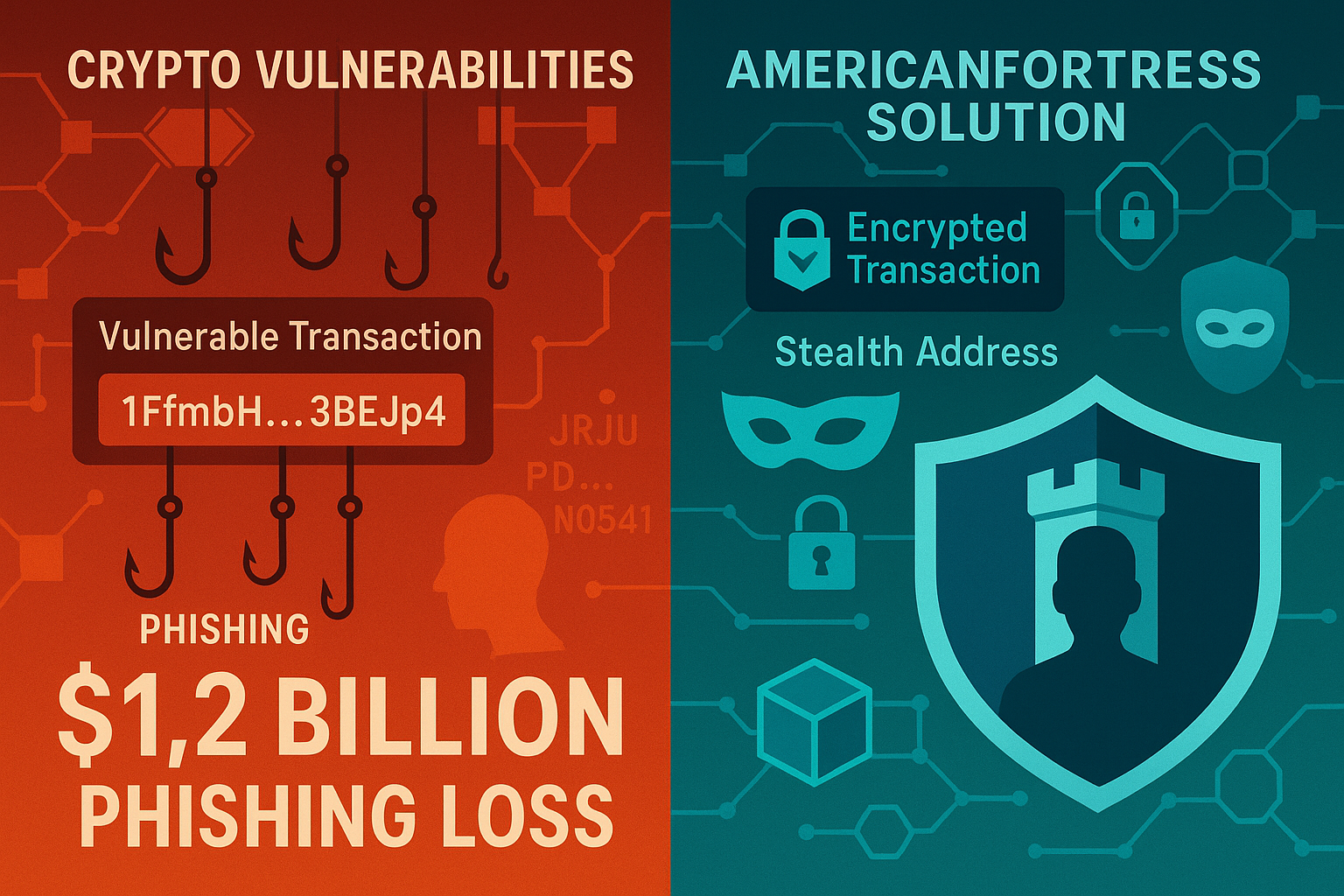
In a groundbreaking development that promises to reshape the cryptocurrency privacy landscape, the Litecoin Foundation and AmericanFortress have announced their partnership to launch the world’s most private Litecoin wallet. This collaboration, unveiled on September 8, 2025, represents a paradigm shift in how we approach cryptocurrency security, privacy, and user experience, addressing the critical $1.2 billion annual loss to crypto phishing scams while maintaining full regulatory compliance [1].

The partnership between these two industry leaders comes at a pivotal moment when cryptocurrency adoption is accelerating, but security vulnerabilities continue to plague the ecosystem. With phishing attacks reaching unprecedented levels and traditional wallet addresses creating confusion and risk for users, the AmericanFortress Litecoin Wallet introduces revolutionary “Send-to-Name” technology that fundamentally eliminates the most common attack vectors while preserving the privacy and decentralization principles that define cryptocurrency [2].

This isn’t merely another wallet launch—it’s the introduction of a comprehensive privacy infrastructure that positions Litecoin at the forefront of the privacy-focused cryptocurrency movement. By integrating MimbleWimble Extension Blocks (MWEB), FortressNames™ technology, and advanced cryptographic protocols, this wallet delivers what David Schwartz, Project Director at the Litecoin Foundation, describes as “a milestone for privacy infrastructure, not just for Litecoin, but for the entire crypto ecosystem” [3].

The significance of this partnership extends beyond technical innovation to address fundamental challenges facing cryptocurrency adoption. Traditional wallet addresses—those long, complex strings of characters that users must copy and paste—have become the primary vector for phishing attacks and user error. The AmericanFortress solution replaces these vulnerable address strings with human-readable names and auto-generated stealth addresses, creating a user experience that rivals traditional banking apps while delivering unprecedented privacy protection.

The Privacy Crisis in Cryptocurrency: Understanding the $1.2 Billion Problem

The cryptocurrency industry faces a privacy and security crisis that threatens to undermine mainstream adoption. According to recent data, $1.2 billion was lost to crypto phishing scams in the United States alone during 2024, with the vast majority of these attacks exploiting the complexity and vulnerability of traditional wallet address systems [4]. This staggering figure represents not just financial losses, but a fundamental failure of current cryptocurrency infrastructure to protect users from increasingly sophisticated attack vectors.

The root of this problem lies in the inherent design of cryptocurrency addresses. Traditional wallet addresses are long, alphanumeric strings that are virtually impossible for humans to memorize or verify accurately. When users copy and paste these addresses, they create multiple opportunities for attackers to intercept and modify the destination, redirecting funds to malicious wallets. This vulnerability has been exploited through various methods, including clipboard malware, fake websites, and social engineering attacks that trick users into sending funds to incorrect addresses.

The psychological impact of these losses extends far beyond the immediate financial damage. Each successful phishing attack erodes public confidence in cryptocurrency systems and creates barriers to adoption among mainstream users who view the technology as inherently risky and complex. This perception problem has significant implications for the long-term growth and legitimacy of the cryptocurrency ecosystem, particularly as institutional investors and regulatory bodies evaluate the maturity and security of digital asset infrastructure.

Traditional privacy solutions in the cryptocurrency space have often required users to make difficult trade-offs between security, usability, and regulatory compliance. Privacy coins like Monero and Zcash offer strong anonymity features but face increasing regulatory scrutiny and exchange delistings. Layer-2 privacy solutions often require technical expertise to implement correctly and may not provide comprehensive protection across all transaction types. The result has been a fragmented privacy landscape where users must choose between convenience and security, often leaving them vulnerable to attacks or regulatory complications.

The AmericanFortress and Litecoin partnership addresses these challenges through a fundamentally different approach that prioritizes privacy by design rather than privacy as an add-on feature. By integrating privacy protections at the protocol level and combining them with intuitive user experience improvements, this solution eliminates the traditional trade-offs that have hindered privacy adoption in the cryptocurrency space.

Revolutionary Send-to-Name Technology: Eliminating Phishing at the Source
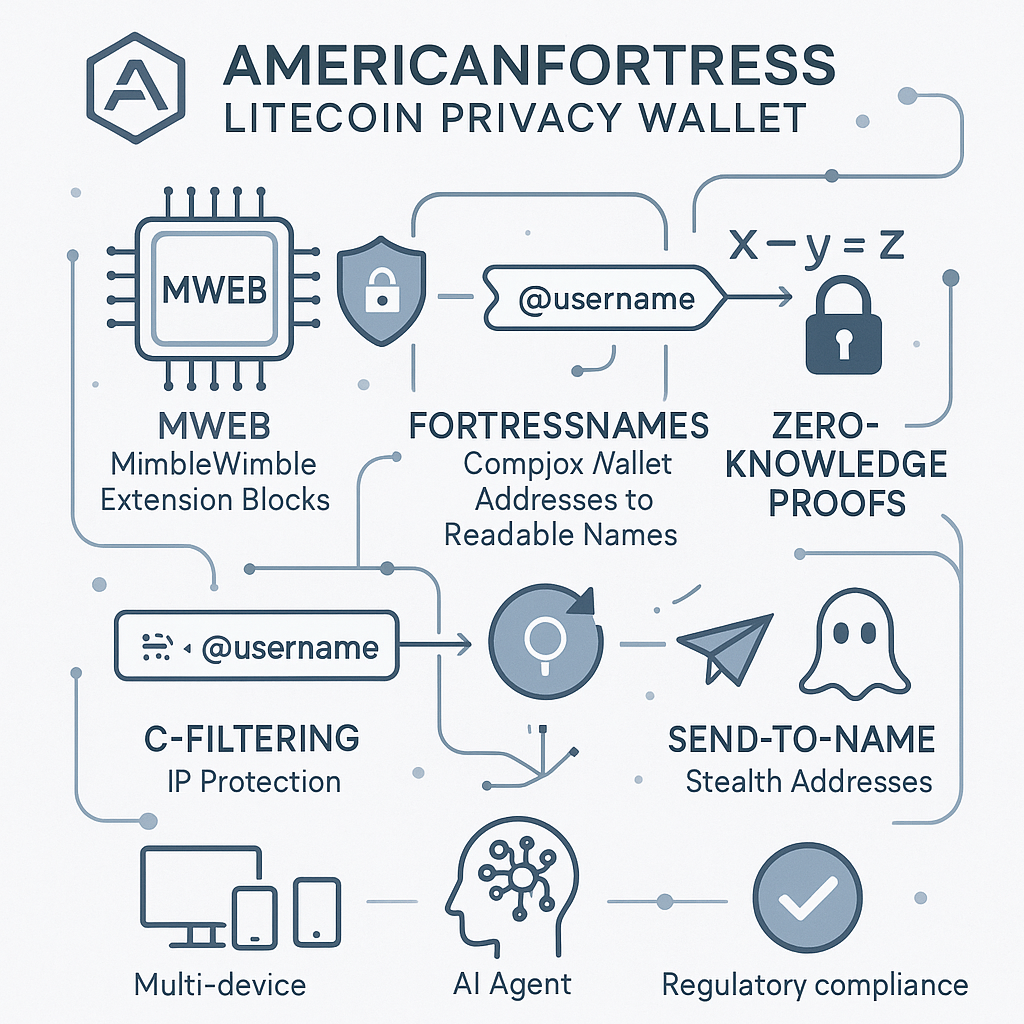
Privacy Wallet Features

The cornerstone of the AmericanFortress Litecoin Wallet is its revolutionary Send-to-Name technology, which represents a fundamental reimagining of how cryptocurrency transactions are initiated and secured. This system replaces the vulnerable copy-paste address model with human-readable names and automatically generated stealth addresses that are unique to each sender-receiver pair, creating a transaction environment that is both more secure and more intuitive than traditional cryptocurrency wallets [5].

The technical implementation of Send-to-Name technology involves sophisticated cryptographic protocols that generate unique stealth addresses for every transaction between specific users. When a user wants to send Litecoin to another person, they simply enter that person’s FortressName™—a human-readable identifier like “@johnsmith”—rather than a complex wallet address. The system then automatically generates a one-time stealth address that is known only to the sender and receiver, eliminating the possibility of address interception or modification by malicious actors.

This approach fundamentally disrupts the attack vectors that phishing scams rely upon. Traditional phishing attacks work by intercepting or modifying wallet addresses during the copy-paste process, redirecting funds to attacker-controlled wallets. With Send-to-Name technology, there are no addresses to intercept or modify—each transaction uses a unique, automatically generated address that cannot be predicted or replicated by attackers. This creates what Mehow Pospieszalski, CEO of AmericanFortress, describes as “bulletproof privacy without compromising on speed, usability, or interoperability” [6].

The user experience improvements delivered by Send-to-Name technology extend beyond security to address fundamental usability challenges that have hindered cryptocurrency adoption. Users no longer need to carefully verify long address strings, worry about typos that could result in lost funds, or maintain complex address books for frequent recipients. Instead, they can send cryptocurrency as easily as sending an email or text message, using memorable names that are both human-readable and cryptographically secure.

The system also incorporates advanced features designed for the emerging AI-driven economy. AI agents can use FortressNames™ to conduct autonomous transactions without requiring human intervention to verify addresses or manage complex cryptographic keys. This capability positions the AmericanFortress Litecoin Wallet as infrastructure for the programmable economy, where AI systems will need to conduct secure, private transactions on behalf of users and organizations.

From a technical perspective, the Send-to-Name system leverages the AF Token to secure the integrity of the decentralized Names database and power the dynamic address computation that makes stealth addresses possible. This creates a self-sustaining ecosystem where the security and functionality of the privacy features are maintained through cryptoeconomic incentives rather than centralized control, preserving the decentralized principles that are fundamental to cryptocurrency systems.

MWEB Integration: Layer-2 Privacy That Preserves Litecoin’s Core Values

The integration of MimbleWimble Extension Blocks (MWEB) into the AmericanFortress Litecoin Wallet represents a sophisticated approach to privacy that maintains compatibility with Litecoin’s existing infrastructure while adding powerful confidentiality features. MWEB technology, which has been under development for several years, provides a Layer-2 privacy solution that allows users to conduct confidential transactions without compromising the transparency and auditability that regulators and institutions require from blockchain systems [7].

MimbleWimble, the privacy protocol that underlies MWEB, was originally proposed as a way to improve both privacy and scalability in blockchain systems. The protocol uses a combination of cryptographic techniques, including Confidential Transactions and CoinJoin-style transaction aggregation, to obscure transaction amounts and participant identities while maintaining the mathematical properties that allow network participants to verify the integrity of the blockchain without revealing sensitive information.

The implementation of MWEB as an extension block system allows Litecoin to maintain backward compatibility with existing wallets and infrastructure while providing opt-in privacy features for users who require them. This approach addresses one of the key challenges facing privacy-focused cryptocurrencies: the need to balance privacy with regulatory compliance and network effects. Users can choose to conduct transactions through the MWEB system when privacy is required, or use standard Litecoin transactions when transparency is preferred or required by regulatory frameworks.

The technical architecture of MWEB integration in the AmericanFortress wallet is designed to make privacy the default setting while preserving user choice and regulatory compliance options. When users initiate transactions through the wallet, the system automatically routes them through MWEB unless specifically configured otherwise, ensuring that privacy protection is applied consistently without requiring technical expertise from users. This default-privacy approach represents a significant departure from traditional privacy solutions that require users to actively opt-in to privacy features.

The privacy protections provided by MWEB extend beyond simple transaction obfuscation to include comprehensive metadata protection. Traditional blockchain analysis techniques rely on transaction graph analysis, timing correlation, and amount correlation to deanonymize users and track fund flows. MWEB’s transaction aggregation and confidential transaction features disrupt these analysis techniques by breaking the transaction graph and hiding transaction amounts, making it significantly more difficult for observers to track user activity or build comprehensive profiles of user behavior.

The scalability benefits of MWEB integration also contribute to the overall value proposition of the AmericanFortress Litecoin Wallet. By aggregating multiple transactions into single MWEB blocks, the system reduces the on-chain footprint of privacy transactions while improving throughput and reducing fees. This creates a positive feedback loop where increased privacy adoption leads to improved network efficiency, making privacy features more attractive to cost-conscious users and supporting broader adoption of privacy-preserving transaction methods.

C-Filtering and IP Protection: Comprehensive Privacy Beyond Transaction Data
Crypto Privacy Security

While transaction privacy is crucial, comprehensive cryptocurrency privacy requires protection against network-level surveillance and IP address correlation attacks. The AmericanFortress Litecoin Wallet addresses these concerns through advanced C-filtering technology that prevents IP-to-wallet deanonymization when wallets connect to public servers, creating a comprehensive privacy solution that protects users at multiple layers of the network stack [8].

C-filtering, or client-side filtering, represents a sophisticated approach to privacy that allows wallets to retrieve blockchain data without revealing which specific transactions or addresses they are interested in. Traditional cryptocurrency wallets must query blockchain nodes for information about specific addresses, creating a correlation between IP addresses and wallet addresses that can be exploited by network observers to deanonymize users. C-filtering eliminates this correlation by allowing wallets to download filtered blockchain data without revealing their specific interests to network nodes.

The implementation of C-filtering in the AmericanFortress wallet involves the use of Bloom filters and other probabilistic data structures that allow the wallet to specify its data requirements in a way that provides plausible deniability about which specific transactions or addresses it is monitoring. This approach ensures that even if network traffic is intercepted or analyzed, observers cannot determine which addresses belong to specific users based on their network activity patterns.

The privacy benefits of C-filtering extend beyond simple IP address protection to include comprehensive metadata privacy that prevents various forms of network analysis. Traffic analysis attacks, which attempt to correlate network activity patterns with transaction timing and amounts, are disrupted by the probabilistic nature of C-filtering requests. Timing correlation attacks, which attempt to link wallet synchronization events with transaction broadcasts, are prevented by the batch processing approach used in C-filtering implementations.

The technical implementation of C-filtering in the AmericanFortress wallet is designed to be transparent to users while providing comprehensive protection against network-level surveillance. The wallet automatically generates appropriate filter parameters based on user activity patterns and privacy requirements, ensuring that privacy protection is applied consistently without requiring manual configuration or technical expertise from users. This automated approach eliminates the privacy risks associated with misconfigured privacy settings while ensuring that protection is applied comprehensively across all wallet operations.

The integration of C-filtering with other privacy features in the AmericanFortress wallet creates a comprehensive privacy solution that addresses multiple attack vectors simultaneously. While MWEB provides transaction-level privacy and Send-to-Name technology eliminates address-based attacks, C-filtering ensures that network-level metadata does not compromise the privacy protections provided by these other systems. This layered approach to privacy represents a significant advancement over single-point privacy solutions that may leave users vulnerable to attacks at other layers of the system.

Zero-Knowledge Proofs and Regulatory Compliance: Privacy Without Compromise

One of the most significant challenges facing privacy-focused cryptocurrency solutions is the need to balance user privacy with regulatory compliance requirements. The AmericanFortress Litecoin Wallet addresses this challenge through the innovative use of zero-knowledge proofs that allow users to demonstrate compliance with regulatory requirements without revealing sensitive transaction details or compromising their privacy [9].

Zero-knowledge proofs are cryptographic protocols that allow one party to prove to another party that they know a specific piece of information without revealing the information itself. In the context of cryptocurrency privacy, zero-knowledge proofs can be used to demonstrate that transactions comply with regulatory requirements—such as anti-money laundering (AML) rules or tax reporting obligations—without revealing transaction amounts, participant identities, or other sensitive details that could compromise user privacy.

The implementation of zero-knowledge proofs in the AmericanFortress wallet is designed to provide selective disclosure capabilities that allow users to prove specific compliance requirements to authorized parties while maintaining comprehensive privacy protection against unauthorized surveillance. This approach enables users to satisfy regulatory obligations without sacrificing the privacy protections that are essential for financial autonomy and security in the digital age.

The technical architecture of the zero-knowledge proof system incorporates advanced cryptographic techniques, including zk-SNARKs (Zero-Knowledge Succinct Non-Interactive Arguments of Knowledge) and other privacy-preserving proof systems that have been extensively tested and validated in production cryptocurrency systems. These proof systems allow users to generate cryptographic evidence that their transactions comply with specific regulatory requirements without revealing the underlying transaction data that would be necessary for traditional compliance verification methods.

The regulatory compliance features of the AmericanFortress wallet are designed to be forward-compatible with evolving regulatory frameworks while preserving user privacy and autonomy. The system incorporates flexible proof generation capabilities that can be adapted to meet different regulatory requirements across various jurisdictions, ensuring that users can maintain compliance with local laws while benefiting from comprehensive privacy protection.

The integration of zero-knowledge proofs with other privacy features in the AmericanFortress wallet creates a comprehensive solution that addresses the traditional trade-off between privacy and compliance. Users can conduct private transactions using MWEB and Send-to-Name technology while maintaining the ability to demonstrate compliance with regulatory requirements through selective disclosure of specific transaction attributes. This approach represents a significant advancement in privacy-preserving compliance technology that could serve as a model for other cryptocurrency systems seeking to balance privacy with regulatory requirements.

AI Agent Integration and the Programmable Economy

The AmericanFortress Litecoin Wallet is designed not just for human users, but for the emerging AI-driven economy where autonomous agents will need to conduct secure, private transactions on behalf of users and organizations. This forward-looking approach positions the wallet as critical infrastructure for the programmable economy, where AI systems will manage increasingly complex financial operations that require both privacy and security [10].

The AI agent integration capabilities of the AmericanFortress wallet leverage the Send-to-Name technology to enable autonomous systems to conduct transactions without requiring human intervention for address verification or security validation. AI agents can use FortressNames™ to identify transaction recipients and automatically generate secure stealth addresses, eliminating the risk of address-based attacks while enabling fully automated transaction processing.

The technical implementation of AI agent support involves sophisticated API interfaces and cryptographic protocols that allow AI systems to securely manage private keys and conduct transactions while maintaining comprehensive audit trails and security controls. The wallet provides programmatic interfaces that enable AI agents to access privacy features, generate compliance proofs, and manage complex multi-party transactions without compromising security or privacy protections.

The privacy features of the AmericanFortress wallet are particularly important for AI agent applications, where transaction privacy can protect sensitive business logic, competitive information, and user data from unauthorized surveillance. AI agents conducting transactions on behalf of users or organizations need comprehensive privacy protection to prevent competitors, malicious actors, or unauthorized parties from analyzing transaction patterns to extract sensitive information about business operations, user behavior, or strategic decisions.

The regulatory compliance capabilities of the wallet are also crucial for AI agent applications, where autonomous systems must be able to demonstrate compliance with various regulatory requirements without human intervention. The zero-knowledge proof system enables AI agents to generate compliance evidence automatically while maintaining privacy protection, ensuring that autonomous systems can operate within regulatory frameworks without compromising user privacy or business confidentiality.

The integration of AI agent capabilities with the comprehensive privacy features of the AmericanFortress wallet represents a significant advancement in cryptocurrency infrastructure that anticipates the needs of the emerging digital economy. As AI systems become increasingly sophisticated and autonomous, the need for secure, private, and compliant transaction infrastructure will become critical for enabling the full potential of AI-driven economic systems.

Market Impact and Industry Implications

The launch of the AmericanFortress Litecoin Wallet represents a significant milestone in the evolution of cryptocurrency privacy and security, with implications that extend far beyond the Litecoin ecosystem to influence the broader cryptocurrency industry and regulatory landscape. This partnership demonstrates that privacy and regulatory compliance are not mutually exclusive, potentially reshaping how regulators, institutions, and users approach privacy-focused cryptocurrency solutions [11].

The market impact of this wallet launch is likely to be multifaceted, affecting Litecoin’s competitive positioning, the broader privacy coin market, and the development of privacy-focused cryptocurrency infrastructure. Litecoin, which has historically been positioned as “digital silver” to Bitcoin’s “digital gold,” gains a significant competitive advantage through this privacy upgrade that differentiates it from other proof-of-work cryptocurrencies while maintaining its core values of decentralization and security.

The demonstration that comprehensive privacy features can be implemented while maintaining regulatory compliance addresses one of the key concerns that have limited institutional adoption of privacy-focused cryptocurrencies. Traditional privacy coins have faced increasing regulatory scrutiny and exchange delistings due to concerns about their potential use for illicit activities. The AmericanFortress approach, which combines strong privacy protection with selective disclosure capabilities, provides a model for privacy implementation that could satisfy both user privacy needs and regulatory compliance requirements.

The technical innovations introduced by the AmericanFortress Litecoin Wallet, particularly the Send-to-Name technology and comprehensive privacy architecture, are likely to influence the development of other cryptocurrency projects and privacy solutions. The success of this approach could accelerate the adoption of similar technologies across the cryptocurrency ecosystem, leading to improved privacy and security standards industry-wide.

The partnership also has significant implications for the enterprise cryptocurrency market, where privacy and compliance requirements have limited the adoption of cryptocurrency solutions for business applications. The combination of privacy protection, regulatory compliance, and AI agent integration capabilities positions the AmericanFortress wallet as infrastructure for enterprise cryptocurrency adoption, potentially opening new markets and use cases for cryptocurrency technology.

The broader implications for cryptocurrency regulation are also significant, as this wallet demonstrates that privacy-preserving cryptocurrency systems can be designed to support regulatory compliance and law enforcement needs. This could influence regulatory approaches to privacy-focused cryptocurrencies and potentially lead to more nuanced regulatory frameworks that recognize the legitimate privacy needs of cryptocurrency users while addressing concerns about illicit use.

Technical Architecture and Security Considerations

The technical architecture of the AmericanFortress Litecoin Wallet represents a sophisticated integration of multiple privacy and security technologies that work together to provide comprehensive protection while maintaining usability and regulatory compliance. Understanding the technical implementation details is crucial for evaluating the security properties and potential limitations of this privacy solution [12].

The wallet’s architecture is built around a layered security model that provides multiple independent privacy protections, ensuring that the compromise of any single privacy mechanism does not result in complete privacy loss. The Send-to-Name technology operates at the address generation layer, MWEB provides transaction-level privacy, C-filtering protects network-level metadata, and zero-knowledge proofs enable selective compliance disclosure. This layered approach creates redundant privacy protections that significantly increase the difficulty of successful privacy attacks.

The cryptographic foundations of the wallet rely on well-established and extensively audited cryptographic primitives, including elliptic curve cryptography for key generation and digital signatures, advanced hash functions for address generation and proof systems, and proven zero-knowledge proof constructions that have been validated in production cryptocurrency systems. This conservative approach to cryptographic implementation reduces the risk of implementation vulnerabilities while ensuring compatibility with existing Litecoin infrastructure.

The key management system incorporates advanced security features designed to protect user funds and privacy even in the event of device compromise or physical attacks. The wallet uses hierarchical deterministic (HD) key generation to create unique keys for each transaction while maintaining the ability to recover all keys from a single seed phrase. The integration with hardware security modules and secure enclaves provides additional protection for high-value accounts and enterprise users.

The network security architecture includes comprehensive protection against various forms of network-based attacks, including man-in-the-middle attacks, traffic analysis, and network surveillance. The C-filtering implementation uses multiple network nodes and probabilistic data structures to prevent any single node from gaining complete visibility into user transaction patterns. The wallet also incorporates Tor integration and other network privacy tools to provide additional protection against network-level surveillance.

The software security architecture follows industry best practices for secure software development, including comprehensive code auditing, formal verification of critical cryptographic components, and regular security updates to address emerging threats. The wallet’s modular architecture allows for rapid deployment of security updates and feature enhancements while maintaining backward compatibility with existing user accounts and transaction history.

Future Roadmap and Development Plans

The AmericanFortress Litecoin Wallet represents the first phase of a comprehensive roadmap that extends well beyond the initial beta release to encompass advanced features, broader ecosystem integration, and enterprise-grade solutions. Understanding the planned development trajectory provides insight into the long-term vision for privacy-focused cryptocurrency infrastructure and the potential impact on the broader cryptocurrency ecosystem [13].

The immediate roadmap focuses on the successful deployment of the beta version in September 2025, with comprehensive testing and user feedback integration to ensure that the privacy and security features function correctly across various use cases and operating environments. The beta release will include all core privacy features—Send-to-Name technology, MWEB integration, C-filtering, and zero-knowledge proof capabilities—while providing a foundation for additional feature development and ecosystem integration.

The production release planned for Q1 2026 will incorporate lessons learned from the beta testing period and add enterprise-grade features designed for institutional users and high-volume applications. These features include advanced key management capabilities, multi-signature support, institutional custody integration, and enhanced compliance reporting tools that enable organizations to use privacy-focused cryptocurrency solutions while meeting their regulatory and audit requirements.

The AI agent integration capabilities planned for Q1 2026 represent a significant expansion of the wallet’s functionality to support the emerging programmable economy. These features will include comprehensive API interfaces for AI systems, automated compliance verification, smart contract integration, and advanced transaction orchestration capabilities that enable AI agents to conduct complex multi-party transactions while maintaining privacy and security protections.

The longer-term roadmap includes expansion beyond Litecoin to support multiple cryptocurrencies and blockchain networks, creating a comprehensive privacy infrastructure that can serve the entire cryptocurrency ecosystem. This multi-chain approach will leverage the Send-to-Name technology and privacy architecture developed for Litecoin to provide consistent privacy and security features across different blockchain platforms.

The development team is also working on advanced privacy features that will further enhance the wallet’s capabilities, including improved metadata protection, enhanced network privacy, and integration with emerging privacy technologies such as confidential smart contracts and privacy-preserving decentralized finance protocols. These features will ensure that the AmericanFortress wallet remains at the forefront of privacy technology as the cryptocurrency ecosystem continues to evolve.

Conclusion: A New Era of Cryptocurrency Privacy and Security

The partnership between AmericanFortress and the Litecoin Foundation represents a watershed moment in the evolution of cryptocurrency privacy and security, demonstrating that comprehensive privacy protection can be achieved while maintaining regulatory compliance, user-friendly design, and robust security. This collaboration addresses fundamental challenges that have hindered cryptocurrency adoption while positioning Litecoin at the forefront of the privacy-focused cryptocurrency movement.

The revolutionary Send-to-Name technology eliminates the $1.2 billion phishing problem that has plagued the cryptocurrency industry, while the integration of MWEB, C-filtering, and zero-knowledge proofs creates a comprehensive privacy solution that protects users at multiple layers of the system. The forward-looking AI agent integration capabilities position this wallet as critical infrastructure for the emerging programmable economy, where autonomous systems will require secure, private, and compliant transaction capabilities.

The success of this partnership could have far-reaching implications for the cryptocurrency industry, regulatory landscape, and broader adoption of privacy-preserving financial technologies. By demonstrating that privacy and compliance are not mutually exclusive, the AmericanFortress Litecoin Wallet provides a model for privacy implementation that could influence the development of other cryptocurrency projects and potentially reshape regulatory approaches to privacy-focused digital assets.

As the cryptocurrency ecosystem continues to mature and evolve, the need for comprehensive privacy and security solutions will only increase. The AmericanFortress Litecoin Wallet represents a significant step forward in addressing these needs while maintaining the decentralization, security, and user empowerment principles that define the cryptocurrency movement. This partnership marks the beginning of a new era where privacy is not a luxury or afterthought, but a fundamental feature of cryptocurrency infrastructure that enables users to transact with confidence, security, and autonomy in the digital economy.

References

[1] Crypto.news. “Exclusive: Litecoin Foundation and AmericanFortress to launch privacy-focused wallet.” September 8, 2025. https://crypto.news/exclusive-litecoin-foundation-and-americanfortress-to-launch-privacy-focused-wallet/

[2] AmericanFortress. “American Fortress SDK: Secure Web3 Wallet Integration for Phishing Protection.” 2025. https://americanfortress.io/

[3] AInvest. “Litecoin Gets Stealth Upgrade: Privacy Meets Regulation in New Wallet.” September 9, 2025. https://www.ainvest.com/news/litecoin-stealth-upgrade-privacy-meets-regulation-wallet-2509/

[4] AmericanFortress. “Phishing Statistics and Security Solutions.” 2025. https://americanfortress.io/

[5] Crypto.news. “Exclusive: Litecoin Foundation and AmericanFortress to launch privacy-focused wallet.” September 8, 2025.

[6] AInvest. “Litecoin Gets Stealth Upgrade: Privacy Meets Regulation in New Wallet.” September 9, 2025.

[7] Litecoin Foundation. “MWEB Integration and Privacy Features.” 2025.

[8] AmericanFortress. “C-Filtering and Network Privacy Protection.” 2025.

[9] AInvest. “Litecoin Gets Stealth Upgrade: Privacy Meets Regulation in New Wallet.” September 9, 2025.

[10] AmericanFortress. “AI Agent Integration and Programmable Economy.” 2025.

[11] Crypto.news. “Exclusive: Litecoin Foundation and AmericanFortress to launch privacy-focused wallet.” September 8, 2025.

[12] AmericanFortress. “Technical Architecture and Security Documentation.” 2025.

[13] AmericanFortress. “Development Roadmap and Future Plans.” 2025.

The Perfect Storm: How $53 Billion in Crypto Leverage and Cloud Computing’s $2.2 Trillion Boom Are Reshaping Digital Finance

Published by everythingcryptoitclouds.com | August 15, 2025

The digital finance landscape is experiencing a seismic shift that few saw coming. As Bitcoin touches new record highs above $124,000 and the global cloud computing market races toward a staggering $2.2 trillion valuation by 2030, we’re witnessing the convergence of two technological revolutions that are fundamentally reshaping how we think about money, data, and digital infrastructure.

The numbers tell a compelling story. Crypto-collateralized lending has exploded to an all-time high of $53.09 billion in Q2 2025, representing a massive 27.44% quarter-over-quarter growth [1]. Meanwhile, the cloud computing sector continues its relentless expansion, growing at a compound annual growth rate of 16.6% and projected to surge from $781.27 billion in 2025 to $911 billion in 2026 [2]. But these aren’t just isolated trends—they’re interconnected forces that are creating unprecedented opportunities and challenges in the digital economy.

Blockchain Technology Infrastructure

The Crypto Leverage Revolution: $53 Billion and Counting

The cryptocurrency lending market has reached a critical inflection point that demands our attention. According to Galaxy Research’s comprehensive Q2 2025 analysis, the total crypto-collateralized lending market has expanded to $53.09 billion, with DeFi applications alone accounting for $26.47 billion—a staggering 42.11% increase from the previous quarter [1].

This explosive growth isn’t happening in a vacuum. The surge in crypto leverage is being driven by three fundamental forces that are reshaping the entire digital asset ecosystem. First, we’re seeing a reflexivity effect where rising asset prices fuel increased borrowing activity, creating a self-reinforcing cycle of growth. As Bitcoin and other major cryptocurrencies reach new highs, investors are increasingly willing to use their digital assets as collateral to access additional capital.

Second, increased competition among lending platforms is driving down borrowing costs while improving service quality. This competitive dynamic has created more attractive rates and better scalability, making crypto-backed lending accessible to a broader range of investors. The market is no longer dominated by a few players—instead, we’re seeing a diverse ecosystem of both centralized finance (CeFi) and decentralized finance (DeFi) platforms competing for market share.

Third, and perhaps most significantly, digital asset treasury companies (DATCOs) have emerged as a major new source of demand. These entities, which hold cryptocurrencies as part of their corporate treasury strategies, are increasingly turning to CeFi lenders to finance their operations and expansion plans. This institutional adoption represents a fundamental shift in how businesses view cryptocurrency—not just as a speculative asset, but as a legitimate form of corporate treasury management.

The market concentration tells its own story about the maturation of this sector. Tether dominates the CeFi lending space with $10.14 billion in outstanding loans, commanding a 57.02% market share. Nexo follows with $1.96 billion (11.01% market share), while Galaxy holds $1.11 billion (6.23% market share). Together, these top three players control 74.26% of the tracked CeFi lending market [1].

But perhaps the most remarkable aspect of this growth is its resilience. The crypto lending market has grown by $10.59 billion (+147.5%) since the bear market trough of $7.18 billion in Q4 2023. This recovery demonstrates not just the cyclical nature of crypto markets, but the underlying structural demand for crypto-backed financial services.

September’s Altcoin Season: The $2 Trillion Rotation Begins

As we move into September, market analysts are predicting the beginning of what could be the most significant altcoin season in years. Coinbase Institutional’s latest research identifies three key drivers that could shift market leadership from Bitcoin to alternative cryptocurrencies, potentially triggering a massive capital rotation worth trillions of dollars [3].

The first driver is the softening of Bitcoin dominance. Bitcoin’s share of the total cryptocurrency market value has shown signs of weakening after peaking earlier this year. This isn’t just a temporary fluctuation—it represents a fundamental shift in how capital flows through the crypto ecosystem. Historically, as Bitcoin dominance declines, capital flows first into large-cap altcoins like Ethereum, Solana, and XRP, before eventually trickling down to mid-cap and small-cap tokens. This rotation effect creates opportunities for investors who can position themselves ahead of the trend.

The second factor is the dramatic improvement in liquidity conditions across major cryptocurrency exchanges. Traders are now seeing tighter bid-ask spreads and deeper order books, making it significantly easier to enter and exit altcoin positions without incurring heavy slippage. This improved liquidity is particularly important for institutional investors and larger players who might otherwise avoid less-traded tokens due to execution concerns.

The third and perhaps most crucial driver is the renewed appetite for risk among cryptocurrency investors. As macroeconomic conditions stabilize and market volatility remains contained, investors are increasingly willing to seek higher returns in riskier crypto assets. This environment is particularly conducive to sustained inflows into the altcoin market, especially if Bitcoin’s price consolidates rather than surging to new highs.

Data Center Infrastructure

The performance data already shows early signs of this rotation. While Bitcoin is up an impressive 27.2% year-to-date, several major altcoins are significantly outperforming. Ethereum has gained 37.9%, XRP has surged 49%, and even traditionally volatile assets like ADA have posted gains of 8.96% [3]. This outperformance suggests that the market is already beginning to price in the expected altcoin season.

Cloud Computing’s $2.2 Trillion Infrastructure Boom

While the cryptocurrency world captures headlines with its dramatic price movements and leverage growth, the cloud computing sector is quietly building the infrastructure that will support the next generation of digital finance. The numbers are staggering: the global cloud computing market is projected to reach $2.2 trillion by 2030, growing from its current base of $781.27 billion in 2025 [4].

This growth isn’t just about traditional enterprise applications moving to the cloud. We’re witnessing a fundamental transformation in how financial services, cryptocurrency platforms, and blockchain networks operate. The integration of artificial intelligence and machine learning with cloud infrastructure is unlocking new levels of efficiency and capability that were previously impossible.

The convergence of AI and cloud computing is particularly relevant for cryptocurrency platforms and DeFi protocols. These systems require massive computational resources to process transactions, maintain security, and provide real-time analytics to users. Cloud infrastructure provides the scalability and reliability needed to support the growing crypto ecosystem, while AI enhances everything from fraud detection to automated trading strategies.

Private cloud adoption is being driven by data sovereignty concerns, particularly relevant for cryptocurrency exchanges and financial institutions that must comply with varying regulatory requirements across different jurisdictions. The ability to maintain control over data location and access while still benefiting from cloud scalability has become a critical competitive advantage [5].

Edge computing and IoT integration represent another major trend that’s reshaping the cloud landscape. For cryptocurrency mining operations and blockchain networks, edge computing can reduce latency and improve efficiency by processing data closer to where it’s generated. This is particularly important for high-frequency trading applications and real-time blockchain analytics.

The Convergence: Where Crypto Meets Cloud

The intersection of cryptocurrency growth and cloud computing expansion is creating entirely new categories of business opportunities. Cryptocurrency mining operations are increasingly relying on cloud infrastructure to scale their operations efficiently. Cloud mining platforms have emerged as a major trend in 2025, offering investors exposure to cryptocurrency mining without the need to purchase and maintain expensive hardware [6].

The scalability benefits are obvious. Traditional cryptocurrency mining requires significant upfront capital investment in specialized hardware, ongoing maintenance costs, and access to cheap electricity. Cloud mining platforms abstract away these complexities, allowing investors to participate in mining operations through cloud-based contracts. This democratization of mining access is expanding the total addressable market for cryptocurrency mining beyond traditional tech-savvy investors.

But the convergence goes deeper than just mining. Cryptocurrency exchanges and DeFi platforms are leveraging cloud infrastructure to handle the massive transaction volumes and computational requirements of modern digital finance. The ability to scale computing resources up or down based on demand is crucial for platforms that experience significant volatility in user activity.

Altcoin Season Index

Data analytics and artificial intelligence are becoming increasingly important for cryptocurrency platforms. Cloud computing provides the computational power needed to analyze massive datasets, identify trading patterns, and provide real-time insights to users. This capability is particularly valuable for institutional investors who require sophisticated analytics tools to make informed investment decisions.

The security implications are equally significant. Cloud providers offer enterprise-grade security features that many cryptocurrency platforms couldn’t afford to implement independently. This includes advanced encryption, multi-factor authentication, and continuous monitoring for suspicious activity. As the cryptocurrency industry matures and attracts more institutional investment, these security features become increasingly important.

Market Implications and Investment Opportunities

The convergence of crypto leverage growth and cloud computing expansion is creating a new category of investment opportunities that savvy investors are beginning to recognize. The $53 billion crypto lending market represents just the beginning of what could become a much larger ecosystem of crypto-backed financial services.

For investors, the key is understanding how these trends reinforce each other. The growth in crypto lending creates demand for more sophisticated infrastructure, which drives cloud computing adoption. Meanwhile, improved cloud infrastructure enables more efficient and secure crypto platforms, which attracts more users and capital to the ecosystem.

The altcoin season predictions for September add another layer of complexity and opportunity. If Coinbase’s analysis proves correct, we could see a significant rotation of capital from Bitcoin into alternative cryptocurrencies. This rotation would likely benefit platforms and services that support a broad range of digital assets, rather than those focused exclusively on Bitcoin.

The timing is particularly interesting given the broader macroeconomic environment. With traditional interest rates remaining elevated and inflation concerns persisting, investors are increasingly looking for alternative sources of yield. Crypto-backed lending offers attractive returns, while cloud computing stocks provide exposure to one of the fastest-growing sectors in the technology industry.

Regulatory Considerations and Risk Management

As these markets continue to grow and converge, regulatory considerations become increasingly important. The crypto lending market, in particular, operates in a complex regulatory environment that varies significantly across different jurisdictions. Investors and platforms must navigate evolving regulations while building sustainable business models.

The integration of cloud computing with cryptocurrency operations also raises important questions about data sovereignty and regulatory compliance. Financial institutions and cryptocurrency platforms must ensure that their cloud infrastructure meets the regulatory requirements of all jurisdictions in which they operate.

Risk management becomes particularly crucial as leverage levels increase across the crypto ecosystem. The $53 billion in crypto-collateralized lending represents significant systemic risk if not properly managed. Platforms must implement robust risk management frameworks that can handle the volatility inherent in cryptocurrency markets.

Looking Ahead: The Future of Digital Finance Infrastructure

As we look toward the remainder of 2025 and beyond, the convergence of cryptocurrency growth and cloud computing expansion seems likely to accelerate. The infrastructure being built today will support the next generation of digital financial services, from decentralized autonomous organizations (DAOs) to programmable money and beyond.

The $2.2 trillion cloud computing market projection for 2030 suggests that we’re still in the early stages of this transformation. Similarly, the crypto lending market’s growth to $53 billion represents just a fraction of the total addressable market for crypto-backed financial services.

For businesses and investors, the key is positioning for this convergence rather than viewing these trends in isolation. The companies that successfully bridge the gap between traditional cloud computing and emerging cryptocurrency applications are likely to capture disproportionate value as these markets continue to grow and mature.

The September altcoin season predictions add urgency to these considerations. If we do see a significant rotation of capital into alternative cryptocurrencies, it could accelerate the adoption of more diverse crypto-backed financial services and drive additional demand for the cloud infrastructure needed to support them.

Conclusion: Riding the Wave of Digital Transformation

The convergence of $53 billion in crypto leverage and the $2.2 trillion cloud computing boom represents more than just impressive growth numbers—it signals a fundamental transformation in how we think about money, data, and digital infrastructure. As we move into September and the potential beginning of altcoin season, investors and businesses have an opportunity to position themselves at the forefront of this digital revolution.

The key is understanding that these aren’t separate trends but interconnected forces that are reshaping the entire landscape of digital finance. The companies and investors who recognize this convergence and position themselves accordingly are likely to benefit disproportionately as these markets continue to grow and mature.

Whether you’re an individual investor looking to diversify your portfolio, a business considering crypto treasury strategies, or a technology company building the infrastructure for tomorrow’s digital economy, the time to act is now. The perfect storm of crypto growth and cloud expansion is creating opportunities that may not come again for years.


References

[1] Galaxy Research. “The State of Crypto Leverage – Q2 2025.” Galaxy Digital, August 14, 2025. https://www.galaxy.com/insights/research/the-state-of-crypto-leverage-q2-2025

[2] Hostinger. “Top software development trends in 2025: AI, security, and what’s next.” Hostinger Tutorials, August 2025. https://www.hostinger.com/tutorials/software-development-trends

[3] CoinDesk. “3 Reasons Why Altcoins Are Likely to Outperform Starting in September: Coinbase Research.” CoinDesk Markets, August 15, 2025. https://www.coindesk.com/markets/2025/08/15/altcoin-season-could-begin-in-september-as-bitcoin-s-grip-on-crypto-market-coinbase-institutional

[4] Yahoo Finance. “Cloud Computing Market Surges to $2281.1 billion by 2030.” Yahoo Finance, August 2025. https://finance.yahoo.com/news/cloud-computing-market-surges-2-133000144.html

[5] Cloudian. “Private Cloud in 2025: Trends, Technologies, and Best Practices.” Cloudian Guides, August 2025. https://cloudian.com/guides/private-cloud/private-cloud-in-2025-trends-technologies-and-best-practices/

[6] Coin Central. “8 Major Cloud Mining Trends and Platform Reviews in 2025.” Coin Central, August 2025. https://coincentral.com/8-major-cloud-mining-trends-and-platform-reviews-in-2025-secure-and-profitable-new-options-for-cryptocurrency-mining-2/

Future-Proof Your Income: 12 AI Skills That Will Make You Rich in 2025

The artificial intelligence revolution is creating unprecedented opportunities for professionals who develop the right skills, with AI-proficient workers commanding salary premiums of 30-50% while building recession-proof careers in the fastest-growing sector of the global economy.

This comprehensive guide reveals twelve essential AI skills that will generate substantial income opportunities in 2025 and beyond, along with specific strategies for developing expertise and monetizing these capabilities.

## Skill 1: Prompt Engineering and AI Communication

Prompt engineering has emerged as one of the most valuable AI skills, with specialists commanding rates of $75-200 per hour while helping businesses optimize their AI implementations for maximum effectiveness.

This skill involves understanding how to communicate effectively with AI systems to generate desired outputs consistently. Mastery includes knowledge of prompt structures, context management, and optimization techniques for different AI models.

Career opportunities include AI consultant roles, prompt optimization specialist positions, and freelance services for businesses implementing AI tools. Many companies are hiring dedicated prompt engineers to optimize their AI workflows.

Development strategies include practicing with various AI models, studying successful prompt patterns, and building portfolios of effective prompts for different use cases and industries.

## Skill 2: AI-Powered Content Creation and Strategy

Content creation enhanced by AI tools represents a massive opportunity, with skilled practitioners building agencies generating $50,000-500,000+ annually through strategic content services for businesses worldwide.

This skill combines understanding of content marketing principles with mastery of AI tools for writing, design, and multimedia creation. Success requires balancing AI efficiency with human creativity and strategic thinking.

Career paths include content marketing agencies, freelance content services, corporate content strategy roles, and educational content creation for AI training and implementation.

Development approaches include mastering multiple AI content tools, studying successful content strategies, and building portfolios that demonstrate the quality and effectiveness of AI-enhanced content creation.

## Skill 3: AI Business Process Automation

Business process automation using AI tools can generate consulting fees of $100-300 per hour while helping companies reduce costs by 20-40% through intelligent automation of repetitive tasks and workflows.

This skill involves analyzing business processes, identifying automation opportunities, and implementing AI-powered solutions that improve efficiency while maintaining quality and compliance.

Opportunities include automation consulting, process optimization roles, and specialized positions in industries with complex workflows like healthcare, finance, and manufacturing.

Skill development requires understanding business processes, learning automation tools and platforms, and gaining experience with workflow design and optimization methodologies.

## Skill 4: AI Data Analysis and Business Intelligence

Data analysis enhanced by AI tools commands premium salaries of $80,000-200,000+ annually while providing businesses with insights that drive strategic decision-making and competitive advantages.

This skill combines statistical analysis knowledge with AI tools for pattern recognition, predictive modeling, and automated insight generation from complex data sets.

Career opportunities include data scientist roles, business intelligence analyst positions, and consulting services for companies seeking to leverage their data more effectively.

Development strategies include learning statistical analysis, mastering AI analytics tools, and building experience with real-world data sets and business problems.

## Skill 5: AI-Enhanced Software Development

Software development augmented by AI tools enables developers to build applications faster while commanding salary premiums of 25-40% over traditional development roles.

This skill involves using AI for code generation, debugging, testing, and optimization while maintaining software quality and security standards. Understanding of both traditional programming and AI capabilities is essential.

Opportunities include senior developer roles, AI application specialist positions, and consulting services for businesses developing AI-enhanced software solutions.

Skill building requires strong programming fundamentals, experience with AI development tools, and understanding of how to integrate AI capabilities into traditional software applications.

## Skill 6: AI Marketing and Customer Experience

Marketing enhanced by AI tools can increase campaign effectiveness by 30-50% while creating opportunities for specialists to command premium rates of $60-150 per hour.

This skill involves using AI for customer segmentation, personalization, campaign optimization, and customer experience enhancement across multiple channels and touchpoints.

Career paths include digital marketing specialist roles, customer experience consultant positions, and marketing automation specialist opportunities in growing companies.

Development approaches include learning marketing fundamentals, mastering AI marketing tools, and gaining experience with campaign optimization and customer data analysis.

## Skill 7: AI Training and Education

AI training and education represents a rapidly growing market, with skilled instructors and course creators generating $100,000-1,000,000+ annually through educational content and training services.

This skill involves understanding AI concepts deeply enough to teach others, creating effective educational content, and delivering training that helps individuals and organizations adopt AI technologies successfully.

Opportunities include corporate training roles, online course creation, educational consulting, and speaking engagements at conferences and industry events.

Skill development requires deep AI knowledge, teaching and communication skills, and experience creating educational content that effectively transfers complex technical concepts.

## Skill 8: AI Ethics and Governance

AI ethics and governance expertise is becoming increasingly valuable as organizations implement AI systems, with specialists commanding consulting rates of $150-400 per hour.

This skill involves understanding ethical implications of AI implementation, developing governance frameworks, and ensuring AI systems operate fairly and transparently while meeting regulatory requirements.

Career opportunities include AI ethics consultant roles, governance specialist positions, and compliance roles in organizations implementing AI systems at scale.

Development strategies include studying AI ethics frameworks, understanding regulatory requirements, and gaining experience with AI governance implementation in real-world scenarios.

## Skill 9: AI Product Management

Product management for AI-powered products commands premium salaries of $120,000-300,000+ annually while guiding development of products that leverage AI capabilities effectively.

This skill involves understanding both product management principles and AI capabilities, enabling effective planning and execution of AI-enhanced products and services.

Opportunities include product manager roles at AI companies, AI product specialist positions, and consulting services for companies developing AI-powered products.

Skill building requires product management experience, understanding of AI capabilities and limitations, and experience with AI product development lifecycles.

## Skill 10: AI Sales and Business Development

Sales professionals who understand AI capabilities can command salary premiums of 40-60% while helping businesses identify and implement AI solutions that drive growth and efficiency.

This skill involves understanding AI technologies well enough to identify business applications, communicate value propositions effectively, and guide implementation processes.

Career paths include AI sales specialist roles, business development positions at AI companies, and consulting services for businesses exploring AI adoption.

Development approaches include learning AI fundamentals, understanding business applications, and gaining experience with AI sales processes and customer education.

## Skill 11: AI Research and Development

AI research and development roles command some of the highest salaries in technology, with experienced researchers earning $150,000-500,000+ annually while advancing the state of AI technology.

This skill involves understanding cutting-edge AI research, contributing to algorithm development, and translating research into practical applications for business and society.

Opportunities include research roles at technology companies, academic positions, and consulting services for organizations developing proprietary AI capabilities.

Skill development requires strong technical foundations, research experience, and understanding of both theoretical AI concepts and practical implementation challenges.

## Skill 12: AI Strategy and Leadership

AI strategy and leadership expertise enables executives to command premium compensation while guiding organizations through AI transformation initiatives that create competitive advantages.

This skill involves understanding AI capabilities and limitations, developing strategic implementation plans, and leading organizational change initiatives that successfully adopt AI technologies.

Career opportunities include executive roles at AI companies, strategic consulting positions, and leadership roles in organizations undergoing AI transformation.

Development strategies include gaining business leadership experience, understanding AI technologies and applications, and building track records of successful AI implementation and organizational change.

## Skill Development Strategies

Successful AI skill development requires systematic approaches that combine theoretical learning with practical application. Online courses, certifications, and hands-on projects provide foundations for expertise development.

Building portfolios of successful AI projects demonstrates capabilities to potential employers and clients while providing practical experience with real-world challenges and solutions.

Networking within AI communities, attending industry events, and participating in AI projects and competitions provide opportunities to learn from experts and build professional relationships.

## Monetization Approaches

AI skills can be monetized through various approaches including traditional employment, freelance services, consulting practices, and entrepreneurial ventures that leverage AI capabilities.

Employment opportunities often provide stable income and benefits while building experience and expertise. Freelance and consulting services offer higher hourly rates and flexibility while requiring business development skills.

Entrepreneurial approaches including AI-powered businesses, educational content creation, and product development offer unlimited income potential while requiring significant investment and risk tolerance.

## Future Outlook

The AI skills market will continue expanding rapidly as organizations across all industries adopt AI technologies. Early skill development provides competitive advantages and higher earning potential.

Continuous learning and adaptation will be essential as AI technologies evolve rapidly. Professionals who stay current with developments while building deep expertise in specific areas will command premium compensation.

The intersection of AI skills with domain expertise in specific industries often provides the highest value and compensation opportunities for skilled professionals.

## Conclusion

The AI revolution presents unprecedented opportunities for professionals willing to develop relevant skills and expertise. The twelve skills outlined in this guide represent proven pathways to substantial income generation in the rapidly expanding AI economy.

Success requires strategic skill development, practical application, and ongoing learning as technologies evolve. Those who master these skills while staying current with AI advances can build highly profitable careers that provide both financial success and professional fulfillment.

Start developing your AI skills today by choosing areas that align with your interests and existing expertise, then focus systematically on building capabilities that will generate substantial income opportunities in 2025 and beyond.