Published September 26, 2025 | Author: everythingcryptoitclouds.com
In a groundbreaking move that signals the complete transformation of Wall Street’s relationship with cryptocurrency, Morgan Stanley has announced its plans to launch direct crypto trading for E*Trade customers in the first half of 2026. This isn’t just another financial institution dipping its toes into digital assets—this represents a seismic shift that could fundamentally reshape how institutional wealth management approaches cryptocurrency investment and custody.
The announcement, made on September 23, 2025, comes at a time when the cryptocurrency market has reached an unprecedented $3.9 trillion valuation, with Bitcoin commanding $2.25 trillion and Ethereum holding $506 billion of that total market capitalization [1]. What makes this development particularly significant is not just the scale of Morgan Stanley’s commitment, but the sophisticated infrastructure partnership they’ve forged with Zerohash, a crypto infrastructure provider that recently achieved unicorn status with a $104 million funding round [2].
The Strategic Partnership That’s Changing Everything
Morgan Stanley’s approach to crypto trading represents a masterclass in strategic partnership development. Rather than attempting to build cryptocurrency infrastructure from scratch—a process that could take years and cost hundreds of millions—the financial giant has partnered with Zerohash, one of the industry’s leading embedded crypto solutions providers [3].
This partnership is far more than a simple vendor relationship. Morgan Stanley has taken an investment stake in Zerohash, demonstrating a level of commitment that goes beyond typical service provider arrangements [4]. The timing couldn’t be more strategic, as Zerohash recently completed a $104 million Series D-2 funding round led by Interactive Brokers, with Morgan Stanley, SoFi, and Apollo Global Management participating as strategic investors [5].
The partnership structure reveals Morgan Stanley’s sophisticated understanding of the crypto ecosystem. Zerohash will handle the complex technical infrastructure including liquidity provision, custody services, and settlement operations, while Morgan Stanley focuses on what it does best: client relationship management and wealth advisory services. This division of labor allows both companies to leverage their core competencies while delivering a seamless experience to E*Trade customers.
Jed Finn, head of wealth management at Morgan Stanley, emphasized the strategic nature of this approach in an internal memo obtained by CNBC: “We are well underway in preparing to offer crypto trading through a partner model to E-Trade clients in the first half of 2026” [6]. The use of the phrase “partner model” is particularly significant, as it indicates Morgan Stanley’s recognition that cryptocurrency requires specialized expertise that’s best obtained through strategic alliances rather than internal development.
MembersCap: The Early Adopter Validating Institutional Demand
One of the most compelling aspects of Morgan Stanley’s crypto trading initiative is the early validation it has received from sophisticated institutional clients. MembersCap, a Bermuda-regulated investment manager specializing in tokenized reinsurance investments, has already begun using the service, providing crucial real-world testing and validation of the platform’s capabilities [7].
MembersCap’s involvement is particularly noteworthy given the company’s innovative approach to traditional finance. Founded in 2024, MembersCap has pioneered the tokenization of institutional-grade reinsurance investments, creating the first tokenized reinsurance fund designed for sophisticated digital asset investors [8]. In July 2025, the company launched this groundbreaking fund in partnership with Archax, a digital asset exchange, broker, and custodian [9].
The significance of MembersCap’s early adoption extends beyond simple beta testing. In September 2025, MembersCap became the first company to use the new London Stock Exchange blockchain-based platform for private funds, demonstrating their position at the forefront of financial innovation [10]. Their decision to utilize Morgan Stanley’s crypto trading infrastructure validates the platform’s capability to serve sophisticated institutional clients with complex requirements.
This early institutional adoption addresses one of the key challenges facing traditional financial institutions entering the crypto space: proving that their infrastructure can handle the demands of professional investment managers. MembersCap’s successful use of the platform provides Morgan Stanley with a powerful case study demonstrating institutional-grade reliability and functionality.
The Cryptocurrency Landscape: A $3.9 Trillion Opportunity
To understand the magnitude of Morgan Stanley’s strategic move, it’s essential to examine the current state of the cryptocurrency market. What began as a niche asset class dismissed by many traditional financial institutions has evolved into a $3.9 trillion market that can no longer be ignored by serious wealth managers [11].
The market composition reveals the maturation of the cryptocurrency ecosystem. Bitcoin, with its $2.25 trillion market capitalization, has established itself as the digital equivalent of gold—a store of value that institutional investors increasingly view as a necessary portfolio component [12]. Ethereum, commanding $506 billion in market cap, represents the infrastructure layer of decentralized finance, hosting thousands of applications and smart contracts that are reshaping financial services [13].
The inclusion of Solana as one of the three cryptocurrencies available at launch demonstrates Morgan Stanley’s sophisticated understanding of the crypto ecosystem. Solana’s recent achievement of 107,664 transactions per second in a single block has positioned it as a leading platform for high-frequency trading and institutional applications [14]. This technical capability makes Solana particularly attractive to institutional clients who require high-performance blockchain infrastructure for their operations.
The growth trajectory of the cryptocurrency market has been nothing short of extraordinary. From a total market capitalization of less than $1 billion in 2013 to nearly $4 trillion today, cryptocurrencies have demonstrated a compound annual growth rate that far exceeds traditional asset classes [15]. This growth has been driven not just by retail speculation, but increasingly by institutional adoption, regulatory clarity, and the development of sophisticated financial products.
Regulatory Environment: The Trump Administration’s Crypto-Friendly Stance
The timing of Morgan Stanley’s crypto trading launch is inextricably linked to the dramatic shift in regulatory sentiment following the Trump administration’s return to power. The administration’s supportive stance toward cryptocurrency regulation has created an environment where traditional financial institutions feel confident making substantial investments in crypto infrastructure [16].
This regulatory shift represents a complete reversal from the uncertainty that characterized much of the previous regulatory environment. Where banks once faced unclear guidance and potential enforcement actions for crypto-related activities, they now operate in a framework that actively encourages innovation and institutional participation in digital asset markets [17].
The impact of this regulatory clarity cannot be overstated. It has enabled Morgan Stanley to move forward with confidence, knowing that their crypto trading initiative aligns with government policy rather than potentially conflicting with it. This regulatory support has also contributed to the broader institutional adoption wave that includes not just Morgan Stanley, but competitors like Charles Schwab and Robinhood expanding their crypto offerings [18].
The regulatory environment has also facilitated the type of strategic partnerships that make Morgan Stanley’s approach possible. Zerohash’s ability to provide comprehensive crypto infrastructure services depends on clear regulatory frameworks that define custody requirements, compliance obligations, and operational standards. The current regulatory clarity has enabled these partnerships to flourish, creating the foundation for institutional-grade crypto services.
Technical Infrastructure: The Zerohash Advantage
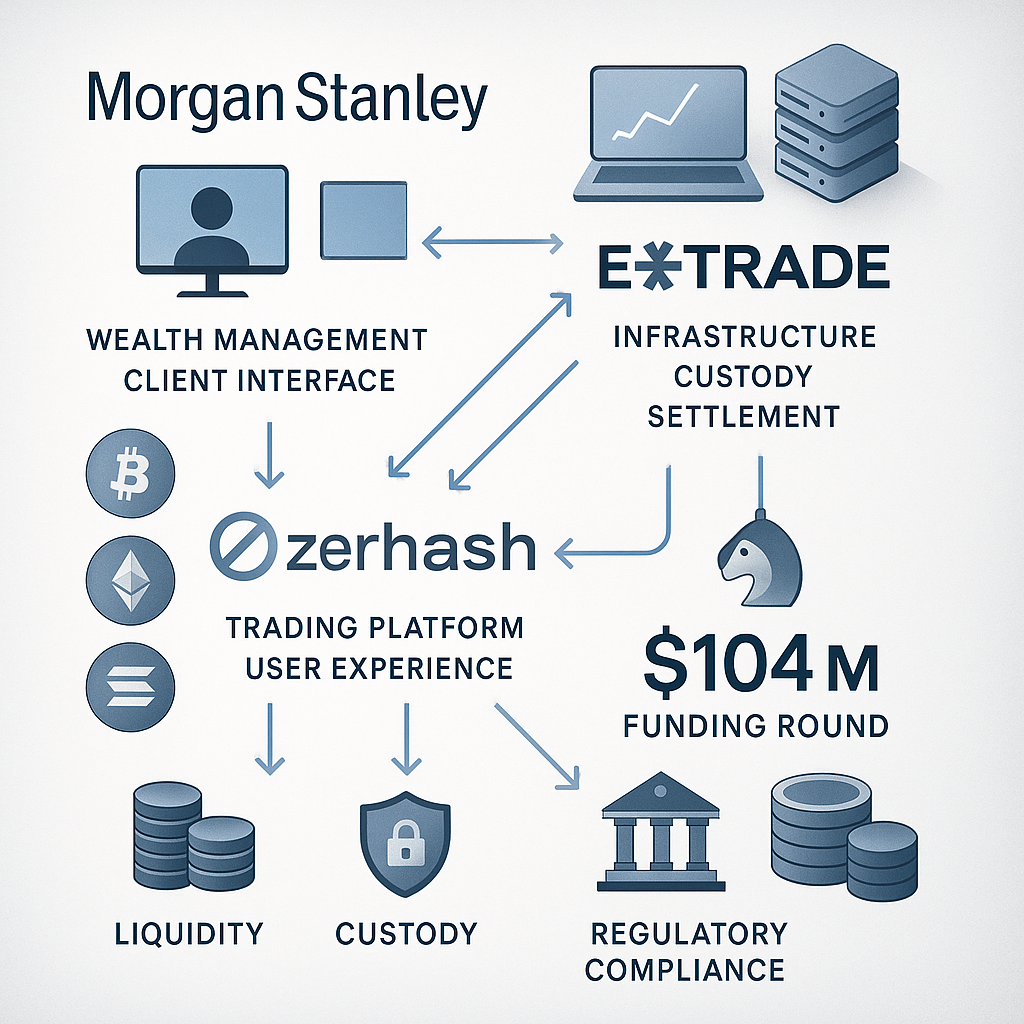
The technical architecture underlying Morgan Stanley’s crypto trading initiative represents a sophisticated approach to financial technology integration. Zerohash’s role as the infrastructure provider encompasses multiple critical functions that would be extremely challenging for a traditional bank to develop independently.
Zerohash’s liquidity provision capabilities are particularly crucial for institutional clients. The company has developed relationships with multiple cryptocurrency exchanges and market makers, enabling them to provide competitive pricing and deep liquidity across all supported cryptocurrencies [19]. This liquidity infrastructure ensures that E*Trade clients can execute large trades without significant market impact, a critical requirement for institutional investors.
The custody services provided by Zerohash represent another critical component of the technical infrastructure. Cryptocurrency custody requires specialized security measures, including multi-signature wallets, hardware security modules, and sophisticated key management systems [20]. Zerohash has invested heavily in developing institutional-grade custody solutions that meet the security and compliance requirements of traditional financial institutions.
Settlement operations in the cryptocurrency space involve complex interactions between traditional banking systems and blockchain networks. Zerohash’s settlement infrastructure handles the conversion between fiat currencies and cryptocurrencies, manages blockchain transaction fees, and ensures compliance with anti-money laundering and know-your-customer requirements [21]. This technical complexity would represent a significant development challenge for Morgan Stanley to tackle independently.
The integration between Zerohash’s infrastructure and Morgan Stanley’s existing ETrade platform requires sophisticated API development and real-time data synchronization. The seamless user experience that ETrade customers will enjoy depends on complex backend systems that handle account management, trade execution, and portfolio reporting across both traditional and digital assets [22].
Competitive Landscape: Positioning Against Robinhood and Schwab
Morgan Stanley’s entry into direct crypto trading places the firm in direct competition with established players who have already captured significant market share in retail crypto trading. Understanding this competitive landscape is crucial for assessing the potential impact of Morgan Stanley’s initiative.
Robinhood has established itself as a leader in retail crypto trading, offering a wide range of cryptocurrency options through an intuitive mobile-first interface [23]. The platform’s success has been built on simplicity, low fees, and accessibility for retail investors. However, Robinhood’s focus on retail customers leaves an opportunity for Morgan Stanley to differentiate through institutional-grade services and comprehensive wealth management integration.
Charles Schwab has taken a more conservative approach, providing clients with access to Bitcoin and Ethereum exchange-traded funds rather than direct cryptocurrency ownership [24]. This approach reduces complexity and regulatory risk but also limits the potential returns and flexibility that direct ownership provides. Morgan Stanley’s direct ownership model represents a more aggressive approach that could attract clients seeking greater control over their cryptocurrency investments.
The competitive advantage that Morgan Stanley brings to this market extends beyond just cryptocurrency trading. The firm’s comprehensive wealth management platform allows for sophisticated portfolio construction that integrates traditional and digital assets. This holistic approach appeals to high-net-worth clients who want their cryptocurrency investments managed alongside their traditional portfolios by experienced wealth advisors.
Morgan Stanley’s brand reputation and regulatory compliance capabilities also provide significant competitive advantages. Wealthy clients often prioritize security and regulatory compliance over features like low fees or extensive cryptocurrency selection. Morgan Stanley’s established reputation in wealth management and their partnership with Zerohash’s institutional-grade infrastructure addresses these priorities effectively.
The Tokenization Revolution: Beyond Simple Crypto Trading

Perhaps the most forward-looking aspect of Morgan Stanley’s crypto initiative is their focus on tokenization of traditional financial assets. Jed Finn’s internal memo revealed that the firm views cryptocurrency trading as merely “the tip of the iceberg” in a broader transformation of wealth management through distributed ledger technology [25].
Tokenization represents the process of creating digital representations of traditional assets on blockchain networks. This technology enables fractional ownership, 24/7 trading, programmable compliance, and automated settlement for assets that have traditionally been illiquid or difficult to trade [26]. The potential applications span real estate, private equity, bonds, commodities, and virtually any asset class that can be legally represented digitally.
The efficiency gains from tokenization are substantial. Traditional asset transfers often require days or weeks to settle, involve multiple intermediaries, and incur significant transaction costs. Tokenized assets can settle in minutes, reduce intermediary fees, and enable new forms of financial innovation through smart contract automation [27].
Morgan Stanley’s focus on tokenization positions the firm at the forefront of a transformation that could reshape the entire wealth management industry. “Tokenized substitutes for cash begin paying interest as soon as it hits the wallet,” Finn noted in his memo, highlighting the immediate efficiency gains that tokenization can provide [28]. This capability could revolutionize cash management for wealthy clients, eliminating the opportunity cost of holding non-interest-bearing cash balances.
The development of Morgan Stanley’s proprietary wallet solution is a critical component of their tokenization strategy. This wallet will serve as the custody solution for clients’ digital assets, but more importantly, it will provide the foundation for holding and managing tokenized versions of traditional assets [29]. The wallet’s development represents a significant technical undertaking that will position Morgan Stanley to offer innovative financial products that competitors cannot match.
Market Implications and Industry Transformation
The announcement of Morgan Stanley’s crypto trading initiative has implications that extend far beyond the firm itself. As one of the most conservative and prestigious names on Wall Street, Morgan Stanley’s embrace of cryptocurrency sends a powerful signal to the entire financial services industry about the legitimacy and permanence of digital assets.
The wealth management industry has been watching Morgan Stanley’s approach to cryptocurrency with particular interest. Wealth management accounts for nearly half of Morgan Stanley’s total revenue, making the firm more dependent on this business line than most of its competitors [30]. This dependence means that Morgan Stanley’s strategic decisions in wealth management often influence industry-wide trends.
The success of Morgan Stanley’s crypto initiative could accelerate adoption across the wealth management industry. Competitors who have been hesitant to offer direct cryptocurrency trading may feel compelled to develop similar capabilities to avoid losing clients to Morgan Stanley. This competitive dynamic could lead to rapid industry-wide adoption of crypto trading capabilities.
The institutional validation that Morgan Stanley’s entry provides could also impact cryptocurrency valuations and market dynamics. When a firm with Morgan Stanley’s reputation and client base begins offering direct crypto trading, it signals to the market that cryptocurrencies have achieved a level of institutional acceptance that supports higher valuations [31].
The integration of cryptocurrency trading with traditional wealth management services also has the potential to change how clients think about portfolio construction. Rather than viewing cryptocurrencies as speculative investments separate from their traditional portfolios, clients may begin to see digital assets as legitimate portfolio components that deserve strategic allocation alongside stocks, bonds, and other traditional assets.
Risk Management and Regulatory Compliance
Morgan Stanley’s approach to crypto trading demonstrates sophisticated risk management that addresses the unique challenges of digital asset custody and trading. The partnership with Zerohash allows Morgan Stanley to leverage specialized expertise in cryptocurrency risk management while maintaining oversight and control over client relationships.
The custody risks associated with cryptocurrency are fundamentally different from traditional asset custody. Cryptocurrency custody requires secure key management, protection against cyber attacks, and sophisticated backup and recovery procedures [32]. The irreversible nature of blockchain transactions means that security breaches or operational errors can result in permanent loss of assets, making robust security measures essential.
Regulatory compliance in the cryptocurrency space involves navigating a complex web of federal and state regulations that continue to evolve. Anti-money laundering requirements, know-your-customer obligations, and reporting requirements for cryptocurrency transactions require specialized compliance systems and procedures [33]. Zerohash’s expertise in crypto compliance allows Morgan Stanley to meet these requirements without developing internal capabilities from scratch.
The reputational risks associated with cryptocurrency trading are also significant for a firm like Morgan Stanley. Any security breaches, compliance failures, or operational issues could damage the firm’s reputation and client relationships. The partnership structure with Zerohash helps mitigate these risks by leveraging proven infrastructure and expertise while maintaining appropriate oversight and control.
Market risk management for cryptocurrency trading requires sophisticated systems for monitoring volatility, managing position limits, and providing appropriate client education about the risks of digital asset investment. Morgan Stanley’s wealth management platform will need to integrate cryptocurrency risk metrics with traditional portfolio risk management to provide clients with comprehensive risk reporting.
Financial Projections and Revenue Potential
The revenue potential from Morgan Stanley’s crypto trading initiative is substantial, reflecting both the size of the cryptocurrency market and the firm’s extensive client base. With wealth management representing nearly half of Morgan Stanley’s revenue, successful crypto adoption could have a meaningful impact on the firm’s financial performance [34].
Trading revenue from cryptocurrency transactions could be significant given the higher volatility and trading frequency typical in crypto markets compared to traditional assets. Cryptocurrency trading volumes often exceed those of traditional assets, and the bid-ask spreads in crypto markets can be wider than those in traditional markets, potentially generating higher trading revenue per transaction [35].
Custody and wallet services represent another revenue opportunity that could prove particularly lucrative. Unlike traditional asset custody, cryptocurrency custody involves ongoing technical services and security measures that justify higher fees. The development of Morgan Stanley’s proprietary wallet solution positions the firm to capture this revenue stream while providing enhanced services to clients [36].
The tokenization services that Morgan Stanley plans to offer could represent an entirely new revenue category. As the firm helps clients tokenize traditional assets, they could earn fees for structuring, custody, and ongoing management of these tokenized investments. The efficiency gains from tokenization could also enable Morgan Stanley to offer new financial products with attractive fee structures [37].
Asset management fees on cryptocurrency holdings could also contribute significantly to revenue. As clients allocate larger portions of their portfolios to cryptocurrencies, the assets under management subject to Morgan Stanley’s fee structure will increase. Given the higher volatility of cryptocurrencies, the dollar value of assets under management could grow more rapidly than with traditional assets [38].
Technology Integration and User Experience
The success of Morgan Stanley’s crypto trading initiative will depend heavily on the seamless integration of cryptocurrency capabilities with the existing E*Trade platform. This integration represents a significant technical challenge that requires careful coordination between Morgan Stanley’s technology teams and Zerohash’s infrastructure.
The user experience for ETrade customers must feel familiar and intuitive while providing access to sophisticated cryptocurrency trading capabilities. This means integrating crypto trading into the existing ETrade interface without overwhelming users with complexity or creating confusion about the differences between traditional and digital asset trading [39].
Real-time portfolio reporting that combines traditional and digital assets represents another significant technical challenge. Cryptocurrency prices can be highly volatile and trade 24/7, requiring continuous price updates and portfolio valuation. The integration of this real-time data with traditional portfolio reporting systems requires sophisticated data management and processing capabilities [40].
Order management systems for cryptocurrency trading must handle the unique characteristics of digital asset markets, including different trading hours, settlement procedures, and market structures. The integration of these systems with Morgan Stanley’s existing order management infrastructure requires careful design to ensure reliability and performance [41].
Mobile accessibility will be crucial for the success of the crypto trading platform. Cryptocurrency markets operate continuously, and clients expect to be able to monitor and trade their digital assets from mobile devices at any time. The mobile integration must provide full functionality while maintaining the security standards required for financial transactions [42].
Future Expansion and Strategic Vision
Morgan Stanley’s crypto trading initiative represents just the beginning of a broader strategic vision for digital asset integration across the firm’s wealth management platform. The “tip of the iceberg” comment from Jed Finn suggests that the firm has ambitious plans for expanding their digital asset capabilities beyond simple trading [43].
The development of additional cryptocurrency offerings seems likely as the platform matures and client demand grows. While the initial launch will support Bitcoin, Ethereum, and Solana, the infrastructure being developed could easily accommodate additional cryptocurrencies as they gain institutional acceptance and regulatory clarity [44].
International expansion of crypto trading capabilities could represent a significant growth opportunity. As regulatory frameworks for cryptocurrency trading develop in other jurisdictions, Morgan Stanley could leverage their Zerohash partnership to offer crypto trading to clients in international markets where the firm has a presence [45].
The integration of decentralized finance (DeFi) protocols could represent the next frontier for Morgan Stanley’s crypto capabilities. DeFi protocols offer sophisticated financial services including lending, borrowing, and yield generation that could be attractive to institutional clients. However, the regulatory and technical challenges of DeFi integration would require careful consideration and development [46].
Institutional crypto services beyond retail trading could also represent a significant expansion opportunity. Morgan Stanley could leverage their crypto infrastructure to offer services to corporate clients, including treasury management, payment processing, and blockchain-based financial products [47].
Conclusion: A Watershed Moment for Institutional Crypto Adoption
Morgan Stanley’s announcement of crypto trading for E*Trade customers represents far more than just another financial institution adding cryptocurrency services. This initiative signals a fundamental shift in how Wall Street views digital assets—from speculative investments to legitimate portfolio components that deserve institutional-grade infrastructure and professional management.
The sophisticated partnership with Zerohash demonstrates that successful crypto adoption requires specialized expertise and infrastructure that traditional financial institutions are wise to obtain through strategic alliances rather than internal development. The early validation from sophisticated clients like MembersCap provides confidence that the platform can meet the demanding requirements of institutional investors.
The timing of this initiative, coinciding with favorable regulatory developments and a $3.9 trillion cryptocurrency market, positions Morgan Stanley to capture significant market share in the rapidly growing institutional crypto market. The firm’s focus on tokenization and distributed ledger technology beyond simple crypto trading suggests a vision for transforming wealth management that extends far beyond current market offerings.
As the first half of 2026 approaches and Morgan Stanley’s crypto trading platform launches, the financial services industry will be watching closely to see how clients respond and whether competitors follow suit. The success of this initiative could accelerate institutional crypto adoption across Wall Street, fundamentally changing how wealth managers approach digital asset investment and custody.
The revolution in institutional cryptocurrency services has begun, and Morgan Stanley’s comprehensive approach to crypto trading, custody, and tokenization positions the firm at the forefront of this transformation. For investors, wealth managers, and the broader financial services industry, this represents a watershed moment that could reshape the landscape of digital asset investment for years to come.
References
[1] Reuters – “Morgan Stanley to offer crypto trading on ETrade platform through Zerohash tie-up” (September 23, 2025)
[2] CNBC – “Startup Zerohash raises $104M from Morgan Stanley, SoFi, Apollo” (September 23, 2025)
[3] CoinDesk – “Interactive Brokers (IBKR) Leads $104M Zerohash Round” (September 23, 2025)
[4] CNBC – “Morgan Stanley plans to offer crypto trading through E-Trade next year” (September 23, 2025)
[5] Globe Newswire – “Interactive Brokers leads zerohash capital raise” (September 23, 2025)
[6] CNBC – “Morgan Stanley plans to offer crypto trading through E-Trade next year” (September 23, 2025)
[7] Artemis – “MembersCap unlocks reinsurance capital as first to use new London Stock Exchange platform” (September 15, 2025)
[8] PR Newswire – “Members Capital Management Completes Initial Deployment of Tokenised Reinsurance Fund” (July 4, 2025)
[9] MembersCap Press Release (July 8, 2025)
[10] CoinDesk – “London Stock Exchange Unveils Blockchain-Based Platform for Private Funds” (September 15, 2025)
[11] Reuters – “Morgan Stanley to offer crypto trading on ETrade platform through Zerohash tie-up” (September 23, 2025)
[12] CoinMarketCap Data (September 2025)
[13] CoinMarketCap Data (September 2025)
[14] Solana Network Performance Data (August 2025)
[15] Historical Cryptocurrency Market Data
[16] CNBC – “Morgan Stanley plans to offer crypto trading through E-Trade next year” (September 23, 2025)
[17] Industry Analysis – Regulatory Environment Changes (2025)
[18] Reuters – “Morgan Stanley to offer crypto trading on E*Trade platform through Zerohash tie-up” (September 23, 2025)
[19] Zerohash Technical Documentation
[20] Cryptocurrency Custody Best Practices (Industry Standards)
[21] Zerohash Settlement Infrastructure Overview
[22] Financial Technology Integration Analysis
[23] Robinhood Crypto Trading Platform Analysis
[24] Charles Schwab Cryptocurrency Offerings Review
[25] CNBC – “Morgan Stanley plans to offer crypto trading through E-Trade next year” (September 23, 2025)
[26] Tokenization Technology Overview (Industry Analysis)
[27] Distributed Ledger Technology Benefits Analysis
[28] CNBC – “Morgan Stanley plans to offer crypto trading through E-Trade next year” (September 23, 2025)
[29] Morgan Stanley Wallet Development Plans
[30] Morgan Stanley Financial Reports (2024)
[31] Institutional Crypto Adoption Impact Analysis
[32] Cryptocurrency Security Best Practices
[33] Crypto Regulatory Compliance Requirements
[34] Morgan Stanley Revenue Analysis
[35] Cryptocurrency Trading Volume Analysis
[36] Digital Asset Custody Revenue Models
[37] Tokenization Service Revenue Potential
[38] Asset Management Fee Projections
[39] User Experience Design Principles
[40] Real-time Portfolio Management Systems
[41] Cryptocurrency Order Management Requirements
[42] Mobile Trading Platform Standards
[43] CNBC – “Morgan Stanley plans to offer crypto trading through E-Trade next year” (September 23, 2025)
[44] Cryptocurrency Market Expansion Analysis
[45] International Crypto Regulation Overview
[46] Decentralized Finance Integration Challenges
[47] Institutional Crypto Services Market Analysis

 Crypto, IT & Cloud