
At 9:15 a.m. Eastern on Thursday, August 20, Bitcoin crossed $71,980. Ethereum was up more than 17 percent on the day. For a market that had spent much of the summer grinding sideways between $62,000 and $65,000, the move felt electric — and it came from a direction few had predicted the day before.
The trigger was a statement from the White House. President Trump publicly called for the Senate to advance the Digital Asset Market Clarity Act, legislation that would answer a question the crypto industry has been asking for years: are cryptocurrencies securities or commodities? Within hours of that announcement, traders had their answer — at least in terms of market direction.
The Catalyst: A Presidential Endorsement and Falling Yields
Bitcoin opened August 20 at $69,289.44, already 7.1 percent above its Wednesday close. By mid-morning it had climbed further to $71,980.32 — the highest level since early summer. Ethereum’s move was even more dramatic: the network’s native token opened at $2,251.93, up 17.5 percent from the prior session, and pushed to $2,293.10 within the first hour of New York trading.
Two forces drove the rally simultaneously. The first was President Trump’s vocal support for the Clarity Act, which currently awaits a procedural Senate vote expected in September. The bill would create a formal legal framework distinguishing which digital assets fall under SEC oversight and which fall under CFTC jurisdiction — a distinction that has generated years of litigation, regulatory uncertainty, and exchange shutdowns. Markets interpreted the presidential push as a meaningful increase in the bill’s odds of passage.
The second force was macroeconomic. The U.S. Treasury announced it would increase long-term debt buybacks, a move that pushed long-term Treasury yields lower. When yields on safe-haven bonds fall, investors tend to rotate capital toward riskier assets in search of returns — and in August 2026, that rotation found a crypto market primed and ready to move.
What the Clarity Act Would Actually Change
The Digital Asset Market Clarity Act has been years in the making, and its core promise is straightforward: give the industry a rulebook. Right now, Bitcoin and Ethereum exist in a regulatory grey zone where every enforcement action or court ruling has the potential to reset market expectations overnight. The SEC and CFTC have waged a quiet turf war over jurisdiction, and projects ranging from Ripple to stablecoin issuers have spent hundreds of millions on legal battles that a clear statutory definition would render unnecessary.
Under the Clarity Act as currently written, most proof-of-work assets — including Bitcoin — would be classified as commodities and fall under CFTC supervision, generally considered a more permissive regulatory home. Proof-of-stake tokens and tokens with governance features face more complex classifications. For exchanges, the bill would create a formal registration pathway with the CFTC, replacing the current patchwork of state money transmitter licenses and SEC no-action letters.
The September procedural vote is not a final passage. It is a cloture vote to allow floor debate — a step the bill has failed to clear twice before. But a presidential push changes the political calculus, and institutional desks are now pricing in meaningfully higher probability of eventual passage.
The Bear Market Context: How Far Crypto Has Fallen and Why It Matters
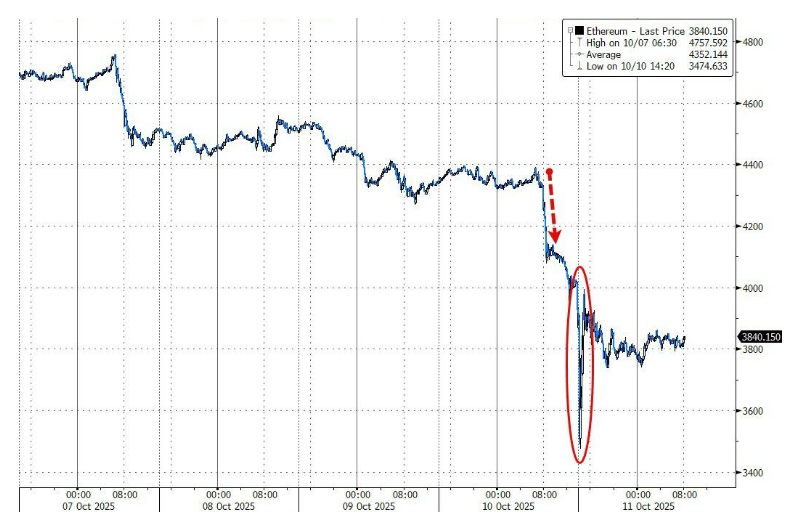
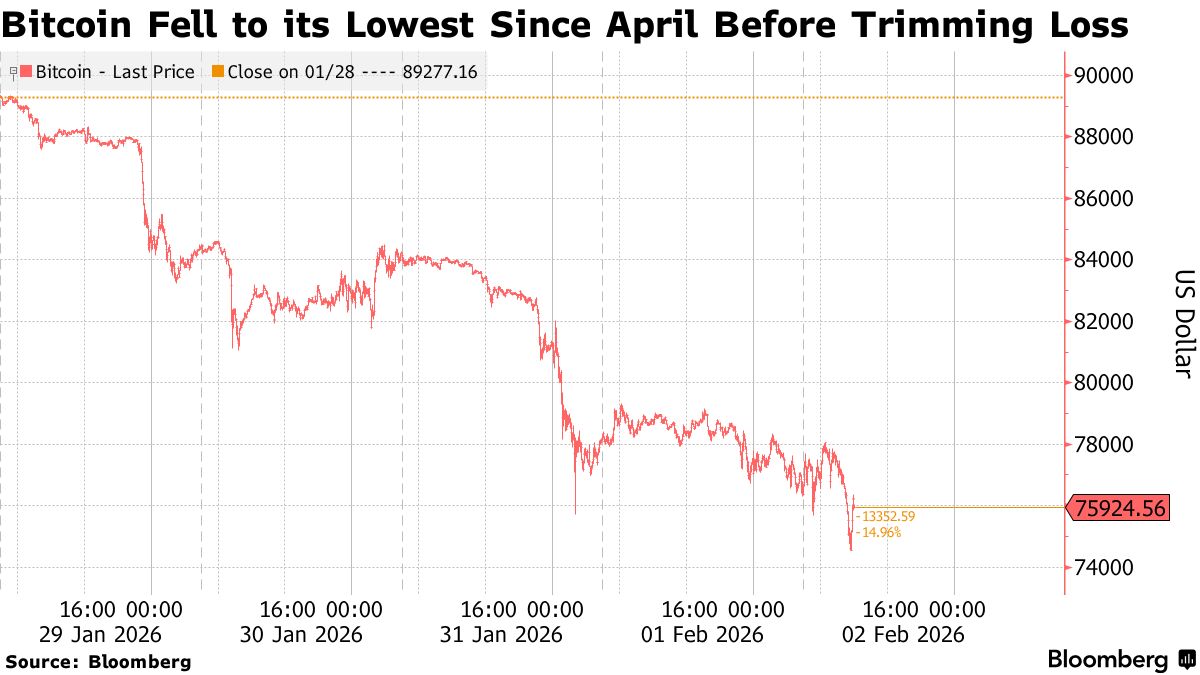
To understand why a single-day 7–17 percent move matters, you have to remember where this market has been. Bitcoin hit its all-time high of $128,198.07 on October 6, 2025. Ethereum peaked at $4,953.73 on August 24, 2025. From those highs to this week’s pre-surge lows, Bitcoin had fallen 51 percent and Ethereum had fallen more than 60 percent.
Year-over-year numbers tell the same story. As of August 18, Bitcoin was down 45.1 percent versus the same date in 2025. Ethereum was down 57.3 percent. Those figures include the new surge — meaning the twelve months preceding this week were, by most measures, a genuine bear market. The $144.63 million in long-position liquidations that accompanied earlier August pullbacks illustrated how leveraged the retail side of this market remained even during the consolidation phase.
What makes the current moment interesting is that the consolidation appears to have been building pressure rather than simply exhausting it. Bitcoin spent most of August trading between its $62,000–$63,000 support zone and $67,000 resistance, with futures open interest climbing to two-month highs even as spot prices moved sideways. The Clarity Act surge broke through that resistance decisively — though whether the move holds will depend on follow-through into next week.
Ethereum’s Outsized Move and What It Signals
While Bitcoin’s 7 percent single-day gain grabbed headlines, Ethereum’s 17.5 percent surge deserves equal attention — not just because it was larger, but because of what it may indicate about market structure.
In bear markets, Ethereum tends to lag Bitcoin on the way up and lead it on the way down, reflecting its higher sensitivity to risk appetite. A move where ETH significantly outperforms BTC on a regulatory-catalyst day historically suggests that institutional and sophisticated traders are positioning for the Clarity Act’s passage to be particularly beneficial for Ethereum’s classification. If ETH lands in the commodity bucket alongside Bitcoin, its DeFi ecosystem — currently processing over $3.7 billion in daily volume — would gain substantially more legal clarity than it has today.
Ethereum’s week-over-week gain of 19.9 percent and its month-over-month gain of 20.3 percent suggest the rotation into ETH began before the presidential statement, indicating that informed money was already positioning ahead of the announcement. Whether that was insider knowledge or simply smart risk-on trading into a structurally oversold asset is impossible to know — but the timing is notable.
Altcoins, Stablecoins, and the Broader Market Landscape
The rally rippled through the wider crypto market, though with varying intensity. Cardano (ADA) had already posted a 10.49 percent weekly gain before the surge, closing at $0.1985. Solana (SOL) continued its steady climb, trading at $75.96 with a 3.86 percent weekly gain. Hyperliquid (HYPE) — one of the standout performers of 2026’s DeFi resurgence — held at $54.74, up 3.66 percent on the week.
Stablecoin infrastructure remains the backbone of the ecosystem’s liquidity. Tether’s USDT carries a market capitalisation of $183.09 billion, while Circle’s USDC sits at $72.15 billion. Together, these two assets represent the plumbing through which most on-chain trading flows — and their combined growth over the past twelve months signals that real dollars are staying in the crypto ecosystem even when prices fall.
One development worth watching: Brazil’s central bank has mandated 24-hour cryptocurrency holds for exchanges operating within its jurisdiction — a move that reduces immediate liquidity but also reduces speculative flash-crash risk. It is an early signal of what regulated crypto markets may look like globally if legislation like the Clarity Act creates a new operational framework for exchanges.
What This Means for You
If you hold Bitcoin or Ethereum, the August 20 surge is genuinely meaningful news — not because one day’s price action changes your long-term thesis, but because it clarifies what the near-term catalysts are. The Clarity Act’s September procedural vote is now the most important single event on the crypto calendar. A cloture vote succeeding would likely extend the rally; a failure to clear cloture would almost certainly give back a significant portion of Thursday’s gains.
For those watching from the sidelines, the prediction market data from Kalshi — which currently prices Bitcoin’s year-end value most likely in the $65,000–$69,999 range — suggests the market is not yet pricing in a full bull market recovery. That is a cautious read, and it may prove too conservative if the Clarity Act passes. It may also prove accurate if the bill stalls again.
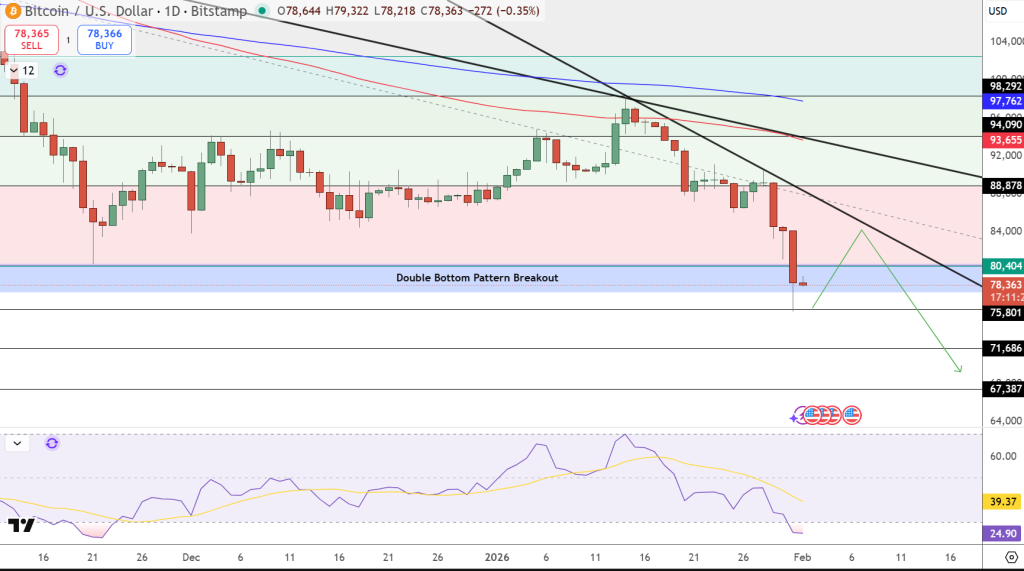
For anyone considering new positions, three practical points are worth keeping in mind. First, the $62,000–$63,000 support zone remains the critical floor: a close below it would signal that the Clarity Act bounce is over and the prior consolidation range is resuming. Second, Bitcoin’s performance relative to geopolitical risk is instructive — since the Middle East conflict began in late February, Bitcoin has declined just 4.4 percent while gold futures have fallen 14.7 percent, suggesting crypto is demonstrating a degree of resilience it did not show in prior crisis periods. Third, ETF inflows returned on Monday after three consecutive days of outflows, which historically precedes broader retail re-engagement in the weeks that follow.
Dollar-cost averaging — adding fixed amounts at regular intervals regardless of price — remains the most defensible approach for most retail participants in a market this volatile. But if you are going to pick a moment to pay attention, the next six weeks are it.
Twelve months ago, Bitcoin was at $128,000 and the conversation was about when it would hit $200,000. Today it is at $72,000 and the conversation is about whether it can hold $65,000 through year-end. That shift tells you everything about how dramatically sentiment can change — and how quickly it can shift back. The Clarity Act is not a guarantee of either outcome. But it is, for the first time in a long time, a reason for the market to look forward rather than back.
Sources
- Yahoo Finance — Bitcoin and Ethereum prices surge after Trump pushes Clarity Act (August 20, 2026)
- Yahoo Finance — Crypto prices mixed as Iran stalemate continues (August 18, 2026)
- CoinIdol — Crypto Market Trends August 2026: Macro Factors & Bitcoin Price Analysis
- Intellectia AI — Crypto Market Outlook August 2026: Bitcoin, Ethereum & Altcoins
- Intellectia AI — Bitcoin Price Outlook August 2026: BTC Rally Analysis