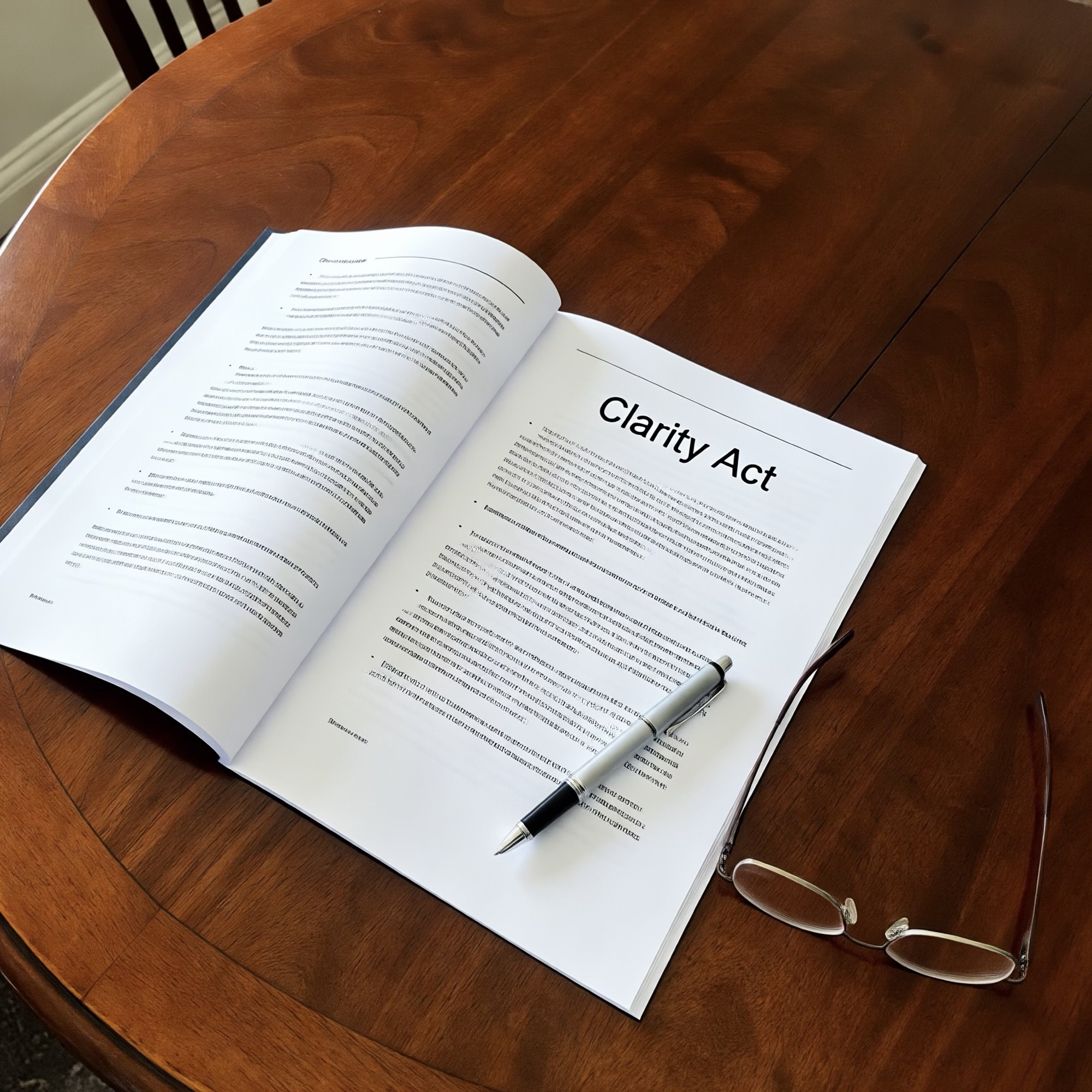
On August 7, 2026, the U.S. Senate quietly walked away from what would have been the most consequential crypto legislation in American history. The Digital Asset Market Clarity Act — 616 pages, 104 sections, four years in the making — failed to reach a floor vote before senators boarded their planes home for summer recess. The bill has now been rescheduled for a procedural vote on September 15. But the delay has done real damage: passage odds on Polymarket have collapsed from 50% to 17–21%, and the window for comprehensive crypto regulation in 2026 is narrowing fast.
For anyone holding digital assets, building on a blockchain, or running a crypto business in the United States, the stakes could not be higher. Here is what happened, why it matters, and what comes next.
What the CLARITY Act Would Actually Do
The Digital Asset Market Clarity Act (H.R. 3633) is not a vague policy statement — it is a structural overhaul of how the U.S. government regulates digital assets. At its core, the bill creates a new legal category: the “digital commodity.” Tokens on blockchains that meet a decentralization threshold would move from SEC oversight to CFTC jurisdiction, ending the years-long legal ambiguity that has forced crypto companies to operate under securities laws written for the 1930s stock market.
The key provisions that the industry has fought hardest for include a maturity certification pathway — a defined process by which token projects can formally exit securities treatment once their network achieves sufficient decentralization — and developer protections under Section 604 (drawn from the Blockchain Regulatory Certainty Act), which would shield non-custodial developers and wallet providers from money-transmitter registration requirements. The bill also incorporates “Keep Your Coins Act” language, providing statutory protection for self-custody — something no federal law currently guarantees.
The House passed H.R. 3633 on July 17, 2025, by a lopsided 294–134 margin. The Senate Banking Committee advanced it 15–9 on May 14, 2026. Everything since then has been a war of attrition over four unresolved disputes that have proven impossible to bridge before recess.
Why It Stalled: Four Disputes That Broke the Timeline
Presidential conflict-of-interest. This is the most politically charged fault line. President Trump’s 2025 financial disclosures reported approximately $1.4 billion in crypto income. Democrats, led by Senators Kirsten Gillibrand, Angela Alsobrooks, and Ruben Gallego, have conditioned their votes on enforceable ethics language that would bar federal officials from issuing or sponsoring digital assets while in office. A July 22 Republican draft included a sunset provision on this language — expiring January 20, 2029, the end of Trump’s term — but Democrats view this as insufficient. The White House has signaled opposition to provisions affecting personal holdings.
DeFi developer liability. Section 604 is the provision that crypto developers care about most. It would shield non-custodial software builders from being treated as money transmitters. Senate Democrats, including Senator Elizabeth Warren, argue this creates an illicit-finance loophole — a way for bad actors to build laundering infrastructure behind a developer shield. A Lummis-Grassley amendment preserved criminal liability for those who knowingly facilitate illegal activity, but Warren remains unconvinced: “This bill was written by the crypto industry to protect and advance the crypto industry,” she said.
Stablecoin yield. The GENIUS Act, signed into law July 18, 2025, governs payment stablecoins and bans issuers from paying interest. Banks now want CLARITY to extend that ban to exchange rewards on stablecoins — essentially preventing crypto platforms from offering yield on stablecoin holdings. Crypto firms are fighting this hard, arguing it would kneecap DeFi and stablecoin adoption. Neither side has moved.
Republican defections. Senator Josh Hawley has broken with his party over community bank concerns embedded in the stablecoin-yield provisions. With Republicans holding 53 seats and at least 2 expected defections, supporters are starting near 50 reliable votes — a full 10 short of the 60 needed to break a filibuster.
The Numbers Are Getting Worse
When Galaxy Research assessed the bill’s prospects in late July, they estimated 50-50 odds of passage. On July 24, they cut that estimate to 30%. Polymarket, which has seen more than $5.5 million in trading volume on the question, has the bill at just 21% to become law by December 31, 2026 — down roughly 48% over recent weeks.
The math is stark. Senate Majority Leader John Thune has committed to bringing the bill to the floor “first thing” when senators return September 15 — but that commitment covers only a procedural vote on the motion to proceed, not final passage. Even if cloture is invoked, the bill must then be reconciled with the Senate Agriculture Committee’s parallel version, aligned with the House-passed text, and signed by the president. Most analysts who track the legislative calendar believe that if final passage does not occur by late September, appropriations battles and midterm campaigning will crowd out any remaining floor time.
A failure this year resets the clock entirely. Comprehensive legislation would be unlikely before mid-2027 at the earliest — a full additional year of regulatory uncertainty for an industry that has been living without clear rules for over a decade.
The Regulatory Parallel Track: What Happens Without the Bill
The industry’s fallback scenario is not nothing — but it is considerably weaker than statute. SEC Chair Paul Atkins has been running “Project Crypto” since outlining it in November 2025, with formal Regulation Crypto rulemaking expected in the second half of 2026. The CFTC, under newly confirmed Chairman Michael Selig, launched “Crypto Sprint” in August 2025 and has been pushing its own guidance aggressively.
Most significantly, on March 17, 2026, the SEC and CFTC issued a joint action formally classifying 16 assets as digital commodities — including Bitcoin, Ethereum, Solana, XRP, and Cardano. This is meaningful clarity for those specific assets. But as SEC Commissioner Hester Peirce has noted, agency guidance can be reversed by the next administration in a way that statute cannot. Regulatory wins won through executive action are inherently temporary. The industry’s long-term push for statutory protection — protection that survives elections — remains unfulfilled.
What This Means for Crypto Holders, Builders, and Businesses
If you hold crypto: The 16 assets already classified as digital commodities have more regulatory clarity today than they did a year ago. The delay does not reverse that. But the self-custody protections and bankruptcy priority provisions in CLARITY — which would have given retail holders stronger legal standing in exchange insolvencies — remain aspirational rather than enforceable.
If you’re building on a blockchain: Developer liability remains in legal grey territory. Section 604’s protections do not exist until the bill passes. Non-custodial wallet providers and DeFi protocol developers are operating without the statutory shield the industry has been counting on.
If you run a crypto exchange or business: Provisional CFTC registration — which would allow exchanges to operate under the new framework during the rulemaking transition — is still pending. Businesses planning their compliance infrastructure around CLARITY’s passage need to build contingency plans around agency-only guidance, which offers less certainty and more litigation risk.
Watch September 15 closely. The procedural vote is a real signal. If Thune cannot invoke cloture, the bill is likely dead for 2026. If cloture passes, the race to final passage will be fast and messy — but possible.
Conclusion: A Bill That Cannot Afford Another Miss
The CLARITY Act’s delay is not a death sentence, but it is a serious wound. The bill that sailed through the House with 294 votes — bipartisan, ambitious, comprehensive — is now a 21% shot on Polymarket, hostage to presidential ethics disputes and stablecoin yield fights that neither side seems willing to resolve. The September 15 vote will tell us whether this Congress can deliver on crypto’s most significant legislative moment in a decade, or whether the industry will spend another year living under guidance that the next president can erase with a memo.
For an industry that has survived exchange collapses, algorithmic failures, and billion-dollar hacks, regulatory uncertainty has always been the background noise. The question now is whether that noise is about to get much louder.
Sources: Disruption Banking · Bitcoin.com News · Tech Insider · Cryptopolitan · CoinDesk


