AI Reality Check: What Last Week’s Stock Crash Means for Broadcom, AMD, Oracle, and Meta

Author: everythingcryptoitclouds.com

Introduction: The Jolt to the AI Trade

Last week, the seemingly unstoppable AI stock rally hit a major speed bump. A sharp selloff, triggered by disappointing news from key players, sent shockwaves through the market, raising the specter of an “AI bubble.” While the overall AI narrative remains robust, the correction served as a crucial reality check, reminding investors that even the most promising growth stories are subject to market scrutiny.

The focus of this correction centered on two major infrastructure providers: Broadcom (AVGO) and Oracle (ORCL). Their struggles quickly dragged down other AI-exposed giants, including Advanced Micro Devices (AMD) and Meta Platforms (META). This article breaks down the reasons behind the crash, analyzes the short-term outlook for the next four weeks, and provides a forecast for early 2026.

AI Crash Visualization

Anatomy of the Selloff: Broadcom and Oracle’s One-Two Punch

The market correction was primarily ignited by a one-two punch from two companies whose fortunes are deeply tied to the AI infrastructure buildout.

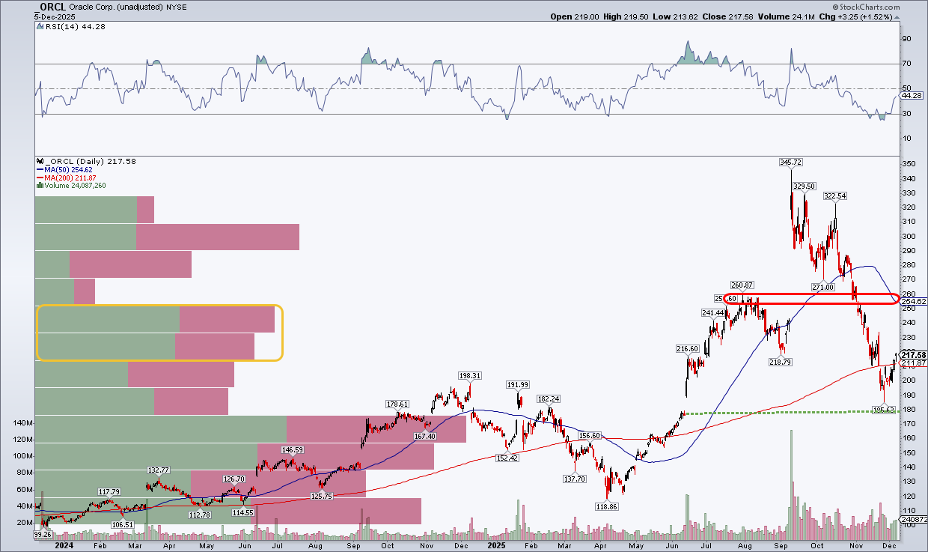
Broadcom’s Margin Scare: Despite reporting better-than-expected quarterly results and strong guidance, Broadcom’s stock plummeted by 11%. The core concern was a warning from management that gross margins would be lower in the short term. This is due to the higher up-front costs associated with producing complex custom AI chip systems and server racks. Furthermore, the CEO tempered expectations for a major deal with OpenAI in 2026, suggesting the immediate revenue boost might not be as explosive as investors had hoped.

Oracle’s Financing Disappointment: Oracle’s stock had already plunged 10% before dropping another 4.5% in the wake of its mixed earnings report (beating on earnings per share but missing on revenue). Investors were particularly disappointed by the lack of detail on how the company plans to finance its massive, debt-fueled AI data center expansion. This raised questions about the sustainability and profitability of the aggressive infrastructure spending required to compete in the AI cloud space.

The combination of Broadcom’s margin concerns and Oracle’s financing uncertainty created a wave of “AI angst,” leading to a broader selloff in the sector.

Oracle Broadcom Chart

Short-Term Outlook: The Next Four Weeks

The next four weeks, often characterized by holiday trading and year-end portfolio adjustments, will be crucial for these stocks.

| Company | Crash Reason | Short-Term Outlook (Next 4 Weeks) |
| :— | :— | :— |
| Broadcom (AVGO) | Margin contraction on custom AI chips. | Analysts are largely recommending to “buy the dip,” viewing the selloff as an overreaction to short-term margin pressure. The underlying demand for their custom chips from hyperscalers remains robust. |
| Oracle (ORCL) | Missed revenue and financing uncertainty. | Volatility is likely as the market digests the debt concerns. A clear communication from management regarding their CapEx financing strategy could stabilize the stock, but until then, it remains under pressure. |
| Advanced Micro Devices (AMD) | General AI trade selloff. | Expected to stabilize quickly. The drop was largely collateral damage from the Broadcom/Oracle news. Strong demand for its EPYC CPUs and Instinct GPUs in the data center market provides a solid floor. |
| Meta Platforms (META) | General AI trade selloff. | Strongly positioned for a rebound. News of trimming the metaverse budget to prioritize AI spending is a positive signal for investors. The stock is likely to benefit from the “flight to quality” within the AI sector. |

Early 2026 Forecast: The Infrastructure Boom Continues

Despite the recent correction, the long-term forecast for the AI infrastructure sector remains overwhelmingly bullish, especially as we head into early 2026. The fundamental driver is the massive, non-negotiable capital expenditure (CapEx) being committed by the world’s largest tech companies.

Meta’s AI Commitment: Meta Platforms is a prime example of this long-term commitment. The company is aggressively shifting resources away from its metaverse division to focus on building out its AI capabilities. Analysts project Meta’s 2026 CapEx to reach an astonishing $109 billion, more than triple its 2023 spending. This colossal investment is primarily directed at AI infrastructure, including the purchase of chips and the construction of data centers.

The Demand for Silicon: This spending spree directly benefits chipmakers like Broadcom and AMD. Broadcom’s custom chip business, despite the short-term margin hit, is poised for massive growth as it supplies hyperscalers like Meta and Google. Similarly, AMD is forecast to see a 20%+ increase in revenue in 2026, driven by the insatiable demand for its high-performance EPYC and Instinct GPUs in the data center. The AI arms race is far from over, and these companies are the essential suppliers.

Oracle’s Long Game: While Oracle faces short-term financing questions, its long-term strategy hinges on becoming a major player in the AI cloud. The massive data center buildout, while costly, is a necessary step to capture future AI-driven revenue. If the company can effectively communicate its financing plan and execute on its AI pipeline, the stock could see a significant recovery in 2026.

AI Data Center

Conclusion: A Correction, Not a Collapse

The recent AI stock selloff was a healthy, albeit painful, market correction. It was driven by specific, company-level concerns about margins and financing, not a collapse in the underlying demand for artificial intelligence.

For investors, the message is clear: the AI revolution is still in its early stages, and the long-term trend of massive infrastructure spending is intact. The next four weeks may see continued volatility as the market finds its footing, but the outlook for early 2026 remains bright. The companies that are the essential building blocks of the AI future—Broadcom, AMD, Oracle, and Meta—are poised to be the biggest beneficiaries of this sustained, multi-year boom.

The Ultimate Guide to Crypto Airdrops in 2026: How to Earn Free Tokens with Testnets and Airdrop Hunting

The cryptocurrency landscape is constantly evolving, and with the anticipated bull run of 2026, a new wave of opportunities is emerging for savvy crypto enthusiasts. Among the most exciting of these are crypto airdrops and testnet rewards, which offer a way to earn free tokens by participating in the growth of new blockchain projects. This guide will provide a comprehensive overview of airdrop hunting, testnet participation, and the strategies you need to maximize your earnings in 2026.

What are Crypto Airdrops and Testnets?

A crypto airdrop is a marketing strategy employed by new blockchain projects to distribute their native tokens to a wide audience. The goal is to bootstrap a community of users and generate awareness for the project. These tokens are often distributed for free to users who meet certain criteria, such as holding a specific cryptocurrency or interacting with the project’s platform.

Testnets, on the other hand, are experimental versions of a blockchain network where developers can test new features and applications without risking real assets. To incentivize participation and gather valuable feedback, projects often reward testnet users with airdrops of their native tokens once the main network (mainnet) launches. This creates a symbiotic relationship where users get to experiment with new technology risk-free and are rewarded for their contributions, while projects get to battle-test their systems before a full-scale launch.

Crypto Airdrop Guide

Why 2026 is the Year of the Airdrop Hunter

The crypto market is cyclical, and all signs point to 2025-2026 being a significant growth period. This extended cycle, driven by institutional investment and structural market changes, is fostering a fertile ground for new projects to launch. As competition for users and attention intensifies, more projects will turn to airdrops as a powerful tool for community building. For the diligent airdrop hunter, this translates into a target-rich environment with unprecedented opportunities to accumulate a diverse portfolio of new and promising tokens.

A Step-by-Step Guide to Participating in Testnets

Engaging with testnets is one of the most reliable ways to qualify for airdrops. Here’s a step-by-step guide to get you started:

Step 1: Find and Join a Testnet

  • Research: Start by exploring new and upcoming blockchain projects. Follow crypto news sites, influencers, and airdrop-specific platforms like Bankless Airdrop Hunter and DappRadar.
  • Join the Community: Most projects announce their testnets on their official social media channels, such as Discord or Telegram. Joining these communities is often a prerequisite for participation.
  • Wallet Setup: You will need a Web3 wallet like MetaMask. It is highly recommended to use a separate, dedicated wallet for airdrop hunting to protect your primary assets.

Step 2: Active Participation

  • Get Testnet Tokens: Once you’ve joined a testnet, you’ll need testnet tokens (which have no real-world value) to interact with the platform. These are usually available for free through a “faucet” provided by the project.
  • Test Everything: The goal is to use the platform as extensively as possible. This includes swapping tokens, providing liquidity, minting NFTs, and testing every available feature.
  • Provide Feedback: Actively report any bugs or user interface issues you encounter. This is a valuable contribution that projects often reward.

Step 3: Build Your On-Chain Reputation

  • Be Consistent: Daily participation is key. Projects often track user activity and reward the most consistent and engaged participants.
  • Engage Socially: Participate in community discussions, ask thoughtful questions, and help other users. This demonstrates your commitment to the project’s success.
  • Incentivized Quests: Many projects offer incentivized testnet quests that guide you through specific tasks. Completing these is a great way to ensure you meet the airdrop criteria.

Airdrop Parachute Coins

Airdrop Hunting Strategies for 2026

Beyond testnets, there are several other strategies to maximize your airdrop rewards:

| Strategy | Description |
| :— | :— |
| Interact with Protocols Without Tokens | Use established platforms that have not yet launched a native token. These are often prime candidates for future retroactive airdrops. |
| Stake on Emerging Blockchains | Staking tokens on new Layer 1 or Layer 2 blockchains can often make you eligible for airdrops from projects building on that ecosystem. |
| Specialize in a Niche | Focus on a specific category of projects, such as DePIN (Decentralized Physical Infrastructure), Layer 2s, or tap-to-earn applications. This allows you to develop expertise and identify promising opportunities early. |
| Use Multiple Wallets (Carefully) | While some hunters use multiple wallets to increase their allocation, be aware that projects are actively developing methods to detect and disqualify such “Sybil” attacks. |

Hot Airdrop Categories for 2026

  • Layer 1s (e.g., Monad): New base-layer blockchains that aim to improve upon existing technologies.
  • Layer 2s (e.g., Linea): Scalability solutions built on top of existing blockchains like Ethereum.
  • DePIN (e.g., Grass, Dawn): Projects that use token incentives to build real-world physical infrastructure networks.
  • Tap-to-Earn (e.g., Sidekick, Midas): Mobile applications that reward users for simple, gamified interactions.

Airdrop Hunting

A Word of Caution: Beware of Scams

As with any lucrative opportunity in the crypto space, airdrops are a magnet for scammers. Be vigilant and follow these safety tips:

  • Never Share Your Private Keys: No legitimate airdrop will ever ask for your private keys or seed phrase.
  • Verify Official Links: Always double-check that you are interacting with the project’s official website and social media channels.
  • Be Wary of Unsolicited DMs: Scammers often impersonate project team members and send direct messages with malicious links.
  • Don’t Pay for an Airdrop: Legitimate airdrops are free. If a project asks you to send funds to receive an airdrop, it is a scam.

Conclusion: The Future is Free (If You Work for It)

Crypto airdrops and testnet rewards offer a unique and exciting way to earn free tokens and become an early adopter of the next wave of blockchain innovation. While the potential rewards are significant, they require diligence, consistency, and a healthy dose of skepticism. By following the strategies outlined in this guide, you can position yourself to capitalize on the airdrop opportunities of 2026 and build a diverse and promising crypto portfolio from the ground up.

Disclaimer: This article is for informational purposes only and does not constitute financial advice. Always conduct your own research before participating in any airdrop or testnet program.

Dreamcash: The Revolutionary Mobile-First Crypto Trading Platform That’s Changing Everything (Get 10,000 Free Points!)

Dreamcash Mobile Trading Platform

Published September 26, 2025 | Author: everythingcryptoitclouds.com

The cryptocurrency trading landscape is experiencing a seismic shift, and at the epicenter of this transformation stands Dreamcash—a revolutionary mobile-first crypto wealth platform that’s redefining how we think about digital asset trading. With its tagline “Trading so good it feels like a dream,” Dreamcash isn’t just another trading app; it’s a comprehensive ecosystem that combines artificial intelligence, automated yield strategies, and zero-friction onboarding to democratize crypto wealth building for everyone.

In an industry where complexity has long been the barrier to entry, Dreamcash emerges as the solution that bridges the gap between sophisticated institutional-grade tools and the intuitive user experience that modern smartphone users demand. The platform launched its exclusive invite-only waitlist in August 2025, and the response has been nothing short of extraordinary—with over 40,000 signups and more than $500 million in pre-launch trading volume already recorded [1].

What makes Dreamcash particularly compelling is its strategic partnership with Hyperliquid, a proven infrastructure that processes over $10 billion in daily trading volume [2]. This partnership ensures that users have access to institutional-grade liquidity and execution from day one, while the platform’s AI-driven analytics provide insights that were previously available only to professional traders and hedge funds.

The timing of Dreamcash’s launch couldn’t be more perfect. As the cryptocurrency market continues to mature and institutional adoption accelerates, there’s a growing demand for platforms that can provide professional-grade tools without the complexity that has traditionally characterized crypto trading. Dreamcash addresses this need head-on with its mobile-first approach, recognizing that the future of finance is increasingly mobile and that users expect the same level of sophistication and ease of use from their trading platforms as they do from their favorite social media apps.

The Vision Behind Dreamcash: Democratizing Crypto Wealth Building

The fundamental vision driving Dreamcash is elegantly simple yet profoundly ambitious: to democratize crypto wealth building through intelligent tools, automated strategies, and zero-friction onboarding. This vision represents a departure from the traditional approach to cryptocurrency trading, which has often been characterized by steep learning curves, complex interfaces, and barriers that exclude all but the most technically sophisticated users.

Hubert Johnson, Head of Marketing at Dreamcash, articulates this vision with remarkable clarity: “We’re building the future of how people interact with crypto markets. Imagine having AI-driven insights, automated yield strategies, and professional-grade tools accessible through an interface as simple as your favorite social app” [3]. This statement encapsulates the core philosophy that drives every aspect of Dreamcash’s development—the belief that sophisticated financial tools should be accessible to everyone, not just institutional investors and crypto veterans.

The democratization of crypto wealth building represents more than just making trading more accessible; it’s about fundamentally changing the relationship between individuals and financial markets. Traditional wealth building has long been the domain of those with significant capital, extensive financial knowledge, or access to professional advisors. Dreamcash challenges this paradigm by providing tools that level the playing field, allowing anyone with a smartphone to access the same sophisticated strategies and insights that were previously available only to institutional investors.

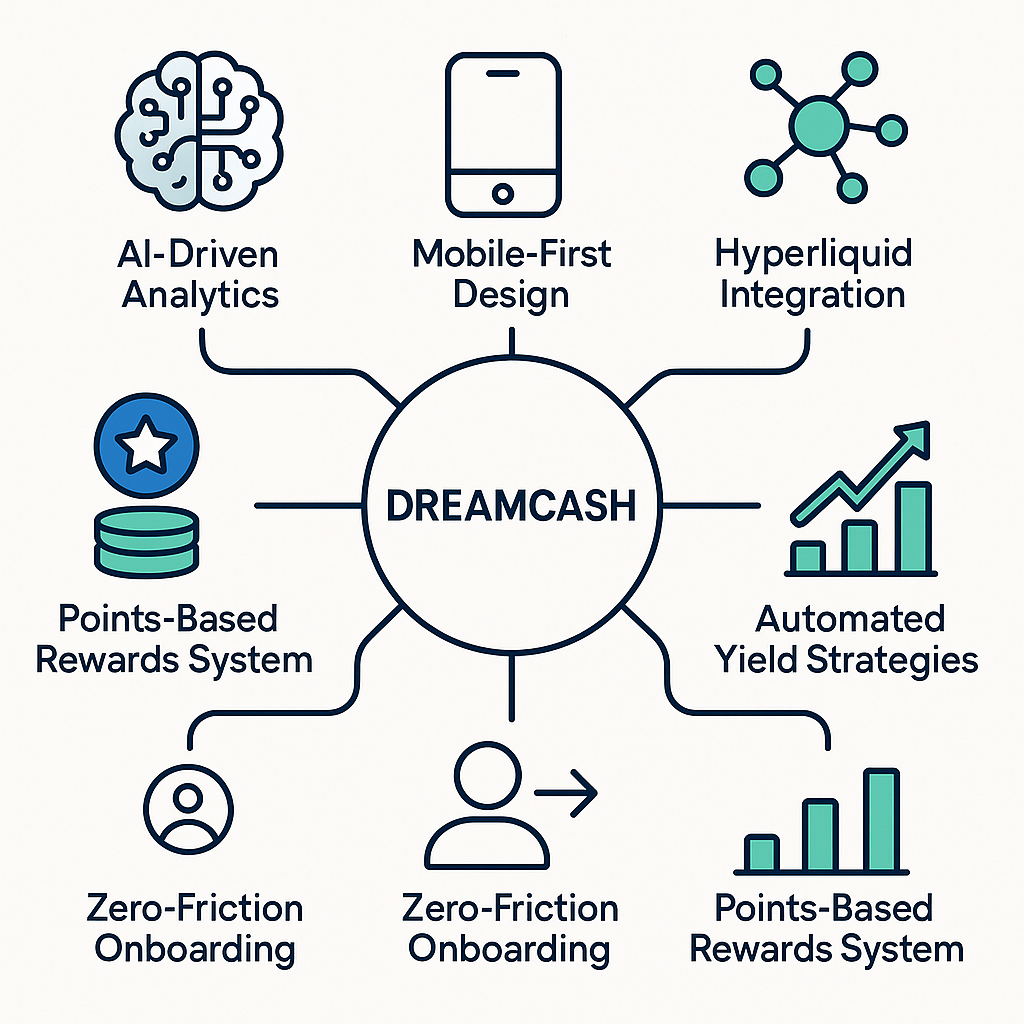
This democratization is achieved through several key innovations that distinguish Dreamcash from traditional trading platforms. The platform’s AI-driven analytics provide users with market insights and opportunity identification that would typically require extensive research and analysis. The automated yield strategies eliminate the need for users to actively manage their positions, allowing them to benefit from sophisticated trading strategies without requiring deep technical knowledge. The zero-friction onboarding process removes the traditional barriers that have prevented many potential users from entering the crypto market.

The mobile-first design philosophy reflects a deep understanding of how modern users interact with technology. Rather than treating mobile as an afterthought or a simplified version of a desktop platform, Dreamcash has been designed from the ground up for mobile users. This approach recognizes that smartphones have become the primary computing device for most people and that the future of finance will be increasingly mobile-centric.

Revolutionary Features That Set Dreamcash Apart

Dreamcash Key Features and Benefits

Dreamcash’s revolutionary approach to crypto trading is built on several key features that collectively create an experience unlike anything currently available in the market. These features represent years of development and a deep understanding of both the technical requirements of sophisticated trading and the user experience expectations of modern mobile applications.

The AI-driven analytics system represents perhaps the most significant innovation in Dreamcash’s feature set. This system leverages advanced machine learning algorithms to analyze market data, identify trading opportunities, and provide users with actionable insights. The AI system is powered by a partnership with RysoAI, which brings institutional-grade artificial intelligence capabilities to retail users [4]. This partnership ensures that Dreamcash users have access to the same level of market analysis and opportunity identification that professional traders and hedge funds rely on.

The AI system operates continuously, monitoring market conditions across multiple cryptocurrencies and identifying patterns that might indicate profitable trading opportunities. Unlike traditional technical analysis tools that require users to interpret charts and indicators, Dreamcash’s AI system provides clear, actionable recommendations that users can act on with confidence. The system also learns from user behavior and market outcomes, continuously improving its recommendations and adapting to changing market conditions.

Automated yield strategies represent another groundbreaking feature that sets Dreamcash apart from traditional trading platforms. These strategies are designed to generate consistent returns regardless of market direction, using sophisticated techniques such as delta-neutral positioning and arbitrage opportunities. The automated nature of these strategies means that users can benefit from professional-grade trading techniques without needing to understand the underlying mechanics or actively manage their positions.

The delta-neutral strategies are particularly innovative, as they allow users to generate yield even in volatile or declining markets. These strategies work by taking offsetting positions that profit from market inefficiencies rather than directional price movements. This approach provides a level of stability and predictability that is rare in cryptocurrency trading, making it particularly attractive to users who want exposure to crypto markets without the extreme volatility typically associated with digital assets.

The zero-friction onboarding process eliminates many of the traditional barriers that have prevented mainstream adoption of cryptocurrency trading. Traditional crypto exchanges often require extensive know-your-customer (KYC) procedures, complex account setup processes, and significant technical knowledge just to begin trading. Dreamcash streamlines this process, allowing users to begin building their crypto portfolios immediately upon downloading the app.

This streamlined onboarding is achieved through innovative approaches to identity verification and risk management that maintain security while eliminating unnecessary friction. The platform uses advanced fraud detection and risk assessment algorithms to identify and prevent malicious activity while allowing legitimate users to access the platform quickly and easily. This approach represents a significant advancement in balancing security with user experience in the cryptocurrency space.

The Hyperliquid integration provides Dreamcash users with access to institutional-grade liquidity and execution capabilities. Hyperliquid is a proven infrastructure platform that processes over $10 billion in daily trading volume, providing deep liquidity across multiple cryptocurrency pairs [5]. This integration ensures that Dreamcash users can execute trades quickly and at competitive prices, even for large positions that might experience slippage on smaller exchanges.

The integration with Hyperliquid also provides access to advanced order types and trading features that are typically available only on professional trading platforms. These features include advanced stop-loss orders, trailing stops, and sophisticated position management tools that help users optimize their trading strategies and manage risk effectively.

The Points-Based Rewards System: Gamifying Crypto Engagement

One of the most innovative aspects of Dreamcash’s approach to user engagement is its comprehensive points-based rewards system, which gamifies the crypto trading experience while providing tangible benefits to early adopters. This system represents a sophisticated approach to user acquisition and retention that goes far beyond traditional referral programs or promotional offers.

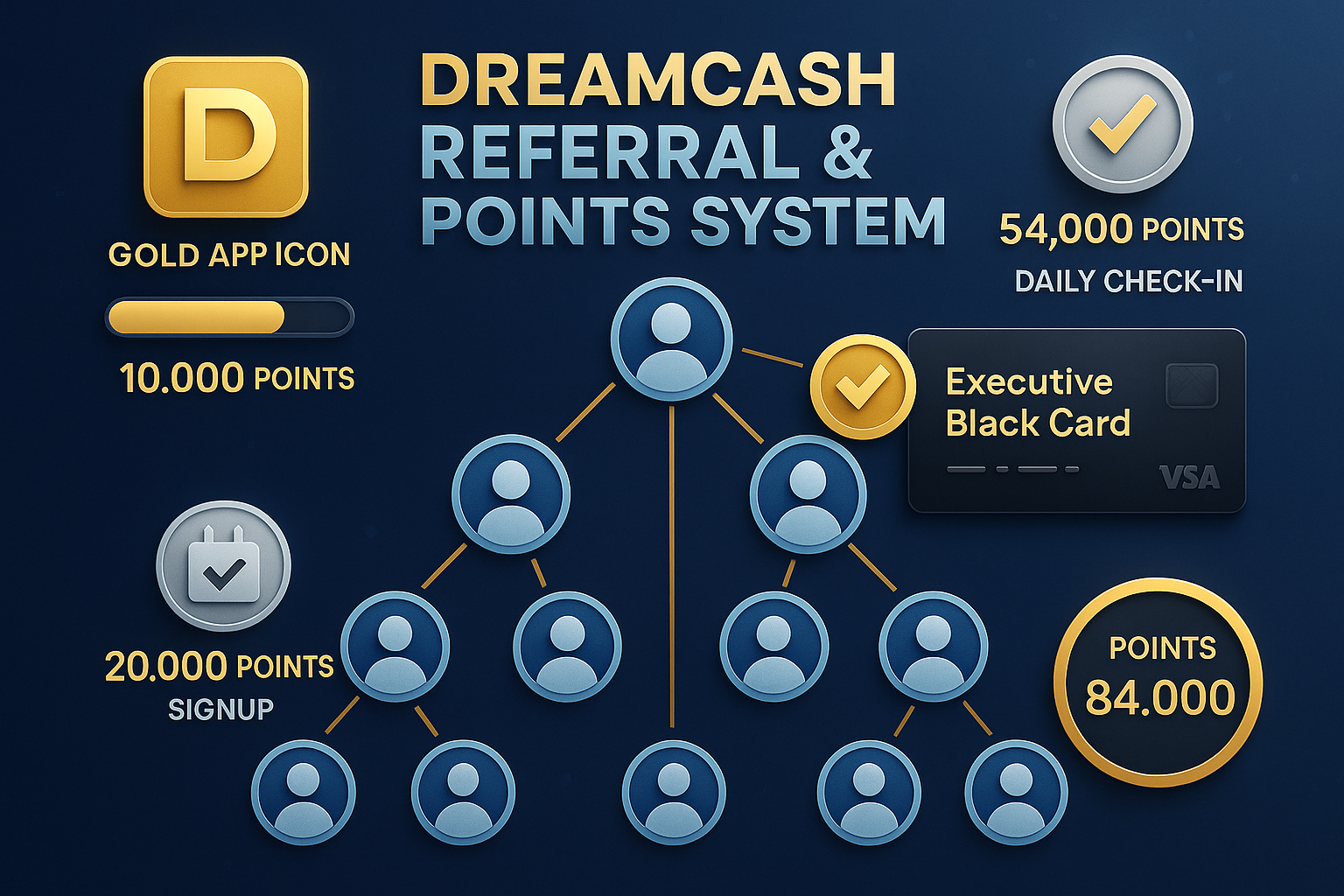
The points system operates on multiple levels, providing rewards for various types of engagement with the platform. Users earn one point per second simply for being on the waitlist, creating a passive income stream that rewards early adoption and continued engagement [6]. This passive earning mechanism ensures that users are continuously accumulating value even when they’re not actively using the platform, creating a strong incentive for long-term engagement.

Daily check-ins provide an additional 20,000 points, encouraging users to regularly interact with the app and stay engaged with the platform. This daily engagement mechanism helps build habits and ensures that users remain connected to the Dreamcash ecosystem even during the pre-launch phase. The substantial point reward for daily check-ins reflects the platform’s understanding of the value of consistent user engagement and the importance of building strong user habits early in the relationship.

The referral system provides the most substantial point rewards, with users earning 54,000 points for each successful referral [7]. This generous referral reward reflects the platform’s focus on organic growth and word-of-mouth marketing, recognizing that satisfied users are the best advocates for the platform. The referral system also creates a network effect, where each new user potentially brings additional users to the platform, accelerating growth and building a strong community of engaged users.

🎯 EXCLUSIVE OFFER: Use referral code TY74CU to get 10,000 FREE points when you sign up! Join Dreamcash with 10,000 bonus points

The exclusive rewards available through the points system add an element of prestige and exclusivity that appeals to early adopters. The Gold App Icon, available to users who achieve five or more referrals, provides a visible status symbol that distinguishes early supporters of the platform [8]. This exclusive reward will never be available again after the platform launches, creating a sense of urgency and exclusivity that motivates users to actively participate in the referral program.

The Executive Black Card, available to users who achieve ten or more referrals, represents the pinnacle of the pre-launch rewards system. This exclusive status symbol provides not only prestige but also potential access to additional platform benefits and features. Like the Gold App Icon, the Executive Black Card will never be available again after launch, making it a truly exclusive reward for the most engaged early adopters.

The points system is designed with future utility in mind, with strong indications that points will convert to platform benefits or potentially tokens after the official launch. While no official token airdrop has been confirmed, the structure and emphasis of the points system strongly suggest that early participants will receive lasting recognition and benefits for their early support of the platform [9].

Technical Infrastructure: The Hyperliquid Advantage

The technical foundation of Dreamcash is built on a strategic partnership with Hyperliquid, one of the most robust and proven infrastructure platforms in the cryptocurrency space. This partnership provides Dreamcash with access to institutional-grade capabilities that would be extremely difficult and expensive to develop independently, while allowing the platform to focus on user experience and innovation rather than infrastructure development.

Hyperliquid processes over $10 billion in daily trading volume, making it one of the largest and most liquid cryptocurrency trading infrastructures in the world [10]. This massive scale provides several critical advantages for Dreamcash users, including deep liquidity across multiple trading pairs, competitive pricing, and the ability to execute large trades without significant market impact. The scale of Hyperliquid’s operations also provides stability and reliability that is essential for a platform targeting mainstream adoption.

The liquidity provided by Hyperliquid is particularly important for the types of automated strategies that Dreamcash offers. Delta-neutral strategies and arbitrage opportunities often require the ability to execute trades quickly and at specific prices, making deep liquidity essential for their success. The Hyperliquid partnership ensures that Dreamcash’s automated strategies can operate effectively even during periods of high market volatility or unusual trading conditions.

The technical architecture of the Hyperliquid platform also provides advanced risk management and security features that are essential for institutional-grade trading. These features include sophisticated position monitoring, automated risk controls, and advanced security measures that protect user funds and trading positions. The proven track record of Hyperliquid in handling large volumes and maintaining security provides confidence that Dreamcash users’ assets and trading activities are protected by best-in-class infrastructure.

The integration between Dreamcash and Hyperliquid is designed to be seamless from the user perspective, with all the complexity of the underlying infrastructure hidden behind Dreamcash’s intuitive mobile interface. Users benefit from the sophisticated capabilities of Hyperliquid without needing to understand or interact with the technical complexities of the underlying system. This approach allows Dreamcash to provide institutional-grade capabilities with consumer-grade simplicity.

The Hyperliquid partnership also provides Dreamcash with access to advanced trading features and order types that are typically available only on professional trading platforms. These features include sophisticated stop-loss orders, trailing stops, and advanced position management tools that help users optimize their trading strategies and manage risk effectively. The availability of these advanced features through Dreamcash’s simple mobile interface represents a significant advancement in making professional trading tools accessible to retail users.

Market Position and Competitive Landscape

Dreamcash enters a cryptocurrency trading market that is both highly competitive and rapidly evolving, with established players ranging from traditional exchanges like Coinbase and Binance to newer mobile-first platforms like Robinhood and newer entrants. However, Dreamcash’s unique combination of features and approach creates a distinct market position that differentiates it from existing competitors.

The mobile-first approach represents a significant competitive advantage in a market where most established platforms were originally designed for desktop use and later adapted for mobile. While many existing platforms offer mobile apps, these are often simplified versions of their desktop platforms or mobile adaptations that don’t fully leverage the unique capabilities and user experience expectations of mobile devices. Dreamcash’s ground-up mobile design allows it to provide a user experience that is optimized for how people actually use their smartphones.

The AI-driven analytics and automated strategies represent another significant competitive differentiator. While some platforms offer basic technical analysis tools or simple automated features, Dreamcash’s partnership with RysoAI provides access to institutional-grade artificial intelligence capabilities that are not available on other retail platforms [11]. This AI integration provides users with insights and opportunities that would typically require extensive research and analysis, creating a significant value proposition for users who want to benefit from sophisticated trading strategies without developing the expertise to implement them independently.

The zero-friction onboarding process addresses one of the most significant barriers to entry in the cryptocurrency market. Traditional exchanges often require extensive documentation, verification processes, and waiting periods before users can begin trading. Dreamcash’s streamlined approach allows users to begin building their crypto portfolios immediately, removing a major source of friction that prevents many potential users from entering the market.

The points-based rewards system and gamification elements also represent a unique approach to user engagement that is not commonly found in traditional cryptocurrency trading platforms. While some platforms offer referral bonuses or promotional rewards, Dreamcash’s comprehensive points system creates ongoing engagement and provides lasting value to early adopters. This approach helps build a strong community of engaged users who have a vested interest in the platform’s success.

The integration with Hyperliquid provides access to liquidity and execution capabilities that rival or exceed those available on major exchanges, while the mobile-first design and user experience innovations provide a level of accessibility and ease of use that is not available on traditional institutional platforms. This combination allows Dreamcash to compete effectively with both retail-focused platforms and institutional-grade trading systems.

The Future of Mobile Crypto Trading

Dreamcash Referral and Points System

Dreamcash represents more than just another trading platform; it embodies a vision of the future of cryptocurrency trading that is mobile-first, AI-powered, and accessible to everyone. The platform’s approach reflects several key trends that are reshaping the financial services industry and points toward a future where sophisticated financial tools are available to anyone with a smartphone.

The mobile-first approach reflects the reality that smartphones have become the primary computing device for most people around the world. This trend is particularly pronounced among younger demographics, who are increasingly comfortable conducting all aspects of their financial lives through mobile devices. Dreamcash’s recognition of this trend and its commitment to providing a truly mobile-native experience positions it well to capture this growing market segment.

The integration of artificial intelligence into trading and investment decisions represents another major trend that is reshaping the financial services industry. As AI technology continues to advance and become more accessible, platforms that can effectively leverage AI to provide value to users will have a significant competitive advantage. Dreamcash’s partnership with RysoAI and its focus on AI-driven analytics positions it at the forefront of this trend.

The democratization of sophisticated financial tools is another key trend that Dreamcash embodies. Traditional wealth management and sophisticated trading strategies have long been available only to high-net-worth individuals and institutional investors. Technology is increasingly making these tools accessible to a broader audience, and platforms that can effectively democratize access to sophisticated financial strategies will capture significant market share.

The gamification of financial services is an emerging trend that Dreamcash has embraced through its points-based rewards system. As younger generations become a larger portion of the investing population, platforms that can make financial services engaging and rewarding will have an advantage in attracting and retaining users. Dreamcash’s comprehensive gamification approach goes beyond simple rewards to create an engaging experience that encourages long-term participation.

The focus on user experience and simplicity represents a broader trend in financial services toward platforms that prioritize ease of use and accessibility. As financial services become increasingly digital, platforms that can provide sophisticated capabilities through simple, intuitive interfaces will have a significant advantage. Dreamcash’s commitment to making professional-grade tools accessible through a simple mobile interface positions it well to benefit from this trend.

Getting Started: Your Path to 10,000 Free Points

For readers interested in joining the Dreamcash revolution, the process is straightforward and rewarding. The platform’s invite-only waitlist provides early access to the platform and the opportunity to begin accumulating points immediately. The points system provides multiple ways to earn rewards, with the potential for these points to convert to lasting benefits or tokens after the platform’s official launch.

Step 1: Download and Register
The first step is to download the Dreamcash app from the App Store or Google Play and complete the registration process. During registration, be sure to enter the referral code TY74CU to receive an immediate bonus of 10,000 points Join here with bonus points. This bonus provides a significant head start in the points accumulation process and demonstrates the platform’s commitment to rewarding early adopters.

Step 2: Begin Earning Points
Once registered, users automatically begin earning one point per second simply for being on the waitlist. This passive earning mechanism ensures that points accumulate continuously, even when users are not actively engaging with the app. The passive earning rate may seem small, but it adds up significantly over time, particularly for early adopters who join during the pre-launch phase.

Step 3: Daily Engagement
Daily check-ins provide an additional 20,000 points, making regular engagement with the app highly rewarding. The daily check-in process is simple and quick, requiring just a few seconds of interaction with the app. However, the point reward is substantial, making daily engagement one of the most efficient ways to accumulate points quickly.

Step 4: Social Media Engagement
Following Dreamcash on social media platforms provides additional point bonuses and helps users stay informed about platform developments and updates. The social media engagement rewards recognize the value of building a strong community around the platform and encourage users to become advocates for Dreamcash within their social networks.

Step 5: Referral Activity
The referral program provides the most substantial point rewards, with 54,000 points awarded for each successful referral. Users receive a unique referral code that they can share with friends, family, and social networks. The generous referral rewards make sharing the platform with others highly beneficial, while also helping to build the Dreamcash community through organic growth.

Step 6: Exclusive Rewards
Users who achieve five or more referrals unlock the Gold App Icon, while those who achieve ten or more referrals receive the Executive Black Card. These exclusive rewards will never be available again after the platform launches, making them truly unique status symbols for early adopters. The exclusive nature of these rewards creates additional motivation for active participation in the referral program.

Investment Implications and Market Opportunity

The emergence of Dreamcash represents a significant development in the cryptocurrency trading space with important implications for investors, traders, and the broader digital asset ecosystem. The platform’s innovative approach to mobile trading, AI integration, and user experience represents a new paradigm that could influence the development of the entire cryptocurrency trading industry.

From an investment perspective, Dreamcash’s approach addresses several key pain points that have limited mainstream adoption of cryptocurrency trading. The complexity of traditional trading platforms, the lack of sophisticated tools for retail users, and the barriers to entry created by cumbersome onboarding processes have all contributed to limiting the growth of the cryptocurrency trading market. Dreamcash’s solutions to these problems position it to capture significant market share as cryptocurrency adoption continues to grow.

The total addressable market for cryptocurrency trading continues to expand rapidly, driven by increasing institutional adoption, growing retail interest, and the development of new financial products and services built on blockchain technology. Platforms that can effectively serve this growing market while providing superior user experience and innovative features are likely to capture disproportionate value as the market continues to mature.

The AI integration and automated strategies offered by Dreamcash also represent a significant advancement in making sophisticated trading techniques accessible to retail users. As artificial intelligence technology continues to advance and become more accessible, platforms that can effectively leverage AI to provide value to users will have a significant competitive advantage. The partnership with RysoAI positions Dreamcash at the forefront of this trend.

The mobile-first approach reflects broader trends in how people interact with financial services and technology. As smartphone adoption continues to grow globally and younger generations become a larger portion of the investing population, platforms that are designed specifically for mobile use will have significant advantages over those that treat mobile as an afterthought.

The points-based rewards system and potential for future token distribution also create interesting dynamics for early adopters. While no official token airdrop has been confirmed, the structure of the points system and the emphasis on early adoption suggest that participants in the pre-launch program may receive significant benefits when the platform officially launches. This creates an asymmetric risk-reward opportunity for early participants.

Conclusion: The Dawn of a New Era in Crypto Trading

Dreamcash represents more than just another cryptocurrency trading platform; it embodies a vision of the future where sophisticated financial tools are accessible to everyone, where artificial intelligence enhances human decision-making, and where mobile technology enables seamless interaction with global financial markets. The platform’s innovative approach to user experience, technical infrastructure, and community building positions it as a potential leader in the next generation of cryptocurrency trading platforms.

The combination of AI-driven analytics, automated yield strategies, zero-friction onboarding, and mobile-first design creates a unique value proposition that addresses many of the barriers that have limited mainstream adoption of cryptocurrency trading. The strategic partnership with Hyperliquid provides the technical foundation necessary to deliver institutional-grade capabilities through a consumer-friendly interface.

The points-based rewards system and focus on community building demonstrate a sophisticated understanding of user engagement and the importance of creating lasting relationships with users. The exclusive rewards available to early adopters create strong incentives for participation while building a community of engaged advocates for the platform.

For individuals interested in participating in the future of cryptocurrency trading, Dreamcash offers an opportunity to join a revolutionary platform during its early stages. The generous rewards for early adoption, combined with the potential for lasting benefits from the points system, create compelling reasons to participate in the pre-launch program.

The cryptocurrency trading industry is at an inflection point, with increasing institutional adoption, growing retail interest, and rapid technological advancement creating opportunities for platforms that can effectively serve this evolving market. Dreamcash’s innovative approach and strong technical foundation position it well to capitalize on these trends and potentially become a leader in the next generation of cryptocurrency trading platforms.

As we look toward the future of finance, platforms like Dreamcash that prioritize accessibility, innovation, and user experience will play an increasingly important role in democratizing access to sophisticated financial tools and opportunities. The revolution in cryptocurrency trading has begun, and Dreamcash is positioned at the forefront of this transformation.

Ready to join the revolution? Use referral code TY74CU to get 10,000 FREE points and be part of the future of crypto trading: https://dreamcash.xyz/share?code=TY74CU


References

[1] ETF.com – “Dreamcash Begins Rollout of Trading Platform with Hyperliquid Integration via Waitlist Access” (August 5, 2025) – https://www.etf.com/sections/news/dreamcash-begins-rollout-trading-platform-hyperliquid-integration-waitlist-access

[2] Yahoo Finance – “Dreamcash Begins Rollout of Trading Platform with Hyperliquid Integration” (August 5, 2025) – https://finance.yahoo.com/news/dreamcash-begins-rollout-trading-platform-221040657.html

[3] ETF.com – “Dreamcash Begins Rollout of Trading Platform with Hyperliquid Integration via Waitlist Access” (August 5, 2025)

[4] Bitrue Blog – “Dreamcash Airdrop: A Complete Guide for Early Participants” (September 17, 2025) – https://www.bitrue.com/blog/how-to-participate-dreamcash-airdrop

[5] ETF.com – “Dreamcash Begins Rollout of Trading Platform with Hyperliquid Integration via Waitlist Access” (August 5, 2025)

[6] Bitrue Blog – “Dreamcash Airdrop: A Complete Guide for Early Participants” (September 17, 2025)

[7] Bitrue Blog – “Dreamcash Airdrop: A Complete Guide for Early Participants” (September 17, 2025)

[8] Bitrue Blog – “Dreamcash Airdrop: A Complete Guide for Early Participants” (September 17, 2025)

[9] Airdrops.io – “Potential Dreamcash Airdrop » How to be eligible?” – https://airdrops.io/dreamcash/

[10] ETF.com – “Dreamcash Begins Rollout of Trading Platform with Hyperliquid Integration via Waitlist Access” (August 5, 2025)

[11] Bitrue Blog – “Dreamcash Airdrop: A Complete Guide for Early Participants” (September 17, 2025)

Morgan Stanley to Launch Crypto Trading for E*Trade Customers: The Wall Street Revolution That’s Reshaping Digital Finance

Morgan Stanley E*Trade Crypto Trading Launch

Published September 26, 2025 | Author: everythingcryptoitclouds.com

In a groundbreaking move that signals the complete transformation of Wall Street’s relationship with cryptocurrency, Morgan Stanley has announced its plans to launch direct crypto trading for E*Trade customers in the first half of 2026. This isn’t just another financial institution dipping its toes into digital assets—this represents a seismic shift that could fundamentally reshape how institutional wealth management approaches cryptocurrency investment and custody.

The announcement, made on September 23, 2025, comes at a time when the cryptocurrency market has reached an unprecedented $3.9 trillion valuation, with Bitcoin commanding $2.25 trillion and Ethereum holding $506 billion of that total market capitalization [1]. What makes this development particularly significant is not just the scale of Morgan Stanley’s commitment, but the sophisticated infrastructure partnership they’ve forged with Zerohash, a crypto infrastructure provider that recently achieved unicorn status with a $104 million funding round [2].

The Strategic Partnership That’s Changing Everything

Morgan Stanley’s approach to crypto trading represents a masterclass in strategic partnership development. Rather than attempting to build cryptocurrency infrastructure from scratch—a process that could take years and cost hundreds of millions—the financial giant has partnered with Zerohash, one of the industry’s leading embedded crypto solutions providers [3].

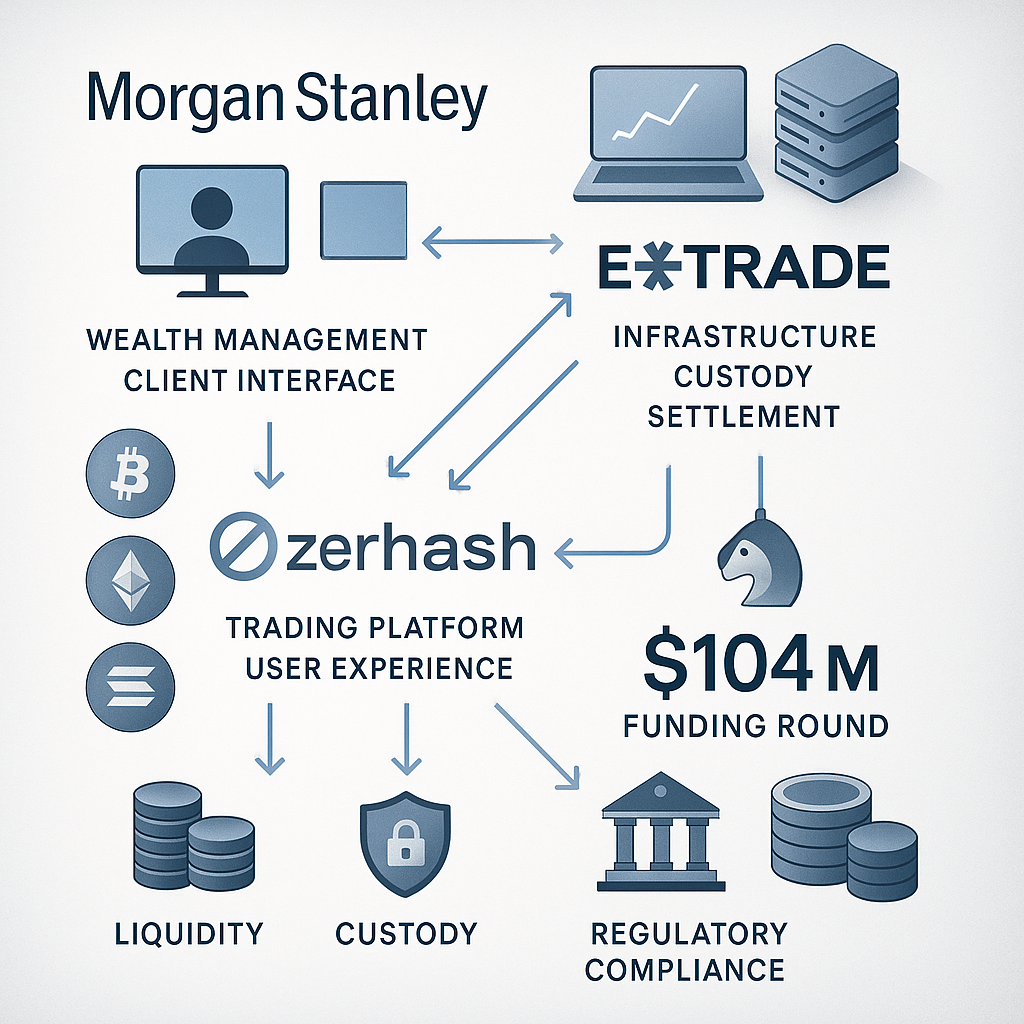
This partnership is far more than a simple vendor relationship. Morgan Stanley has taken an investment stake in Zerohash, demonstrating a level of commitment that goes beyond typical service provider arrangements [4]. The timing couldn’t be more strategic, as Zerohash recently completed a $104 million Series D-2 funding round led by Interactive Brokers, with Morgan Stanley, SoFi, and Apollo Global Management participating as strategic investors [5].

The partnership structure reveals Morgan Stanley’s sophisticated understanding of the crypto ecosystem. Zerohash will handle the complex technical infrastructure including liquidity provision, custody services, and settlement operations, while Morgan Stanley focuses on what it does best: client relationship management and wealth advisory services. This division of labor allows both companies to leverage their core competencies while delivering a seamless experience to E*Trade customers.

Jed Finn, head of wealth management at Morgan Stanley, emphasized the strategic nature of this approach in an internal memo obtained by CNBC: “We are well underway in preparing to offer crypto trading through a partner model to E-Trade clients in the first half of 2026” [6]. The use of the phrase “partner model” is particularly significant, as it indicates Morgan Stanley’s recognition that cryptocurrency requires specialized expertise that’s best obtained through strategic alliances rather than internal development.

MembersCap: The Early Adopter Validating Institutional Demand

One of the most compelling aspects of Morgan Stanley’s crypto trading initiative is the early validation it has received from sophisticated institutional clients. MembersCap, a Bermuda-regulated investment manager specializing in tokenized reinsurance investments, has already begun using the service, providing crucial real-world testing and validation of the platform’s capabilities [7].

MembersCap’s involvement is particularly noteworthy given the company’s innovative approach to traditional finance. Founded in 2024, MembersCap has pioneered the tokenization of institutional-grade reinsurance investments, creating the first tokenized reinsurance fund designed for sophisticated digital asset investors [8]. In July 2025, the company launched this groundbreaking fund in partnership with Archax, a digital asset exchange, broker, and custodian [9].

The significance of MembersCap’s early adoption extends beyond simple beta testing. In September 2025, MembersCap became the first company to use the new London Stock Exchange blockchain-based platform for private funds, demonstrating their position at the forefront of financial innovation [10]. Their decision to utilize Morgan Stanley’s crypto trading infrastructure validates the platform’s capability to serve sophisticated institutional clients with complex requirements.

This early institutional adoption addresses one of the key challenges facing traditional financial institutions entering the crypto space: proving that their infrastructure can handle the demands of professional investment managers. MembersCap’s successful use of the platform provides Morgan Stanley with a powerful case study demonstrating institutional-grade reliability and functionality.

The Cryptocurrency Landscape: A $3.9 Trillion Opportunity

To understand the magnitude of Morgan Stanley’s strategic move, it’s essential to examine the current state of the cryptocurrency market. What began as a niche asset class dismissed by many traditional financial institutions has evolved into a $3.9 trillion market that can no longer be ignored by serious wealth managers [11].

The market composition reveals the maturation of the cryptocurrency ecosystem. Bitcoin, with its $2.25 trillion market capitalization, has established itself as the digital equivalent of gold—a store of value that institutional investors increasingly view as a necessary portfolio component [12]. Ethereum, commanding $506 billion in market cap, represents the infrastructure layer of decentralized finance, hosting thousands of applications and smart contracts that are reshaping financial services [13].

The inclusion of Solana as one of the three cryptocurrencies available at launch demonstrates Morgan Stanley’s sophisticated understanding of the crypto ecosystem. Solana’s recent achievement of 107,664 transactions per second in a single block has positioned it as a leading platform for high-frequency trading and institutional applications [14]. This technical capability makes Solana particularly attractive to institutional clients who require high-performance blockchain infrastructure for their operations.

The growth trajectory of the cryptocurrency market has been nothing short of extraordinary. From a total market capitalization of less than $1 billion in 2013 to nearly $4 trillion today, cryptocurrencies have demonstrated a compound annual growth rate that far exceeds traditional asset classes [15]. This growth has been driven not just by retail speculation, but increasingly by institutional adoption, regulatory clarity, and the development of sophisticated financial products.

Regulatory Environment: The Trump Administration’s Crypto-Friendly Stance

The timing of Morgan Stanley’s crypto trading launch is inextricably linked to the dramatic shift in regulatory sentiment following the Trump administration’s return to power. The administration’s supportive stance toward cryptocurrency regulation has created an environment where traditional financial institutions feel confident making substantial investments in crypto infrastructure [16].

This regulatory shift represents a complete reversal from the uncertainty that characterized much of the previous regulatory environment. Where banks once faced unclear guidance and potential enforcement actions for crypto-related activities, they now operate in a framework that actively encourages innovation and institutional participation in digital asset markets [17].

The impact of this regulatory clarity cannot be overstated. It has enabled Morgan Stanley to move forward with confidence, knowing that their crypto trading initiative aligns with government policy rather than potentially conflicting with it. This regulatory support has also contributed to the broader institutional adoption wave that includes not just Morgan Stanley, but competitors like Charles Schwab and Robinhood expanding their crypto offerings [18].

The regulatory environment has also facilitated the type of strategic partnerships that make Morgan Stanley’s approach possible. Zerohash’s ability to provide comprehensive crypto infrastructure services depends on clear regulatory frameworks that define custody requirements, compliance obligations, and operational standards. The current regulatory clarity has enabled these partnerships to flourish, creating the foundation for institutional-grade crypto services.

Technical Infrastructure: The Zerohash Advantage

Crypto Infrastructure Partnership

The technical architecture underlying Morgan Stanley’s crypto trading initiative represents a sophisticated approach to financial technology integration. Zerohash’s role as the infrastructure provider encompasses multiple critical functions that would be extremely challenging for a traditional bank to develop independently.

Zerohash’s liquidity provision capabilities are particularly crucial for institutional clients. The company has developed relationships with multiple cryptocurrency exchanges and market makers, enabling them to provide competitive pricing and deep liquidity across all supported cryptocurrencies [19]. This liquidity infrastructure ensures that E*Trade clients can execute large trades without significant market impact, a critical requirement for institutional investors.

The custody services provided by Zerohash represent another critical component of the technical infrastructure. Cryptocurrency custody requires specialized security measures, including multi-signature wallets, hardware security modules, and sophisticated key management systems [20]. Zerohash has invested heavily in developing institutional-grade custody solutions that meet the security and compliance requirements of traditional financial institutions.

Settlement operations in the cryptocurrency space involve complex interactions between traditional banking systems and blockchain networks. Zerohash’s settlement infrastructure handles the conversion between fiat currencies and cryptocurrencies, manages blockchain transaction fees, and ensures compliance with anti-money laundering and know-your-customer requirements [21]. This technical complexity would represent a significant development challenge for Morgan Stanley to tackle independently.

The integration between Zerohash’s infrastructure and Morgan Stanley’s existing ETrade platform requires sophisticated API development and real-time data synchronization. The seamless user experience that ETrade customers will enjoy depends on complex backend systems that handle account management, trade execution, and portfolio reporting across both traditional and digital assets [22].

Competitive Landscape: Positioning Against Robinhood and Schwab

Morgan Stanley’s entry into direct crypto trading places the firm in direct competition with established players who have already captured significant market share in retail crypto trading. Understanding this competitive landscape is crucial for assessing the potential impact of Morgan Stanley’s initiative.

Robinhood has established itself as a leader in retail crypto trading, offering a wide range of cryptocurrency options through an intuitive mobile-first interface [23]. The platform’s success has been built on simplicity, low fees, and accessibility for retail investors. However, Robinhood’s focus on retail customers leaves an opportunity for Morgan Stanley to differentiate through institutional-grade services and comprehensive wealth management integration.

Charles Schwab has taken a more conservative approach, providing clients with access to Bitcoin and Ethereum exchange-traded funds rather than direct cryptocurrency ownership [24]. This approach reduces complexity and regulatory risk but also limits the potential returns and flexibility that direct ownership provides. Morgan Stanley’s direct ownership model represents a more aggressive approach that could attract clients seeking greater control over their cryptocurrency investments.

The competitive advantage that Morgan Stanley brings to this market extends beyond just cryptocurrency trading. The firm’s comprehensive wealth management platform allows for sophisticated portfolio construction that integrates traditional and digital assets. This holistic approach appeals to high-net-worth clients who want their cryptocurrency investments managed alongside their traditional portfolios by experienced wealth advisors.

Morgan Stanley’s brand reputation and regulatory compliance capabilities also provide significant competitive advantages. Wealthy clients often prioritize security and regulatory compliance over features like low fees or extensive cryptocurrency selection. Morgan Stanley’s established reputation in wealth management and their partnership with Zerohash’s institutional-grade infrastructure addresses these priorities effectively.

The Tokenization Revolution: Beyond Simple Crypto Trading

Wall Street Crypto Adoption

Perhaps the most forward-looking aspect of Morgan Stanley’s crypto initiative is their focus on tokenization of traditional financial assets. Jed Finn’s internal memo revealed that the firm views cryptocurrency trading as merely “the tip of the iceberg” in a broader transformation of wealth management through distributed ledger technology [25].

Tokenization represents the process of creating digital representations of traditional assets on blockchain networks. This technology enables fractional ownership, 24/7 trading, programmable compliance, and automated settlement for assets that have traditionally been illiquid or difficult to trade [26]. The potential applications span real estate, private equity, bonds, commodities, and virtually any asset class that can be legally represented digitally.

The efficiency gains from tokenization are substantial. Traditional asset transfers often require days or weeks to settle, involve multiple intermediaries, and incur significant transaction costs. Tokenized assets can settle in minutes, reduce intermediary fees, and enable new forms of financial innovation through smart contract automation [27].

Morgan Stanley’s focus on tokenization positions the firm at the forefront of a transformation that could reshape the entire wealth management industry. “Tokenized substitutes for cash begin paying interest as soon as it hits the wallet,” Finn noted in his memo, highlighting the immediate efficiency gains that tokenization can provide [28]. This capability could revolutionize cash management for wealthy clients, eliminating the opportunity cost of holding non-interest-bearing cash balances.

The development of Morgan Stanley’s proprietary wallet solution is a critical component of their tokenization strategy. This wallet will serve as the custody solution for clients’ digital assets, but more importantly, it will provide the foundation for holding and managing tokenized versions of traditional assets [29]. The wallet’s development represents a significant technical undertaking that will position Morgan Stanley to offer innovative financial products that competitors cannot match.

Market Implications and Industry Transformation

The announcement of Morgan Stanley’s crypto trading initiative has implications that extend far beyond the firm itself. As one of the most conservative and prestigious names on Wall Street, Morgan Stanley’s embrace of cryptocurrency sends a powerful signal to the entire financial services industry about the legitimacy and permanence of digital assets.

The wealth management industry has been watching Morgan Stanley’s approach to cryptocurrency with particular interest. Wealth management accounts for nearly half of Morgan Stanley’s total revenue, making the firm more dependent on this business line than most of its competitors [30]. This dependence means that Morgan Stanley’s strategic decisions in wealth management often influence industry-wide trends.

The success of Morgan Stanley’s crypto initiative could accelerate adoption across the wealth management industry. Competitors who have been hesitant to offer direct cryptocurrency trading may feel compelled to develop similar capabilities to avoid losing clients to Morgan Stanley. This competitive dynamic could lead to rapid industry-wide adoption of crypto trading capabilities.

The institutional validation that Morgan Stanley’s entry provides could also impact cryptocurrency valuations and market dynamics. When a firm with Morgan Stanley’s reputation and client base begins offering direct crypto trading, it signals to the market that cryptocurrencies have achieved a level of institutional acceptance that supports higher valuations [31].

The integration of cryptocurrency trading with traditional wealth management services also has the potential to change how clients think about portfolio construction. Rather than viewing cryptocurrencies as speculative investments separate from their traditional portfolios, clients may begin to see digital assets as legitimate portfolio components that deserve strategic allocation alongside stocks, bonds, and other traditional assets.

Risk Management and Regulatory Compliance

Morgan Stanley’s approach to crypto trading demonstrates sophisticated risk management that addresses the unique challenges of digital asset custody and trading. The partnership with Zerohash allows Morgan Stanley to leverage specialized expertise in cryptocurrency risk management while maintaining oversight and control over client relationships.

The custody risks associated with cryptocurrency are fundamentally different from traditional asset custody. Cryptocurrency custody requires secure key management, protection against cyber attacks, and sophisticated backup and recovery procedures [32]. The irreversible nature of blockchain transactions means that security breaches or operational errors can result in permanent loss of assets, making robust security measures essential.

Regulatory compliance in the cryptocurrency space involves navigating a complex web of federal and state regulations that continue to evolve. Anti-money laundering requirements, know-your-customer obligations, and reporting requirements for cryptocurrency transactions require specialized compliance systems and procedures [33]. Zerohash’s expertise in crypto compliance allows Morgan Stanley to meet these requirements without developing internal capabilities from scratch.

The reputational risks associated with cryptocurrency trading are also significant for a firm like Morgan Stanley. Any security breaches, compliance failures, or operational issues could damage the firm’s reputation and client relationships. The partnership structure with Zerohash helps mitigate these risks by leveraging proven infrastructure and expertise while maintaining appropriate oversight and control.

Market risk management for cryptocurrency trading requires sophisticated systems for monitoring volatility, managing position limits, and providing appropriate client education about the risks of digital asset investment. Morgan Stanley’s wealth management platform will need to integrate cryptocurrency risk metrics with traditional portfolio risk management to provide clients with comprehensive risk reporting.

Financial Projections and Revenue Potential

The revenue potential from Morgan Stanley’s crypto trading initiative is substantial, reflecting both the size of the cryptocurrency market and the firm’s extensive client base. With wealth management representing nearly half of Morgan Stanley’s revenue, successful crypto adoption could have a meaningful impact on the firm’s financial performance [34].

Trading revenue from cryptocurrency transactions could be significant given the higher volatility and trading frequency typical in crypto markets compared to traditional assets. Cryptocurrency trading volumes often exceed those of traditional assets, and the bid-ask spreads in crypto markets can be wider than those in traditional markets, potentially generating higher trading revenue per transaction [35].

Custody and wallet services represent another revenue opportunity that could prove particularly lucrative. Unlike traditional asset custody, cryptocurrency custody involves ongoing technical services and security measures that justify higher fees. The development of Morgan Stanley’s proprietary wallet solution positions the firm to capture this revenue stream while providing enhanced services to clients [36].

The tokenization services that Morgan Stanley plans to offer could represent an entirely new revenue category. As the firm helps clients tokenize traditional assets, they could earn fees for structuring, custody, and ongoing management of these tokenized investments. The efficiency gains from tokenization could also enable Morgan Stanley to offer new financial products with attractive fee structures [37].

Asset management fees on cryptocurrency holdings could also contribute significantly to revenue. As clients allocate larger portions of their portfolios to cryptocurrencies, the assets under management subject to Morgan Stanley’s fee structure will increase. Given the higher volatility of cryptocurrencies, the dollar value of assets under management could grow more rapidly than with traditional assets [38].

Technology Integration and User Experience

The success of Morgan Stanley’s crypto trading initiative will depend heavily on the seamless integration of cryptocurrency capabilities with the existing E*Trade platform. This integration represents a significant technical challenge that requires careful coordination between Morgan Stanley’s technology teams and Zerohash’s infrastructure.

The user experience for ETrade customers must feel familiar and intuitive while providing access to sophisticated cryptocurrency trading capabilities. This means integrating crypto trading into the existing ETrade interface without overwhelming users with complexity or creating confusion about the differences between traditional and digital asset trading [39].

Real-time portfolio reporting that combines traditional and digital assets represents another significant technical challenge. Cryptocurrency prices can be highly volatile and trade 24/7, requiring continuous price updates and portfolio valuation. The integration of this real-time data with traditional portfolio reporting systems requires sophisticated data management and processing capabilities [40].

Order management systems for cryptocurrency trading must handle the unique characteristics of digital asset markets, including different trading hours, settlement procedures, and market structures. The integration of these systems with Morgan Stanley’s existing order management infrastructure requires careful design to ensure reliability and performance [41].

Mobile accessibility will be crucial for the success of the crypto trading platform. Cryptocurrency markets operate continuously, and clients expect to be able to monitor and trade their digital assets from mobile devices at any time. The mobile integration must provide full functionality while maintaining the security standards required for financial transactions [42].

Future Expansion and Strategic Vision

Morgan Stanley’s crypto trading initiative represents just the beginning of a broader strategic vision for digital asset integration across the firm’s wealth management platform. The “tip of the iceberg” comment from Jed Finn suggests that the firm has ambitious plans for expanding their digital asset capabilities beyond simple trading [43].

The development of additional cryptocurrency offerings seems likely as the platform matures and client demand grows. While the initial launch will support Bitcoin, Ethereum, and Solana, the infrastructure being developed could easily accommodate additional cryptocurrencies as they gain institutional acceptance and regulatory clarity [44].

International expansion of crypto trading capabilities could represent a significant growth opportunity. As regulatory frameworks for cryptocurrency trading develop in other jurisdictions, Morgan Stanley could leverage their Zerohash partnership to offer crypto trading to clients in international markets where the firm has a presence [45].

The integration of decentralized finance (DeFi) protocols could represent the next frontier for Morgan Stanley’s crypto capabilities. DeFi protocols offer sophisticated financial services including lending, borrowing, and yield generation that could be attractive to institutional clients. However, the regulatory and technical challenges of DeFi integration would require careful consideration and development [46].

Institutional crypto services beyond retail trading could also represent a significant expansion opportunity. Morgan Stanley could leverage their crypto infrastructure to offer services to corporate clients, including treasury management, payment processing, and blockchain-based financial products [47].

Conclusion: A Watershed Moment for Institutional Crypto Adoption

Morgan Stanley’s announcement of crypto trading for E*Trade customers represents far more than just another financial institution adding cryptocurrency services. This initiative signals a fundamental shift in how Wall Street views digital assets—from speculative investments to legitimate portfolio components that deserve institutional-grade infrastructure and professional management.

The sophisticated partnership with Zerohash demonstrates that successful crypto adoption requires specialized expertise and infrastructure that traditional financial institutions are wise to obtain through strategic alliances rather than internal development. The early validation from sophisticated clients like MembersCap provides confidence that the platform can meet the demanding requirements of institutional investors.

The timing of this initiative, coinciding with favorable regulatory developments and a $3.9 trillion cryptocurrency market, positions Morgan Stanley to capture significant market share in the rapidly growing institutional crypto market. The firm’s focus on tokenization and distributed ledger technology beyond simple crypto trading suggests a vision for transforming wealth management that extends far beyond current market offerings.

As the first half of 2026 approaches and Morgan Stanley’s crypto trading platform launches, the financial services industry will be watching closely to see how clients respond and whether competitors follow suit. The success of this initiative could accelerate institutional crypto adoption across Wall Street, fundamentally changing how wealth managers approach digital asset investment and custody.

The revolution in institutional cryptocurrency services has begun, and Morgan Stanley’s comprehensive approach to crypto trading, custody, and tokenization positions the firm at the forefront of this transformation. For investors, wealth managers, and the broader financial services industry, this represents a watershed moment that could reshape the landscape of digital asset investment for years to come.


References

[1] Reuters – “Morgan Stanley to offer crypto trading on ETrade platform through Zerohash tie-up” (September 23, 2025)
[2] CNBC – “Startup Zerohash raises $104M from Morgan Stanley, SoFi, Apollo” (September 23, 2025)
[3] CoinDesk – “Interactive Brokers (IBKR) Leads $104M Zerohash Round” (September 23, 2025)
[4] CNBC – “Morgan Stanley plans to offer crypto trading through E-Trade next year” (September 23, 2025)
[5] Globe Newswire – “Interactive Brokers leads zerohash capital raise” (September 23, 2025)
[6] CNBC – “Morgan Stanley plans to offer crypto trading through E-Trade next year” (September 23, 2025)
[7] Artemis – “MembersCap unlocks reinsurance capital as first to use new London Stock Exchange platform” (September 15, 2025)
[8] PR Newswire – “Members Capital Management Completes Initial Deployment of Tokenised Reinsurance Fund” (July 4, 2025)
[9] MembersCap Press Release (July 8, 2025)
[10] CoinDesk – “London Stock Exchange Unveils Blockchain-Based Platform for Private Funds” (September 15, 2025)
[11] Reuters – “Morgan Stanley to offer crypto trading on E
Trade platform through Zerohash tie-up” (September 23, 2025)
[12] CoinMarketCap Data (September 2025)
[13] CoinMarketCap Data (September 2025)
[14] Solana Network Performance Data (August 2025)
[15] Historical Cryptocurrency Market Data
[16] CNBC – “Morgan Stanley plans to offer crypto trading through E-Trade next year” (September 23, 2025)
[17] Industry Analysis – Regulatory Environment Changes (2025)
[18] Reuters – “Morgan Stanley to offer crypto trading on E*Trade platform through Zerohash tie-up” (September 23, 2025)
[19] Zerohash Technical Documentation
[20] Cryptocurrency Custody Best Practices (Industry Standards)
[21] Zerohash Settlement Infrastructure Overview
[22] Financial Technology Integration Analysis
[23] Robinhood Crypto Trading Platform Analysis
[24] Charles Schwab Cryptocurrency Offerings Review
[25] CNBC – “Morgan Stanley plans to offer crypto trading through E-Trade next year” (September 23, 2025)
[26] Tokenization Technology Overview (Industry Analysis)
[27] Distributed Ledger Technology Benefits Analysis
[28] CNBC – “Morgan Stanley plans to offer crypto trading through E-Trade next year” (September 23, 2025)
[29] Morgan Stanley Wallet Development Plans
[30] Morgan Stanley Financial Reports (2024)
[31] Institutional Crypto Adoption Impact Analysis
[32] Cryptocurrency Security Best Practices
[33] Crypto Regulatory Compliance Requirements
[34] Morgan Stanley Revenue Analysis
[35] Cryptocurrency Trading Volume Analysis
[36] Digital Asset Custody Revenue Models
[37] Tokenization Service Revenue Potential
[38] Asset Management Fee Projections
[39] User Experience Design Principles
[40] Real-time Portfolio Management Systems
[41] Cryptocurrency Order Management Requirements
[42] Mobile Trading Platform Standards
[43] CNBC – “Morgan Stanley plans to offer crypto trading through E-Trade next year” (September 23, 2025)
[44] Cryptocurrency Market Expansion Analysis
[45] International Crypto Regulation Overview
[46] Decentralized Finance Integration Challenges
[47] Institutional Crypto Services Market Analysis

How to Make Money with a Side Hustle in 2025: The Complete Guide to Financial Freedom

Author: everythingcryptoitclouds.com

Professional woman working from home on laptop representing side hustles

Professional woman working from home on laptop representing side hustles

The landscape of work has fundamentally transformed, and 2025 represents a pivotal moment for anyone looking to build additional income streams through side hustles. With more than 36% of Americans already engaged in side hustles outside their primary employment, and Generation Z leading the charge with nearly half (48%) pursuing supplementary income opportunities, the side hustle economy has evolved from a trend into a necessity for financial resilience.

The convergence of artificial intelligence, remote work technologies, and digital platforms has created unprecedented opportunities for individuals to monetize their skills, creativity, and expertise. However, success in the side hustle economy requires more than just enthusiasm—it demands strategic thinking, skill development, and an understanding of market dynamics that separate the top earners from those struggling to generate meaningful income.

This comprehensive guide explores the most lucrative side hustle opportunities available in 2025, backed by extensive research and real-world data. Whether you’re looking to supplement your current income, build a pathway to entrepreneurship, or achieve complete financial independence, the strategies and opportunities outlined here will provide you with the roadmap to success.

The Current State of the Side Hustle Economy

The side hustle economy has reached a critical mass that cannot be ignored by anyone serious about building wealth in the modern era. Recent research from TurboTax reveals a stark reality about income distribution among side hustlers: while 45% of participants earn less than $500 monthly from their side activities, and 27% generate between $500 and $1,000, only a select 2% achieve the coveted milestone of earning more than $5,000 per month.

This income disparity isn’t accidental—it reflects fundamental differences in approach, skill application, and strategic thinking. The top earners understand principles that the majority overlook, creating a significant opportunity for those willing to learn and apply proven methodologies.

The technological revolution has been the primary catalyst for this transformation. Artificial intelligence tools have democratized access to sophisticated business capabilities, while digital platforms have eliminated traditional barriers to market entry. Simultaneously, the shift toward remote work has normalized flexible employment arrangements, making side hustles more socially acceptable and practically feasible than ever before.

AI laptop with futuristic interface representing AI side hustles

AI technology is revolutionizing side hustle opportunities

Corporate America has also adapted to this new reality. A growing 74% of executives now consider degrees irrelevant when hiring freelancers, focusing instead on demonstrated expertise and proven results. This shift represents a fundamental change in how value is assessed in the modern economy, creating opportunities for skilled individuals regardless of their educational background.

The data reveals another crucial trend: 78% of CEOs assert that their top freelancers contribute more value than degree-holding employees. This statistic underscores the potential for side hustlers to not only supplement their income but to build expertise that surpasses traditional employment in terms of both compensation and professional satisfaction.

The Four Most In-Demand Side Hustles for 2025

Based on comprehensive market analysis and industry reports, four side hustle categories have emerged as particularly lucrative and sustainable for 2025. These opportunities combine high demand with significant earning potential, making them ideal for individuals seeking to maximize their return on time investment.

1. Template Graphic Designer: Capitalizing on Content Creation Demand

The explosion of digital content across all business sectors has created an insatiable demand for graphic design templates. Every business, from local restaurants to multinational corporations, requires consistent visual content for their websites, social media platforms, blogs, TikTok videos, Instagram posts, LinkedIn updates, and YouTube channels.

Angelique Rewers, CEO of small business consulting firm BoldHaus, describes the current market conditions as “insane” in terms of the volume of graphic templates needed given the content creation requirements of modern businesses. This demand stems from the reality that businesses must maintain constant visibility across multiple digital channels to remain competitive.

The template graphic design side hustle involves creating reusable design assets that businesses can customize for their specific needs. These templates might include social media post designs, website headers, presentation slides, marketing materials, and branding elements. The key advantage of this approach is scalability—once created, templates can be sold repeatedly without additional time investment.

Successful template designers typically focus on specific niches or industries, developing expertise in particular aesthetic styles or business sectors. For example, a designer might specialize in minimalist templates for tech startups, vibrant designs for fitness brands, or professional layouts for financial services companies.

The earning potential in this field is substantial. Template packages on platforms like Etsy regularly sell for $72 or more, with successful designers creating multiple packages across different themes and styles. The platform economics are favorable, with Etsy charging only 20 cents per listing plus a 6.5% transaction fee, allowing designers to retain the majority of their revenue.

To succeed in template design, individuals need proficiency in design software such as Adobe Creative Suite, Canva Pro, or Figma. However, the barrier to entry is relatively low, as many online resources and tutorials can help beginners develop the necessary skills. The key to success lies in understanding current design trends, maintaining consistent quality, and developing a distinctive style that resonates with target customers.

2. AI Content Creator: Leveraging Artificial Intelligence for Content Production

The artificial intelligence revolution has created entirely new categories of side hustle opportunities, with AI content creation emerging as one of the most accessible and lucrative options. This field involves using AI tools to help businesses create, optimize, and distribute content across their digital channels.

AI content creators work with existing business content—such as conference presentations, YouTube videos, media interviews, or blog articles—and use sophisticated AI tools like Jasper, Claude, and ChatGPT to generate fresh, engaging content for social media accounts, LinkedIn posts, newsletters, and other marketing channels. This process, known as content repurposing, allows businesses to maximize the value of their existing content investments while maintaining consistent communication with their audiences.

The beauty of AI content creation lies in its accessibility. Unlike traditional copywriting, which requires extensive writing experience and subject matter expertise, AI content creation focuses on prompt engineering, content strategy, and quality control. The AI tools handle the heavy lifting of grammar, sentence structure, and content generation, while the human operator provides strategic direction and ensures brand consistency.

Freelance platforms have recognized the value of these skills, with AI content creators on Upwork commanding rates as high as $200 per hour. This premium pricing reflects the specialized nature of the work and the significant value it provides to businesses struggling to maintain consistent content production.

Content creation infographic showing different types

Various content creation opportunities in the digital economy

The demand for AI content creators is driven by several factors. First, businesses recognize the importance of consistent content marketing but often lack the internal resources to produce content at the required volume and frequency. Second, the rapid evolution of AI tools means that many business owners feel overwhelmed by the technology and prefer to outsource this function to specialists. Third, the quality of AI-generated content has reached a level where it can effectively supplement or replace human-created content in many contexts.

To succeed as an AI content creator, individuals need to develop expertise in multiple AI platforms, understand content marketing principles, and maintain awareness of industry trends and best practices. The most successful practitioners combine technical proficiency with strategic thinking, helping clients not just create content but develop comprehensive content strategies that drive business results.

3. Podcast Assistant: Supporting the Booming Audio Content Industry

The podcasting industry continues its explosive growth trajectory, with projections indicating that 141 million Americans will listen to podcasts in 2025, representing an increase from 135.4 million in 2024. This growth has created substantial opportunities for individuals who can support podcast creators with the technical and administrative aspects of podcast production.

Two people recording a podcast with professional setup

Professional podcast recording setup

Podcast assistants, also known as podcast managers or producers, handle a wide range of responsibilities that allow content creators to focus on their core competency: creating engaging audio content. These responsibilities include finding and booking guests, editing audio recordings, creating show notes, managing social media promotion, and handling the technical aspects of podcast distribution.

The role has evolved significantly with the shift toward video podcasting. Most podcasters now create video content for platforms like YouTube, adding a visual component to their shows. This trend has expanded the skill requirements for podcast assistants to include video editing, thumbnail creation, and multi-platform content optimization.

The earning potential for podcast assistants varies based on the scope of services provided and the success of the podcasts they support. Individual podcast producers on Fiverr charge up to $500 per project, while those offering comprehensive management services can command monthly retainers of several thousand dollars.

Success in this field requires a combination of technical skills and project management capabilities. Podcast assistants must be proficient in audio editing software such as Audacity, Adobe Audition, or Hindenburg Pro. Video editing skills using tools like Final Cut Pro, Adobe Premiere, or DaVinci Resolve are increasingly valuable. Additionally, understanding of podcast hosting platforms, RSS feeds, and distribution networks is essential.

The most successful podcast assistants develop expertise in specific podcast niches, such as business interviews, true crime, or educational content. This specialization allows them to understand the unique requirements and audience expectations of different podcast formats, making them more valuable to potential clients.

4. Short-term Rental Manager: Capitalizing on the Growing Hospitality Market

The short-term rental market represents one of the most robust growth opportunities in the side hustle economy, with industry analysts projecting 11.4% growth between 2025 and 2030. This expansion is driven by continued consumer preference for unique, personalized accommodation experiences and the ongoing growth of platforms like Airbnb and Vrbo.

Short-term rental management offers both remote and local opportunities, making it accessible to individuals regardless of their geographic location or travel preferences. Remote managers handle booking coordination, guest communication, review management, and administrative tasks, while local managers additionally provide on-site services such as property inspections, maintenance coordination, and guest support.

The scope of services provided by rental managers is comprehensive. They handle the entire guest experience from initial inquiry through post-stay follow-up, including booking management, pre-arrival communication, check-in coordination, during-stay support, and post-departure cleaning and maintenance scheduling. For property owners, this comprehensive service allows them to generate rental income without the time commitment and stress of day-to-day management.

Compensation structures for short-term rental managers vary by market and service level. In high-demand markets like South Florida, managers typically earn a percentage of booking revenue, with rates varying based on the level of service provided. For specific tasks such as property inspections or maintenance coordination, managers can charge hourly rates as high as $35 per hour.

The key to success in short-term rental management lies in developing systems and processes that ensure consistent, high-quality guest experiences. This includes creating detailed property guides, establishing relationships with reliable cleaning and maintenance services, and developing communication templates that address common guest questions and concerns.

Technology plays a crucial role in efficient rental management. Successful managers use property management software to automate booking confirmations, send pre-arrival instructions, coordinate cleaning schedules, and track financial performance. Popular platforms include Hostfully, Guesty, and Lodgify, each offering different features and pricing structures.

Three AI-Powered Side Hustles with Six-Figure Potential

The artificial intelligence revolution has created unprecedented opportunities for individuals to build substantial income streams that can rival or exceed traditional employment compensation. These AI-powered side hustles represent the cutting edge of the modern economy, combining technological innovation with human expertise to create exceptional value for businesses and organizations.

1. AI Consulting: Riding the $643 Billion Wave

AI consulting represents perhaps the most lucrative opportunity in the current side hustle landscape, with market projections that border on the extraordinary. According to BCC Research, the market for artificial intelligence consulting services is projected to grow from $11.3 billion in 2022 to $643.0 billion in 2028. This represents a staggering 5,590% increase in just six years, reflecting the urgent need for businesses to integrate AI technologies into their operations.

The demand for AI consulting is driven by a fundamental shift in business strategy. An AWS survey reveals that 92% of organizations plan to use AI-powered solutions by 2028, indicating that AI adoption is not optional but essential for competitive survival. However, most businesses lack the internal expertise to navigate this transformation effectively, creating substantial opportunities for knowledgeable consultants.

AI consultants work with businesses to develop comprehensive AI integration strategies, assess current technological capabilities, identify opportunities for AI implementation, and guide the development of AI-powered solutions. This work requires deep technical understanding combined with business acumen, as consultants must translate complex AI concepts into practical business applications.

The earning potential for AI consultants is exceptional, with project fees ranging from $8,000 to $175,000 per engagement. These premium rates reflect the specialized nature of the expertise and the transformational impact that effective AI implementation can have on business operations. For skilled consultants, this represents an opportunity to build a practice that generates substantial income while working with cutting-edge technology.

Success in AI consulting requires significant technical expertise, including understanding of machine learning algorithms, data science principles, and AI development frameworks. However, the investment in developing these skills can yield extraordinary returns, particularly for individuals who can combine technical knowledge with industry-specific expertise.

The most successful AI consultants focus on specific industries or business functions, developing deep expertise in how AI can address particular challenges or opportunities. For example, a consultant might specialize in AI applications for healthcare diagnostics, financial risk assessment, or supply chain optimization. This specialization allows consultants to command premium rates while building a reputation as a subject matter expert.

2. AI Content Reviewer: Ensuring Quality in the AI Era

As artificial intelligence becomes increasingly prevalent in content creation, the need for human oversight and quality control has become critical. AI content reviewers fill this essential role, fact-checking and improving AI-generated content to ensure accuracy, relevance, and quality. This emerging field represents a unique opportunity to earn substantial income while contributing to the responsible development of AI technology.

AI content reviewers work with companies developing AI models, helping to improve the accuracy and reliability of AI-generated responses. This work involves reviewing AI outputs, identifying errors or inaccuracies, providing feedback for model improvement, and ensuring that AI-generated content meets quality standards. The role is particularly important as businesses increasingly rely on AI for customer-facing content and communications.

Companies like Outlier have emerged as major employers in this space, offering remote freelance opportunities for experienced writers who want to make a meaningful impact in the AI industry. These positions typically require strong writing skills, attention to detail, and the ability to evaluate content across multiple dimensions including accuracy, relevance, and appropriateness.

The compensation for AI content reviewers reflects the specialized nature of the work and the value it provides to AI development companies. Outlier reports paying up to $27 per hour for experienced reviewers, with weekly payment schedules that provide consistent income flow. While this may seem modest compared to AI consulting rates, the steady nature of the work and the potential for scaling across multiple projects can result in substantial monthly earnings.

The field offers multiple specialization opportunities, including AI content trainer, AI STEM writing coach, AI English writing coach, and AI freelance writer and trainer. Each specialization requires different skill sets and offers different earning potential, allowing individuals to focus on areas that align with their expertise and interests.

Success as an AI content reviewer requires excellent writing skills, strong analytical capabilities, and the ability to work efficiently with AI-generated content. The most successful reviewers develop expertise in specific content types or subject areas, making them more valuable to AI companies developing specialized models.

3. AI-Powered Marketing Consulting: The $1.5 Trillion Opportunity

Marketing represents one of the most promising applications of artificial intelligence, with the marketing AI market estimated to reach $1.5 trillion by 2030. This massive market opportunity, combined with projected 8% growth in demand for marketing managers, creates exceptional opportunities for individuals who can combine marketing expertise with AI capabilities.

AI-powered marketing consultants help businesses leverage artificial intelligence tools to improve their marketing effectiveness, efficiency, and return on investment. This work involves using AI for customer analytics, campaign optimization, content personalization, lead scoring, and predictive modeling. The combination of marketing strategy with AI implementation creates exceptional value for clients while commanding premium consulting rates.

The role requires understanding of both marketing principles and AI technologies. Successful consultants use AI tools to analyze customer data, identify patterns and trends, develop targeted marketing campaigns, and optimize marketing performance across multiple channels. This data-driven approach to marketing provides measurable results that justify premium pricing.

AI-powered marketing consultants can structure their services in multiple ways, including hourly consulting, project-based engagements, or monthly retainers. Retainer arrangements are particularly attractive, as they provide predictable monthly income while allowing consultants to develop deep relationships with clients. Successful consultants often charge several thousand dollars per month for comprehensive AI-powered marketing services.

The field offers numerous specialization opportunities, including social media marketing, content marketing, email marketing, search engine optimization, and paid advertising. Each specialization requires different AI tools and techniques, allowing consultants to focus on areas where they can provide the greatest value.

Success in AI-powered marketing consulting requires staying current with rapidly evolving AI tools and marketing platforms. The most successful consultants continuously experiment with new technologies, measure results rigorously, and develop case studies that demonstrate their expertise and results. This evidence-based approach helps justify premium pricing while building a reputation for delivering measurable business results.

The Two Critical Strategies That Separate Top Earners from the Rest

While opportunity abounds in the side hustle economy, success is not guaranteed. The stark income disparity between the top 2% of side hustlers who earn over $5,000 monthly and the 72% who earn less than $1,000 monthly reflects fundamental differences in approach and strategy. Two key principles distinguish the highest earners from those struggling to generate meaningful income.

Professional entrepreneur working in modern office

Strategic approach to entrepreneurship and side hustles

Strategy 1: Skill Stacking for Maximum Value Creation

Skill stacking represents one of the most powerful strategies for increasing earning potential in the side hustle economy. Rather than competing as a specialist in a single area, successful side hustlers combine multiple complementary skills to create unique value propositions that command premium pricing.

The concept of skill stacking recognizes that not all skills need to be performed at an expert level to create value. According to Indeed, skill stacking is “a process that individuals undertake to make themselves more valuable or relevant. During this process, an individual learns a variety of skills rather than focusing on one. This approach can provide professionals with additional opportunities in various sectors.”

The power of skill stacking lies in the multiplicative effect of combining different capabilities. For example, a freelancer with strong copywriting skills and basic SEO knowledge can position themselves as an SEO content strategist, commanding higher rates than either a pure copywriter or basic SEO practitioner. Similarly, someone combining brand strategy expertise with graphic design capabilities can offer comprehensive branding consultancy services, providing complete solutions rather than individual components.

Successful skill stacking combinations in the current market include:

Copywriting + SEO = SEO Content Strategist/Writer: This combination addresses the critical need for content that both engages readers and performs well in search engines. Businesses increasingly recognize that content must serve dual purposes, making this skill combination highly valuable.

Brand Strategy + Graphic Design = Branding Consultancy: Rather than offering design services alone, this combination provides complete brand development solutions, from strategic positioning through visual implementation. This comprehensive approach allows practitioners to charge significantly higher rates while providing greater value to clients.

Video Editing + Digital Marketing = Video Marketing Campaign Management: With video content becoming essential for business marketing, the combination of technical video skills with marketing strategy creates opportunities for comprehensive campaign management services.

The key to successful skill stacking is identifying complementary skills that address complete business needs rather than individual components. This approach allows side hustlers to position themselves as solution providers rather than service vendors, justifying premium pricing while reducing competition from specialists in individual areas.

Skill stacking also provides career resilience, as practitioners are not dependent on demand for any single skill. If one area experiences reduced demand, other skills can compensate, providing stability and flexibility in an evolving economy.

Strategy 2: Scalable Delivery Systems for Time Freedom

The second critical strategy that separates top earners from the rest is the development of scalable delivery systems. While many side hustlers remain trapped in time-for-money exchanges, the highest earners create systems that generate income with minimal ongoing time investment, essentially creating passive income streams within their side hustle activities.

Scalable delivery transforms side hustles from additional jobs into business systems that can grow without proportional increases in time commitment. This approach allows successful side hustlers to maintain their primary employment while building substantial additional income streams, or to transition completely to entrepreneurship with confidence in their income stability.

The most effective scalable delivery methods include:

Digital Products: Creating templates, e-books, courses, or software tools that can be sold repeatedly without additional production time. Once created, these products generate ongoing revenue with minimal maintenance requirements.

Online Courses and Training: Developing educational content that can be delivered to multiple students simultaneously. This approach leverages expertise once to serve many customers, creating significant leverage on time investment.

Workshops and Training Events: Conducting group training sessions that serve multiple clients simultaneously, rather than providing individual consulting services. This approach maintains the personal touch of consulting while dramatically improving time efficiency.

Team Building and Delegation: Hiring contractors or freelancers to handle routine tasks, allowing the side hustler to focus on high-value activities such as client acquisition and strategic development. This approach requires initial investment but can dramatically increase earning potential.

Automation and AI Integration: Using technology to handle routine customer interactions, content creation, and administrative tasks. This approach reduces time requirements while maintaining service quality, allowing for business growth without proportional time increases.

The most successful side hustlers combine multiple scalable delivery methods, creating robust systems that generate income from various sources. This diversification provides both increased earning potential and reduced risk, as income is not dependent on any single method or client relationship.

Implementing scalable delivery requires initial investment of time and often money, but the long-term benefits are substantial. Side hustlers who successfully implement these systems report not only higher income but also greater satisfaction and work-life balance, as they regain control over their time while building wealth.

The Most In-Demand Skills Driving Premium Rates in 2025

Understanding which skills command the highest rates and fastest growth is essential for anyone looking to maximize their side hustle potential. Upwork’s comprehensive analysis of their platform reveals significant trends that illuminate the most promising opportunities for skill development and specialization.

The AI Skills Revolution

The most dramatic trend in the freelance economy is the explosive growth of artificial intelligence-related skills. Generative AI modeling and AI data annotation have experienced growth rates as high as 220% year-over-year, reflecting the rapid integration of AI technologies across industries including healthcare, finance, and marketing.

This growth has created a fundamental shift in the freelance economy, with businesses prioritizing deep technical expertise over generalist capabilities. Freelancers specializing in generative AI modeling now command premium rates, earning up to 22% more on an hourly basis than traditional roles in AI and machine learning. This premium reflects both the scarcity of these skills and the exceptional value they provide to businesses implementing AI solutions.

The demand for AI skills extends beyond technical implementation to include data preparation and quality control. AI data annotation and labeling have emerged as critical functions, as businesses recognize that AI model performance depends heavily on the quality of training data. Knowledge representation, another rapidly growing field, involves structuring information in ways that AI systems can effectively process and utilize.

The Human-Centric Skills Surge

Paradoxically, as businesses embrace artificial intelligence, demand for distinctly human skills has also surged. Personal coaching has emerged among the fastest-growing skills on freelance platforms, with demand increasing by 74% year-over-year. This trend reflects businesses’ recognition that technological advancement must be accompanied by human development to achieve optimal results.

Career coaching and training and development roles have similarly experienced rapid growth, as organizations invest in helping their workforces navigate technological change. This trend underscores the growing importance of adaptability and continuous learning in the modern economy, creating opportunities for individuals who can guide others through professional transitions and skill development.

The surge in human-centric roles reflects a broader understanding that successful AI implementation requires not just technical expertise but also change management, training, and ongoing support. Businesses are recognizing that technology alone cannot drive transformation—human expertise is essential for successful adoption and optimization.

Technical Skills Commanding Premium Rates

Beyond AI-specific capabilities, several technical skill categories continue to command premium rates and demonstrate strong growth potential:

Scripting and Automation has emerged as the fastest-growing skill in coding and web development, reflecting businesses’ desire to streamline operations and reduce manual processes. This skill combines programming knowledge with business process understanding, creating opportunities for individuals who can identify and automate routine tasks.

Web Design and UX/UI Design continue to show strong demand as businesses recognize the critical importance of user experience in digital success. The shift toward mobile-first design and the increasing sophistication of user expectations have created ongoing opportunities for skilled designers.

Video Production has become essential as businesses embrace video content for marketing, training, and communication. The combination of technical video skills with understanding of business communication needs creates opportunities for comprehensive video production services.

Emerging Opportunities in Traditional Fields

Several traditional business functions have experienced renewed growth as businesses adapt to changing market conditions:

Supply Chain and Logistics Project Management has emerged as a critical skill, reflecting the ongoing challenges businesses face in managing complex supply networks. The combination of project management expertise with supply chain knowledge creates opportunities for specialized consulting services.

Qualitative Research has gained importance as businesses seek to understand changing customer behaviors and preferences. The ability to design and conduct research studies, analyze qualitative data, and provide actionable insights has become increasingly valuable.

Display Advertising and Campaign Management continue to show strong growth as businesses increase their digital marketing investments. The combination of creative skills with analytical capabilities creates opportunities for comprehensive advertising management services.

The Skills-Over-Degrees Revolution

Perhaps the most significant trend in the freelance economy is the declining importance of formal education credentials. A growing 74% of executives report that degrees are irrelevant when hiring freelancers, focusing instead on demonstrated expertise and proven results. This shift represents a fundamental change in how professional value is assessed and creates opportunities for skilled individuals regardless of their educational background.

This trend is reinforced by executive perceptions of freelancer value, with 78% of CEOs asserting that their top freelancers contribute more value than degree-holding employees. This statistic reflects the practical, results-oriented nature of freelance work and the premium placed on demonstrated capability over theoretical knowledge.

The implications of this trend are profound for side hustlers. Success depends not on credentials but on the ability to deliver measurable results for clients. This creates opportunities for individuals who can develop skills through practical application, online learning, and real-world experience, rather than formal education programs.

Getting Started: Your Roadmap to Side Hustle Success

Transforming side hustle opportunities into substantial income requires systematic approach and strategic execution. The following roadmap provides a structured path from initial skill assessment through income optimization, based on the strategies employed by the most successful side hustlers.

Infographic showing 35 side hustles at home

Comprehensive overview of home-based side hustle opportunities

Phase 1: Skills Assessment and Market Research

Before launching any side hustle, successful practitioners conduct thorough assessments of their existing capabilities and market opportunities. This foundation phase determines the most promising directions for skill development and business focus.

Begin by cataloging your current skills across all areas of expertise, including professional experience, personal interests, and informal knowledge. Consider both technical capabilities and soft skills, as the most successful side hustles often combine multiple skill areas. Pay particular attention to skills that complement each other, as these combinations often create the most valuable service offerings.

Simultaneously, research market demand for various skill combinations using freelance platforms like Upwork, Fiverr, and Freelancer. Analyze pricing trends, competition levels, and client requirements to identify opportunities where your skills align with market needs. This research phase should also include studying successful practitioners in your areas of interest, understanding their service offerings, pricing strategies, and client acquisition methods.

Phase 2: Skill Development and Specialization

Based on your assessment and market research, develop a focused skill development plan that emphasizes the most promising opportunities. Prioritize skills that complement your existing capabilities and address high-demand market needs.

For AI-related skills, begin with foundational understanding of artificial intelligence concepts and gradually develop expertise in specific tools and applications. Platforms like Coursera, Udemy, and LinkedIn Learning offer comprehensive courses in AI fundamentals, while hands-on experience with tools like ChatGPT, Claude, and Jasper provides practical application knowledge.

For creative skills like graphic design or video production, focus on mastering industry-standard software while developing a distinctive style or specialization. Build a portfolio that demonstrates your capabilities across different project types and client needs.

For consulting and coaching skills, develop expertise in specific industries or business functions. This specialization allows you to command premium rates while reducing competition from generalist practitioners.

Phase 3: Platform Selection and Profile Optimization

Choose freelance platforms that align with your skills and target market. Upwork tends to favor professional services and long-term client relationships, while Fiverr is better suited for standardized services and quick turnaround projects. LinkedIn can be effective for high-value consulting services, while industry-specific platforms may offer opportunities in specialized fields.

Optimize your profiles to highlight your unique value proposition and skill combinations. Use specific examples and quantifiable results to demonstrate your capabilities. Include relevant keywords that potential clients might use when searching for services, but ensure the content remains natural and engaging.

Develop a portfolio that showcases your best work across different project types and industries. For service-based offerings, create case studies that demonstrate your problem-solving approach and the results you’ve achieved for clients.

Phase 4: Service Development and Pricing Strategy

Structure your services to maximize value delivery while enabling scalable growth. Consider offering multiple service tiers that address different client needs and budget levels. This approach allows you to serve a broader market while providing upgrade paths for existing clients.

Develop pricing strategies that reflect the value you provide rather than simply competing on cost. Research competitor pricing, but focus on differentiating your offerings through superior quality, faster delivery, or additional value-added services.

Create service packages that combine multiple skills or deliverables, as these typically command higher rates than individual services. For example, a social media management package might include content creation, posting schedules, and performance analytics.

Phase 5: Client Acquisition and Relationship Building

Develop a systematic approach to client acquisition that combines multiple channels and strategies. This might include freelance platform bidding, direct outreach to potential clients, content marketing, and referral programs.

Focus on building long-term client relationships rather than pursuing one-time projects. Repeat clients provide more predictable income and typically pay higher rates as they become familiar with your capabilities and value.

Implement systems for client communication, project management, and quality control. These systems become increasingly important as your business grows and you begin working with multiple clients simultaneously.

Phase 6: Scaling and Optimization

As your side hustle grows, implement scalable delivery methods that allow you to increase income without proportionally increasing time investment. This might include creating digital products, developing online courses, or building a team of contractors to handle routine tasks.

Continuously analyze your business performance, identifying the most profitable services and clients. Focus your growth efforts on the areas that provide the highest return on time investment.

Consider transitioning from hourly billing to project-based or retainer pricing as your expertise and client relationships develop. These pricing models typically provide higher income and more predictable cash flow.

Quick-Start Opportunities for Immediate Income

For individuals seeking to generate income quickly while developing longer-term strategies, several side hustles offer relatively low barriers to entry and fast income potential:

Freelance Website Content Writing requires strong writing skills and basic understanding of web content principles. Many businesses need regular blog posts, website copy, and marketing materials, creating consistent demand for quality writers.

Resume Writing Services combine writing skills with understanding of hiring practices and industry requirements. This service addresses a universal need and can command premium rates for experienced practitioners.

Virtual Assistance leverages administrative and organizational skills to support busy professionals and small businesses. This broad category includes email management, scheduling, research, and various administrative tasks.

These opportunities provide immediate income potential while allowing individuals to develop more specialized skills and higher-value service offerings over time.

Conclusion: Your Path to Financial Freedom Through Strategic Side Hustles

The side hustle economy of 2025 presents unprecedented opportunities for individuals willing to approach income generation strategically and systematically. The convergence of artificial intelligence, remote work technologies, and changing business needs has created a landscape where skilled individuals can build substantial income streams that rival or exceed traditional employment compensation.

The key to success lies not in simply pursuing any available opportunity, but in understanding the fundamental principles that separate the top 2% of earners from those struggling to generate meaningful income. Skill stacking and scalable delivery systems represent the foundation of sustainable side hustle success, enabling practitioners to create unique value propositions while building systems that generate income with minimal ongoing time investment.

The most promising opportunities in 2025 combine technological proficiency with human expertise, addressing the complex needs of businesses navigating digital transformation. Whether through AI consulting, content creation, podcast support, or rental management, successful side hustlers position themselves as solution providers rather than service vendors, commanding premium rates while building long-term client relationships.

The shift away from degree-based hiring toward skills-based evaluation creates opportunities for individuals regardless of their educational background. Success depends on demonstrated capability, measurable results, and the ability to solve real business problems. This meritocratic approach rewards practical expertise and continuous learning over formal credentials.

For those ready to begin their side hustle journey, the roadmap is clear: assess your skills, research market opportunities, develop complementary capabilities, and implement scalable delivery systems. Start with quick-win opportunities to generate immediate income while building toward higher-value services that can provide substantial long-term wealth creation.

The side hustle economy is not a temporary trend but a fundamental shift in how work is structured and value is created. Those who understand and adapt to this new reality will find themselves well-positioned for financial success and professional fulfillment in the years ahead. The opportunities are substantial, the tools are available, and the time to begin is now.

Your financial freedom through strategic side hustles is not just possible—with the right approach and commitment to excellence, it’s inevitable.

References

[1] CNBC. (2024, December 18). 4 in-demand side hustles for 2025: One can pay $200 per hour. https://www.cnbc.com/2024/12/18/4-in-demand-side-hustles-for-2025-one-can-pay-200-per-hour-.html

[2] Forbes. (2025, March 26). How to Make $5K/Month from Side Hustles in 2025. https://www.forbes.com/sites/rachelwells/2025/03/26/how-to-make-5000month-from-side-hustles-in-2025/

[3] Upwork Inc. (2025, January 15). Upwork Unveils 2025’s Most In-Demand Skills. https://investors.upwork.com/news-releases/news-release-details/upwork-unveils-2025s-most-demand-skills

[4] Forbes. (2025, March 11). 3 AI Side Hustles That Pay Up To $100,000+ In 2025. https://www.forbes.com/sites/rachelwells/2025/03/11/3-ai-side-hustles-that-pay-up-to-100000–in-2025/