
AmericanFortress and Litecoin Introduce Privacy-First Wallet: The Revolutionary Partnership That’s Redefining Cryptocurrency Security

Published by everythingcryptoitclouds.com | September 11, 2025
AmericanFortress and Litecoin Partnership

In a groundbreaking development that promises to reshape the cryptocurrency privacy landscape, the Litecoin Foundation and AmericanFortress have announced their partnership to launch the world’s most private Litecoin wallet. This collaboration, unveiled on September 8, 2025, represents a paradigm shift in how we approach cryptocurrency security, privacy, and user experience, addressing the critical $1.2 billion annual loss to crypto phishing scams while maintaining full regulatory compliance [1].

The partnership between these two industry leaders comes at a pivotal moment when cryptocurrency adoption is accelerating, but security vulnerabilities continue to plague the ecosystem. With phishing attacks reaching unprecedented levels and traditional wallet addresses creating confusion and risk for users, the AmericanFortress Litecoin Wallet introduces revolutionary “Send-to-Name” technology that fundamentally eliminates the most common attack vectors while preserving the privacy and decentralization principles that define cryptocurrency [2].

This isn’t merely another wallet launch—it’s the introduction of a comprehensive privacy infrastructure that positions Litecoin at the forefront of the privacy-focused cryptocurrency movement. By integrating MimbleWimble Extension Blocks (MWEB), FortressNames™ technology, and advanced cryptographic protocols, this wallet delivers what David Schwartz, Project Director at the Litecoin Foundation, describes as “a milestone for privacy infrastructure, not just for Litecoin, but for the entire crypto ecosystem” [3].

The significance of this partnership extends beyond technical innovation to address fundamental challenges facing cryptocurrency adoption. Traditional wallet addresses—those long, complex strings of characters that users must copy and paste—have become the primary vector for phishing attacks and user error. The AmericanFortress solution replaces these vulnerable address strings with human-readable names and auto-generated stealth addresses, creating a user experience that rivals traditional banking apps while delivering unprecedented privacy protection.

The Privacy Crisis in Cryptocurrency: Understanding the $1.2 Billion Problem

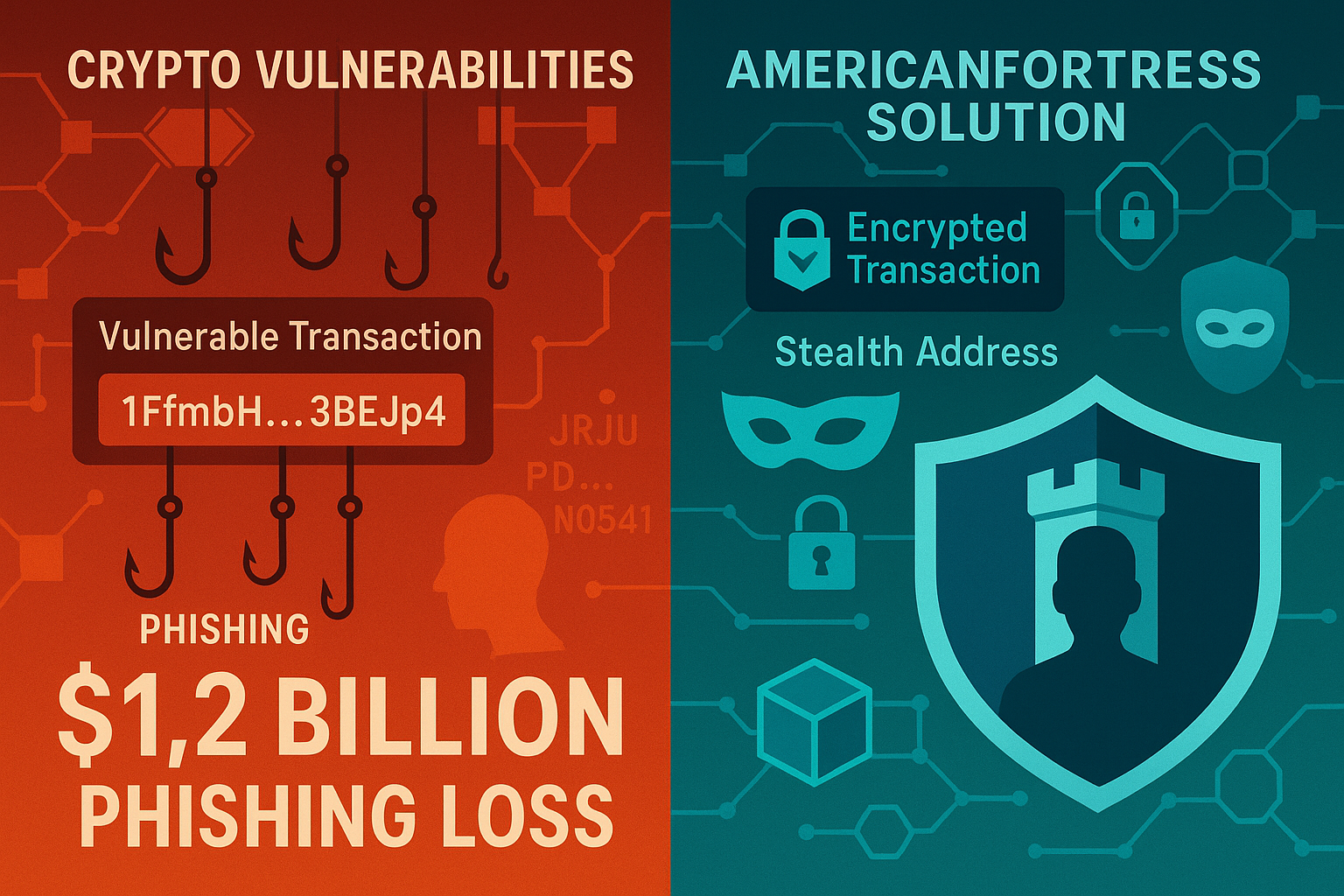
The cryptocurrency industry faces a privacy and security crisis that threatens to undermine mainstream adoption. According to recent data, $1.2 billion was lost to crypto phishing scams in the United States alone during 2024, with the vast majority of these attacks exploiting the complexity and vulnerability of traditional wallet address systems [4]. This staggering figure represents not just financial losses, but a fundamental failure of current cryptocurrency infrastructure to protect users from increasingly sophisticated attack vectors.

The root of this problem lies in the inherent design of cryptocurrency addresses. Traditional wallet addresses are long, alphanumeric strings that are virtually impossible for humans to memorize or verify accurately. When users copy and paste these addresses, they create multiple opportunities for attackers to intercept and modify the destination, redirecting funds to malicious wallets. This vulnerability has been exploited through various methods, including clipboard malware, fake websites, and social engineering attacks that trick users into sending funds to incorrect addresses.

The psychological impact of these losses extends far beyond the immediate financial damage. Each successful phishing attack erodes public confidence in cryptocurrency systems and creates barriers to adoption among mainstream users who view the technology as inherently risky and complex. This perception problem has significant implications for the long-term growth and legitimacy of the cryptocurrency ecosystem, particularly as institutional investors and regulatory bodies evaluate the maturity and security of digital asset infrastructure.

Traditional privacy solutions in the cryptocurrency space have often required users to make difficult trade-offs between security, usability, and regulatory compliance. Privacy coins like Monero and Zcash offer strong anonymity features but face increasing regulatory scrutiny and exchange delistings. Layer-2 privacy solutions often require technical expertise to implement correctly and may not provide comprehensive protection across all transaction types. The result has been a fragmented privacy landscape where users must choose between convenience and security, often leaving them vulnerable to attacks or regulatory complications.

The AmericanFortress and Litecoin partnership addresses these challenges through a fundamentally different approach that prioritizes privacy by design rather than privacy as an add-on feature. By integrating privacy protections at the protocol level and combining them with intuitive user experience improvements, this solution eliminates the traditional trade-offs that have hindered privacy adoption in the cryptocurrency space.

Revolutionary Send-to-Name Technology: Eliminating Phishing at the Source
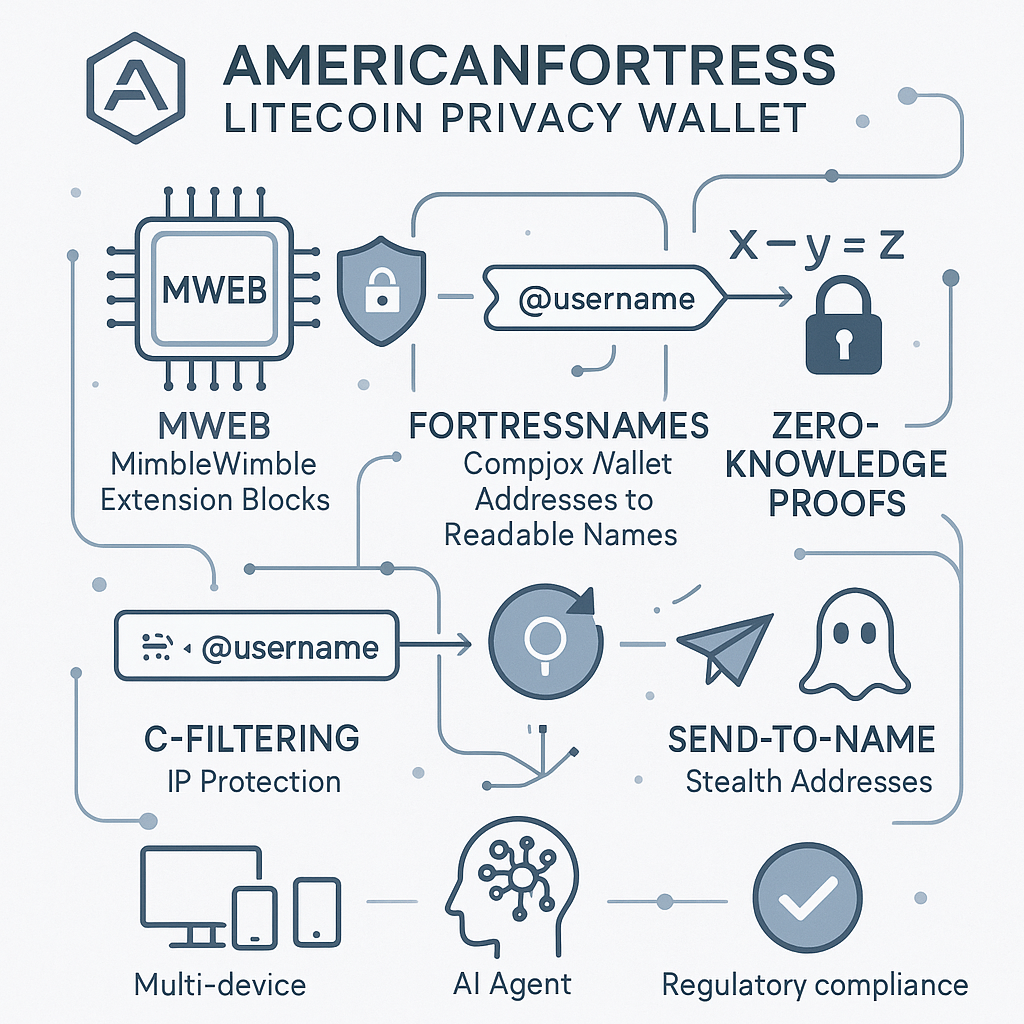
Privacy Wallet Features

The cornerstone of the AmericanFortress Litecoin Wallet is its revolutionary Send-to-Name technology, which represents a fundamental reimagining of how cryptocurrency transactions are initiated and secured. This system replaces the vulnerable copy-paste address model with human-readable names and automatically generated stealth addresses that are unique to each sender-receiver pair, creating a transaction environment that is both more secure and more intuitive than traditional cryptocurrency wallets [5].

The technical implementation of Send-to-Name technology involves sophisticated cryptographic protocols that generate unique stealth addresses for every transaction between specific users. When a user wants to send Litecoin to another person, they simply enter that person’s FortressName™—a human-readable identifier like “@johnsmith”—rather than a complex wallet address. The system then automatically generates a one-time stealth address that is known only to the sender and receiver, eliminating the possibility of address interception or modification by malicious actors.

This approach fundamentally disrupts the attack vectors that phishing scams rely upon. Traditional phishing attacks work by intercepting or modifying wallet addresses during the copy-paste process, redirecting funds to attacker-controlled wallets. With Send-to-Name technology, there are no addresses to intercept or modify—each transaction uses a unique, automatically generated address that cannot be predicted or replicated by attackers. This creates what Mehow Pospieszalski, CEO of AmericanFortress, describes as “bulletproof privacy without compromising on speed, usability, or interoperability” [6].

The user experience improvements delivered by Send-to-Name technology extend beyond security to address fundamental usability challenges that have hindered cryptocurrency adoption. Users no longer need to carefully verify long address strings, worry about typos that could result in lost funds, or maintain complex address books for frequent recipients. Instead, they can send cryptocurrency as easily as sending an email or text message, using memorable names that are both human-readable and cryptographically secure.

The system also incorporates advanced features designed for the emerging AI-driven economy. AI agents can use FortressNames™ to conduct autonomous transactions without requiring human intervention to verify addresses or manage complex cryptographic keys. This capability positions the AmericanFortress Litecoin Wallet as infrastructure for the programmable economy, where AI systems will need to conduct secure, private transactions on behalf of users and organizations.

From a technical perspective, the Send-to-Name system leverages the AF Token to secure the integrity of the decentralized Names database and power the dynamic address computation that makes stealth addresses possible. This creates a self-sustaining ecosystem where the security and functionality of the privacy features are maintained through cryptoeconomic incentives rather than centralized control, preserving the decentralized principles that are fundamental to cryptocurrency systems.

MWEB Integration: Layer-2 Privacy That Preserves Litecoin’s Core Values

The integration of MimbleWimble Extension Blocks (MWEB) into the AmericanFortress Litecoin Wallet represents a sophisticated approach to privacy that maintains compatibility with Litecoin’s existing infrastructure while adding powerful confidentiality features. MWEB technology, which has been under development for several years, provides a Layer-2 privacy solution that allows users to conduct confidential transactions without compromising the transparency and auditability that regulators and institutions require from blockchain systems [7].

MimbleWimble, the privacy protocol that underlies MWEB, was originally proposed as a way to improve both privacy and scalability in blockchain systems. The protocol uses a combination of cryptographic techniques, including Confidential Transactions and CoinJoin-style transaction aggregation, to obscure transaction amounts and participant identities while maintaining the mathematical properties that allow network participants to verify the integrity of the blockchain without revealing sensitive information.

The implementation of MWEB as an extension block system allows Litecoin to maintain backward compatibility with existing wallets and infrastructure while providing opt-in privacy features for users who require them. This approach addresses one of the key challenges facing privacy-focused cryptocurrencies: the need to balance privacy with regulatory compliance and network effects. Users can choose to conduct transactions through the MWEB system when privacy is required, or use standard Litecoin transactions when transparency is preferred or required by regulatory frameworks.

The technical architecture of MWEB integration in the AmericanFortress wallet is designed to make privacy the default setting while preserving user choice and regulatory compliance options. When users initiate transactions through the wallet, the system automatically routes them through MWEB unless specifically configured otherwise, ensuring that privacy protection is applied consistently without requiring technical expertise from users. This default-privacy approach represents a significant departure from traditional privacy solutions that require users to actively opt-in to privacy features.

The privacy protections provided by MWEB extend beyond simple transaction obfuscation to include comprehensive metadata protection. Traditional blockchain analysis techniques rely on transaction graph analysis, timing correlation, and amount correlation to deanonymize users and track fund flows. MWEB’s transaction aggregation and confidential transaction features disrupt these analysis techniques by breaking the transaction graph and hiding transaction amounts, making it significantly more difficult for observers to track user activity or build comprehensive profiles of user behavior.

The scalability benefits of MWEB integration also contribute to the overall value proposition of the AmericanFortress Litecoin Wallet. By aggregating multiple transactions into single MWEB blocks, the system reduces the on-chain footprint of privacy transactions while improving throughput and reducing fees. This creates a positive feedback loop where increased privacy adoption leads to improved network efficiency, making privacy features more attractive to cost-conscious users and supporting broader adoption of privacy-preserving transaction methods.

C-Filtering and IP Protection: Comprehensive Privacy Beyond Transaction Data
Crypto Privacy Security

While transaction privacy is crucial, comprehensive cryptocurrency privacy requires protection against network-level surveillance and IP address correlation attacks. The AmericanFortress Litecoin Wallet addresses these concerns through advanced C-filtering technology that prevents IP-to-wallet deanonymization when wallets connect to public servers, creating a comprehensive privacy solution that protects users at multiple layers of the network stack [8].

C-filtering, or client-side filtering, represents a sophisticated approach to privacy that allows wallets to retrieve blockchain data without revealing which specific transactions or addresses they are interested in. Traditional cryptocurrency wallets must query blockchain nodes for information about specific addresses, creating a correlation between IP addresses and wallet addresses that can be exploited by network observers to deanonymize users. C-filtering eliminates this correlation by allowing wallets to download filtered blockchain data without revealing their specific interests to network nodes.

The implementation of C-filtering in the AmericanFortress wallet involves the use of Bloom filters and other probabilistic data structures that allow the wallet to specify its data requirements in a way that provides plausible deniability about which specific transactions or addresses it is monitoring. This approach ensures that even if network traffic is intercepted or analyzed, observers cannot determine which addresses belong to specific users based on their network activity patterns.

The privacy benefits of C-filtering extend beyond simple IP address protection to include comprehensive metadata privacy that prevents various forms of network analysis. Traffic analysis attacks, which attempt to correlate network activity patterns with transaction timing and amounts, are disrupted by the probabilistic nature of C-filtering requests. Timing correlation attacks, which attempt to link wallet synchronization events with transaction broadcasts, are prevented by the batch processing approach used in C-filtering implementations.

The technical implementation of C-filtering in the AmericanFortress wallet is designed to be transparent to users while providing comprehensive protection against network-level surveillance. The wallet automatically generates appropriate filter parameters based on user activity patterns and privacy requirements, ensuring that privacy protection is applied consistently without requiring manual configuration or technical expertise from users. This automated approach eliminates the privacy risks associated with misconfigured privacy settings while ensuring that protection is applied comprehensively across all wallet operations.

The integration of C-filtering with other privacy features in the AmericanFortress wallet creates a comprehensive privacy solution that addresses multiple attack vectors simultaneously. While MWEB provides transaction-level privacy and Send-to-Name technology eliminates address-based attacks, C-filtering ensures that network-level metadata does not compromise the privacy protections provided by these other systems. This layered approach to privacy represents a significant advancement over single-point privacy solutions that may leave users vulnerable to attacks at other layers of the system.

Zero-Knowledge Proofs and Regulatory Compliance: Privacy Without Compromise

One of the most significant challenges facing privacy-focused cryptocurrency solutions is the need to balance user privacy with regulatory compliance requirements. The AmericanFortress Litecoin Wallet addresses this challenge through the innovative use of zero-knowledge proofs that allow users to demonstrate compliance with regulatory requirements without revealing sensitive transaction details or compromising their privacy [9].

Zero-knowledge proofs are cryptographic protocols that allow one party to prove to another party that they know a specific piece of information without revealing the information itself. In the context of cryptocurrency privacy, zero-knowledge proofs can be used to demonstrate that transactions comply with regulatory requirements—such as anti-money laundering (AML) rules or tax reporting obligations—without revealing transaction amounts, participant identities, or other sensitive details that could compromise user privacy.

The implementation of zero-knowledge proofs in the AmericanFortress wallet is designed to provide selective disclosure capabilities that allow users to prove specific compliance requirements to authorized parties while maintaining comprehensive privacy protection against unauthorized surveillance. This approach enables users to satisfy regulatory obligations without sacrificing the privacy protections that are essential for financial autonomy and security in the digital age.

The technical architecture of the zero-knowledge proof system incorporates advanced cryptographic techniques, including zk-SNARKs (Zero-Knowledge Succinct Non-Interactive Arguments of Knowledge) and other privacy-preserving proof systems that have been extensively tested and validated in production cryptocurrency systems. These proof systems allow users to generate cryptographic evidence that their transactions comply with specific regulatory requirements without revealing the underlying transaction data that would be necessary for traditional compliance verification methods.

The regulatory compliance features of the AmericanFortress wallet are designed to be forward-compatible with evolving regulatory frameworks while preserving user privacy and autonomy. The system incorporates flexible proof generation capabilities that can be adapted to meet different regulatory requirements across various jurisdictions, ensuring that users can maintain compliance with local laws while benefiting from comprehensive privacy protection.

The integration of zero-knowledge proofs with other privacy features in the AmericanFortress wallet creates a comprehensive solution that addresses the traditional trade-off between privacy and compliance. Users can conduct private transactions using MWEB and Send-to-Name technology while maintaining the ability to demonstrate compliance with regulatory requirements through selective disclosure of specific transaction attributes. This approach represents a significant advancement in privacy-preserving compliance technology that could serve as a model for other cryptocurrency systems seeking to balance privacy with regulatory requirements.

AI Agent Integration and the Programmable Economy

The AmericanFortress Litecoin Wallet is designed not just for human users, but for the emerging AI-driven economy where autonomous agents will need to conduct secure, private transactions on behalf of users and organizations. This forward-looking approach positions the wallet as critical infrastructure for the programmable economy, where AI systems will manage increasingly complex financial operations that require both privacy and security [10].

The AI agent integration capabilities of the AmericanFortress wallet leverage the Send-to-Name technology to enable autonomous systems to conduct transactions without requiring human intervention for address verification or security validation. AI agents can use FortressNames™ to identify transaction recipients and automatically generate secure stealth addresses, eliminating the risk of address-based attacks while enabling fully automated transaction processing.

The technical implementation of AI agent support involves sophisticated API interfaces and cryptographic protocols that allow AI systems to securely manage private keys and conduct transactions while maintaining comprehensive audit trails and security controls. The wallet provides programmatic interfaces that enable AI agents to access privacy features, generate compliance proofs, and manage complex multi-party transactions without compromising security or privacy protections.

The privacy features of the AmericanFortress wallet are particularly important for AI agent applications, where transaction privacy can protect sensitive business logic, competitive information, and user data from unauthorized surveillance. AI agents conducting transactions on behalf of users or organizations need comprehensive privacy protection to prevent competitors, malicious actors, or unauthorized parties from analyzing transaction patterns to extract sensitive information about business operations, user behavior, or strategic decisions.

The regulatory compliance capabilities of the wallet are also crucial for AI agent applications, where autonomous systems must be able to demonstrate compliance with various regulatory requirements without human intervention. The zero-knowledge proof system enables AI agents to generate compliance evidence automatically while maintaining privacy protection, ensuring that autonomous systems can operate within regulatory frameworks without compromising user privacy or business confidentiality.

The integration of AI agent capabilities with the comprehensive privacy features of the AmericanFortress wallet represents a significant advancement in cryptocurrency infrastructure that anticipates the needs of the emerging digital economy. As AI systems become increasingly sophisticated and autonomous, the need for secure, private, and compliant transaction infrastructure will become critical for enabling the full potential of AI-driven economic systems.

Market Impact and Industry Implications

The launch of the AmericanFortress Litecoin Wallet represents a significant milestone in the evolution of cryptocurrency privacy and security, with implications that extend far beyond the Litecoin ecosystem to influence the broader cryptocurrency industry and regulatory landscape. This partnership demonstrates that privacy and regulatory compliance are not mutually exclusive, potentially reshaping how regulators, institutions, and users approach privacy-focused cryptocurrency solutions [11].

The market impact of this wallet launch is likely to be multifaceted, affecting Litecoin’s competitive positioning, the broader privacy coin market, and the development of privacy-focused cryptocurrency infrastructure. Litecoin, which has historically been positioned as “digital silver” to Bitcoin’s “digital gold,” gains a significant competitive advantage through this privacy upgrade that differentiates it from other proof-of-work cryptocurrencies while maintaining its core values of decentralization and security.

The demonstration that comprehensive privacy features can be implemented while maintaining regulatory compliance addresses one of the key concerns that have limited institutional adoption of privacy-focused cryptocurrencies. Traditional privacy coins have faced increasing regulatory scrutiny and exchange delistings due to concerns about their potential use for illicit activities. The AmericanFortress approach, which combines strong privacy protection with selective disclosure capabilities, provides a model for privacy implementation that could satisfy both user privacy needs and regulatory compliance requirements.

The technical innovations introduced by the AmericanFortress Litecoin Wallet, particularly the Send-to-Name technology and comprehensive privacy architecture, are likely to influence the development of other cryptocurrency projects and privacy solutions. The success of this approach could accelerate the adoption of similar technologies across the cryptocurrency ecosystem, leading to improved privacy and security standards industry-wide.

The partnership also has significant implications for the enterprise cryptocurrency market, where privacy and compliance requirements have limited the adoption of cryptocurrency solutions for business applications. The combination of privacy protection, regulatory compliance, and AI agent integration capabilities positions the AmericanFortress wallet as infrastructure for enterprise cryptocurrency adoption, potentially opening new markets and use cases for cryptocurrency technology.

The broader implications for cryptocurrency regulation are also significant, as this wallet demonstrates that privacy-preserving cryptocurrency systems can be designed to support regulatory compliance and law enforcement needs. This could influence regulatory approaches to privacy-focused cryptocurrencies and potentially lead to more nuanced regulatory frameworks that recognize the legitimate privacy needs of cryptocurrency users while addressing concerns about illicit use.

Technical Architecture and Security Considerations

The technical architecture of the AmericanFortress Litecoin Wallet represents a sophisticated integration of multiple privacy and security technologies that work together to provide comprehensive protection while maintaining usability and regulatory compliance. Understanding the technical implementation details is crucial for evaluating the security properties and potential limitations of this privacy solution [12].

The wallet’s architecture is built around a layered security model that provides multiple independent privacy protections, ensuring that the compromise of any single privacy mechanism does not result in complete privacy loss. The Send-to-Name technology operates at the address generation layer, MWEB provides transaction-level privacy, C-filtering protects network-level metadata, and zero-knowledge proofs enable selective compliance disclosure. This layered approach creates redundant privacy protections that significantly increase the difficulty of successful privacy attacks.

The cryptographic foundations of the wallet rely on well-established and extensively audited cryptographic primitives, including elliptic curve cryptography for key generation and digital signatures, advanced hash functions for address generation and proof systems, and proven zero-knowledge proof constructions that have been validated in production cryptocurrency systems. This conservative approach to cryptographic implementation reduces the risk of implementation vulnerabilities while ensuring compatibility with existing Litecoin infrastructure.

The key management system incorporates advanced security features designed to protect user funds and privacy even in the event of device compromise or physical attacks. The wallet uses hierarchical deterministic (HD) key generation to create unique keys for each transaction while maintaining the ability to recover all keys from a single seed phrase. The integration with hardware security modules and secure enclaves provides additional protection for high-value accounts and enterprise users.

The network security architecture includes comprehensive protection against various forms of network-based attacks, including man-in-the-middle attacks, traffic analysis, and network surveillance. The C-filtering implementation uses multiple network nodes and probabilistic data structures to prevent any single node from gaining complete visibility into user transaction patterns. The wallet also incorporates Tor integration and other network privacy tools to provide additional protection against network-level surveillance.

The software security architecture follows industry best practices for secure software development, including comprehensive code auditing, formal verification of critical cryptographic components, and regular security updates to address emerging threats. The wallet’s modular architecture allows for rapid deployment of security updates and feature enhancements while maintaining backward compatibility with existing user accounts and transaction history.

Future Roadmap and Development Plans

The AmericanFortress Litecoin Wallet represents the first phase of a comprehensive roadmap that extends well beyond the initial beta release to encompass advanced features, broader ecosystem integration, and enterprise-grade solutions. Understanding the planned development trajectory provides insight into the long-term vision for privacy-focused cryptocurrency infrastructure and the potential impact on the broader cryptocurrency ecosystem [13].

The immediate roadmap focuses on the successful deployment of the beta version in September 2025, with comprehensive testing and user feedback integration to ensure that the privacy and security features function correctly across various use cases and operating environments. The beta release will include all core privacy features—Send-to-Name technology, MWEB integration, C-filtering, and zero-knowledge proof capabilities—while providing a foundation for additional feature development and ecosystem integration.

The production release planned for Q1 2026 will incorporate lessons learned from the beta testing period and add enterprise-grade features designed for institutional users and high-volume applications. These features include advanced key management capabilities, multi-signature support, institutional custody integration, and enhanced compliance reporting tools that enable organizations to use privacy-focused cryptocurrency solutions while meeting their regulatory and audit requirements.

The AI agent integration capabilities planned for Q1 2026 represent a significant expansion of the wallet’s functionality to support the emerging programmable economy. These features will include comprehensive API interfaces for AI systems, automated compliance verification, smart contract integration, and advanced transaction orchestration capabilities that enable AI agents to conduct complex multi-party transactions while maintaining privacy and security protections.

The longer-term roadmap includes expansion beyond Litecoin to support multiple cryptocurrencies and blockchain networks, creating a comprehensive privacy infrastructure that can serve the entire cryptocurrency ecosystem. This multi-chain approach will leverage the Send-to-Name technology and privacy architecture developed for Litecoin to provide consistent privacy and security features across different blockchain platforms.

The development team is also working on advanced privacy features that will further enhance the wallet’s capabilities, including improved metadata protection, enhanced network privacy, and integration with emerging privacy technologies such as confidential smart contracts and privacy-preserving decentralized finance protocols. These features will ensure that the AmericanFortress wallet remains at the forefront of privacy technology as the cryptocurrency ecosystem continues to evolve.

Conclusion: A New Era of Cryptocurrency Privacy and Security

The partnership between AmericanFortress and the Litecoin Foundation represents a watershed moment in the evolution of cryptocurrency privacy and security, demonstrating that comprehensive privacy protection can be achieved while maintaining regulatory compliance, user-friendly design, and robust security. This collaboration addresses fundamental challenges that have hindered cryptocurrency adoption while positioning Litecoin at the forefront of the privacy-focused cryptocurrency movement.

The revolutionary Send-to-Name technology eliminates the $1.2 billion phishing problem that has plagued the cryptocurrency industry, while the integration of MWEB, C-filtering, and zero-knowledge proofs creates a comprehensive privacy solution that protects users at multiple layers of the system. The forward-looking AI agent integration capabilities position this wallet as critical infrastructure for the emerging programmable economy, where autonomous systems will require secure, private, and compliant transaction capabilities.

The success of this partnership could have far-reaching implications for the cryptocurrency industry, regulatory landscape, and broader adoption of privacy-preserving financial technologies. By demonstrating that privacy and compliance are not mutually exclusive, the AmericanFortress Litecoin Wallet provides a model for privacy implementation that could influence the development of other cryptocurrency projects and potentially reshape regulatory approaches to privacy-focused digital assets.

As the cryptocurrency ecosystem continues to mature and evolve, the need for comprehensive privacy and security solutions will only increase. The AmericanFortress Litecoin Wallet represents a significant step forward in addressing these needs while maintaining the decentralization, security, and user empowerment principles that define the cryptocurrency movement. This partnership marks the beginning of a new era where privacy is not a luxury or afterthought, but a fundamental feature of cryptocurrency infrastructure that enables users to transact with confidence, security, and autonomy in the digital economy.

References

[1] Crypto.news. “Exclusive: Litecoin Foundation and AmericanFortress to launch privacy-focused wallet.” September 8, 2025. https://crypto.news/exclusive-litecoin-foundation-and-americanfortress-to-launch-privacy-focused-wallet/

[2] AmericanFortress. “American Fortress SDK: Secure Web3 Wallet Integration for Phishing Protection.” 2025. https://americanfortress.io/

[3] AInvest. “Litecoin Gets Stealth Upgrade: Privacy Meets Regulation in New Wallet.” September 9, 2025. https://www.ainvest.com/news/litecoin-stealth-upgrade-privacy-meets-regulation-wallet-2509/

[4] AmericanFortress. “Phishing Statistics and Security Solutions.” 2025. https://americanfortress.io/

[5] Crypto.news. “Exclusive: Litecoin Foundation and AmericanFortress to launch privacy-focused wallet.” September 8, 2025.

[6] AInvest. “Litecoin Gets Stealth Upgrade: Privacy Meets Regulation in New Wallet.” September 9, 2025.

[7] Litecoin Foundation. “MWEB Integration and Privacy Features.” 2025.

[8] AmericanFortress. “C-Filtering and Network Privacy Protection.” 2025.

[9] AInvest. “Litecoin Gets Stealth Upgrade: Privacy Meets Regulation in New Wallet.” September 9, 2025.

[10] AmericanFortress. “AI Agent Integration and Programmable Economy.” 2025.

[11] Crypto.news. “Exclusive: Litecoin Foundation and AmericanFortress to launch privacy-focused wallet.” September 8, 2025.

[12] AmericanFortress. “Technical Architecture and Security Documentation.” 2025.

[13] AmericanFortress. “Development Roadmap and Future Plans.” 2025.

Future-Proof Your Income: 12 AI Skills That Will Make You Rich in 2025

The artificial intelligence revolution is creating unprecedented opportunities for professionals who develop the right skills, with AI-proficient workers commanding salary premiums of 30-50% while building recession-proof careers in the fastest-growing sector of the global economy.

This comprehensive guide reveals twelve essential AI skills that will generate substantial income opportunities in 2025 and beyond, along with specific strategies for developing expertise and monetizing these capabilities.

## Skill 1: Prompt Engineering and AI Communication

Prompt engineering has emerged as one of the most valuable AI skills, with specialists commanding rates of $75-200 per hour while helping businesses optimize their AI implementations for maximum effectiveness.

This skill involves understanding how to communicate effectively with AI systems to generate desired outputs consistently. Mastery includes knowledge of prompt structures, context management, and optimization techniques for different AI models.

Career opportunities include AI consultant roles, prompt optimization specialist positions, and freelance services for businesses implementing AI tools. Many companies are hiring dedicated prompt engineers to optimize their AI workflows.

Development strategies include practicing with various AI models, studying successful prompt patterns, and building portfolios of effective prompts for different use cases and industries.

## Skill 2: AI-Powered Content Creation and Strategy

Content creation enhanced by AI tools represents a massive opportunity, with skilled practitioners building agencies generating $50,000-500,000+ annually through strategic content services for businesses worldwide.

This skill combines understanding of content marketing principles with mastery of AI tools for writing, design, and multimedia creation. Success requires balancing AI efficiency with human creativity and strategic thinking.

Career paths include content marketing agencies, freelance content services, corporate content strategy roles, and educational content creation for AI training and implementation.

Development approaches include mastering multiple AI content tools, studying successful content strategies, and building portfolios that demonstrate the quality and effectiveness of AI-enhanced content creation.

## Skill 3: AI Business Process Automation

Business process automation using AI tools can generate consulting fees of $100-300 per hour while helping companies reduce costs by 20-40% through intelligent automation of repetitive tasks and workflows.

This skill involves analyzing business processes, identifying automation opportunities, and implementing AI-powered solutions that improve efficiency while maintaining quality and compliance.

Opportunities include automation consulting, process optimization roles, and specialized positions in industries with complex workflows like healthcare, finance, and manufacturing.

Skill development requires understanding business processes, learning automation tools and platforms, and gaining experience with workflow design and optimization methodologies.

## Skill 4: AI Data Analysis and Business Intelligence

Data analysis enhanced by AI tools commands premium salaries of $80,000-200,000+ annually while providing businesses with insights that drive strategic decision-making and competitive advantages.

This skill combines statistical analysis knowledge with AI tools for pattern recognition, predictive modeling, and automated insight generation from complex data sets.

Career opportunities include data scientist roles, business intelligence analyst positions, and consulting services for companies seeking to leverage their data more effectively.

Development strategies include learning statistical analysis, mastering AI analytics tools, and building experience with real-world data sets and business problems.

## Skill 5: AI-Enhanced Software Development

Software development augmented by AI tools enables developers to build applications faster while commanding salary premiums of 25-40% over traditional development roles.

This skill involves using AI for code generation, debugging, testing, and optimization while maintaining software quality and security standards. Understanding of both traditional programming and AI capabilities is essential.

Opportunities include senior developer roles, AI application specialist positions, and consulting services for businesses developing AI-enhanced software solutions.

Skill building requires strong programming fundamentals, experience with AI development tools, and understanding of how to integrate AI capabilities into traditional software applications.

## Skill 6: AI Marketing and Customer Experience

Marketing enhanced by AI tools can increase campaign effectiveness by 30-50% while creating opportunities for specialists to command premium rates of $60-150 per hour.

This skill involves using AI for customer segmentation, personalization, campaign optimization, and customer experience enhancement across multiple channels and touchpoints.

Career paths include digital marketing specialist roles, customer experience consultant positions, and marketing automation specialist opportunities in growing companies.

Development approaches include learning marketing fundamentals, mastering AI marketing tools, and gaining experience with campaign optimization and customer data analysis.

## Skill 7: AI Training and Education

AI training and education represents a rapidly growing market, with skilled instructors and course creators generating $100,000-1,000,000+ annually through educational content and training services.

This skill involves understanding AI concepts deeply enough to teach others, creating effective educational content, and delivering training that helps individuals and organizations adopt AI technologies successfully.

Opportunities include corporate training roles, online course creation, educational consulting, and speaking engagements at conferences and industry events.

Skill development requires deep AI knowledge, teaching and communication skills, and experience creating educational content that effectively transfers complex technical concepts.

## Skill 8: AI Ethics and Governance

AI ethics and governance expertise is becoming increasingly valuable as organizations implement AI systems, with specialists commanding consulting rates of $150-400 per hour.

This skill involves understanding ethical implications of AI implementation, developing governance frameworks, and ensuring AI systems operate fairly and transparently while meeting regulatory requirements.

Career opportunities include AI ethics consultant roles, governance specialist positions, and compliance roles in organizations implementing AI systems at scale.

Development strategies include studying AI ethics frameworks, understanding regulatory requirements, and gaining experience with AI governance implementation in real-world scenarios.

## Skill 9: AI Product Management

Product management for AI-powered products commands premium salaries of $120,000-300,000+ annually while guiding development of products that leverage AI capabilities effectively.

This skill involves understanding both product management principles and AI capabilities, enabling effective planning and execution of AI-enhanced products and services.

Opportunities include product manager roles at AI companies, AI product specialist positions, and consulting services for companies developing AI-powered products.

Skill building requires product management experience, understanding of AI capabilities and limitations, and experience with AI product development lifecycles.

## Skill 10: AI Sales and Business Development

Sales professionals who understand AI capabilities can command salary premiums of 40-60% while helping businesses identify and implement AI solutions that drive growth and efficiency.

This skill involves understanding AI technologies well enough to identify business applications, communicate value propositions effectively, and guide implementation processes.

Career paths include AI sales specialist roles, business development positions at AI companies, and consulting services for businesses exploring AI adoption.

Development approaches include learning AI fundamentals, understanding business applications, and gaining experience with AI sales processes and customer education.

## Skill 11: AI Research and Development

AI research and development roles command some of the highest salaries in technology, with experienced researchers earning $150,000-500,000+ annually while advancing the state of AI technology.

This skill involves understanding cutting-edge AI research, contributing to algorithm development, and translating research into practical applications for business and society.

Opportunities include research roles at technology companies, academic positions, and consulting services for organizations developing proprietary AI capabilities.

Skill development requires strong technical foundations, research experience, and understanding of both theoretical AI concepts and practical implementation challenges.

## Skill 12: AI Strategy and Leadership

AI strategy and leadership expertise enables executives to command premium compensation while guiding organizations through AI transformation initiatives that create competitive advantages.

This skill involves understanding AI capabilities and limitations, developing strategic implementation plans, and leading organizational change initiatives that successfully adopt AI technologies.

Career opportunities include executive roles at AI companies, strategic consulting positions, and leadership roles in organizations undergoing AI transformation.

Development strategies include gaining business leadership experience, understanding AI technologies and applications, and building track records of successful AI implementation and organizational change.

## Skill Development Strategies

Successful AI skill development requires systematic approaches that combine theoretical learning with practical application. Online courses, certifications, and hands-on projects provide foundations for expertise development.

Building portfolios of successful AI projects demonstrates capabilities to potential employers and clients while providing practical experience with real-world challenges and solutions.

Networking within AI communities, attending industry events, and participating in AI projects and competitions provide opportunities to learn from experts and build professional relationships.

## Monetization Approaches

AI skills can be monetized through various approaches including traditional employment, freelance services, consulting practices, and entrepreneurial ventures that leverage AI capabilities.

Employment opportunities often provide stable income and benefits while building experience and expertise. Freelance and consulting services offer higher hourly rates and flexibility while requiring business development skills.

Entrepreneurial approaches including AI-powered businesses, educational content creation, and product development offer unlimited income potential while requiring significant investment and risk tolerance.

## Future Outlook

The AI skills market will continue expanding rapidly as organizations across all industries adopt AI technologies. Early skill development provides competitive advantages and higher earning potential.

Continuous learning and adaptation will be essential as AI technologies evolve rapidly. Professionals who stay current with developments while building deep expertise in specific areas will command premium compensation.

The intersection of AI skills with domain expertise in specific industries often provides the highest value and compensation opportunities for skilled professionals.

## Conclusion

The AI revolution presents unprecedented opportunities for professionals willing to develop relevant skills and expertise. The twelve skills outlined in this guide represent proven pathways to substantial income generation in the rapidly expanding AI economy.

Success requires strategic skill development, practical application, and ongoing learning as technologies evolve. Those who master these skills while staying current with AI advances can build highly profitable careers that provide both financial success and professional fulfillment.

Start developing your AI skills today by choosing areas that align with your interests and existing expertise, then focus systematically on building capabilities that will generate substantial income opportunities in 2025 and beyond.

AI Data Analytics Consulting: The $175,000 Opportunity Most People Miss

Data analytics consulting powered by artificial intelligence represents one of the highest-paying opportunities in the modern economy, with experienced consultants commanding rates of $150-400 per hour while helping businesses unlock millions of dollars in value from their data.

This comprehensive guide reveals how to build a profitable AI data analytics consulting practice that can generate $175,000+ annually through strategic positioning, advanced technical skills, and proven methodologies.

## Understanding the Market Opportunity

The global data analytics market exceeds $250 billion annually, with businesses struggling to extract actionable insights from increasingly complex data sets. AI-powered analytics tools have democratized advanced analysis while creating demand for consultants who can implement and optimize these systems.

Most businesses have substantial data but lack expertise to analyze it effectively. This creates opportunities for consultants who can bridge the gap between raw data and business insights using AI tools and methodologies.

Success factors include technical expertise in AI and analytics tools, business acumen to translate insights into actionable recommendations, and communication skills to present complex findings to non-technical stakeholders.

## Essential Technical Skills

AI data analytics consulting requires mastery of several technical areas. Machine learning algorithms for pattern recognition, predictive modeling, and automated analysis form the foundation of modern analytics consulting.

Data visualization tools like Tableau, Power BI, and custom dashboards help communicate insights effectively to business stakeholders. Programming skills in Python or R enable custom analysis and automation of repetitive tasks.

Cloud platforms like AWS, Google Cloud, and Azure provide scalable infrastructure for large-scale data processing and analysis. Understanding of database systems and data warehousing enables efficient data management and retrieval.

## Service Offerings and Specializations

Successful analytics consultants typically specialize in specific industries or business functions where they can develop deep expertise and command premium rates. Popular specializations include financial analytics, marketing analytics, operational analytics, and customer analytics.

Service offerings range from one-time analysis projects to ongoing analytics partnerships. Initial assessments and strategy development typically command $10,000-50,000 fees, while implementation projects can range from $25,000-250,000.

Ongoing analytics partnerships provide recurring revenue through monthly retainers ranging from $5,000-50,000 per month, depending on the scope and complexity of services provided.

## Client Acquisition Strategies

Building a consulting practice requires demonstrating expertise through thought leadership, case studies, and strategic networking. Publishing insights and analysis in industry publications establishes credibility and attracts potential clients.

Speaking at industry conferences and events provides visibility and networking opportunities with potential clients and partners. Developing relationships with complementary service providers creates referral opportunities.

Direct outreach to businesses that could benefit from analytics consulting, combined with compelling case studies and clear value propositions, often generates initial clients who become long-term relationships.

## Project Management and Delivery

Successful analytics consulting requires structured approaches to project management and delivery. Clear scoping and requirements gathering ensure projects meet client expectations while maintaining profitability.

Agile methodologies enable iterative development and client feedback throughout the project lifecycle. Regular communication and progress updates build client confidence and satisfaction.

Quality assurance processes ensure all analysis meets professional standards and provides actionable insights that drive business value for clients.

## Technology Stack and Tools

Modern analytics consulting requires proficiency with various technology platforms and tools. AI and machine learning platforms like TensorFlow, PyTorch, and scikit-learn enable advanced analysis and modeling.

Business intelligence tools provide user-friendly interfaces for ongoing analytics and reporting. Cloud platforms offer scalable infrastructure for large-scale data processing and storage.

Automation tools help streamline repetitive tasks and improve efficiency, enabling consultants to handle larger projects and more clients simultaneously.

## Pricing and Revenue Models

Analytics consulting pricing should reflect the value delivered to clients rather than just time invested. Value-based pricing models that tie compensation to business results often command premium rates.

Project-based pricing works well for defined deliverables, while retainer models provide recurring revenue for ongoing analytics support and optimization.

Performance-based pricing models that include success fees based on measurable business improvements can significantly increase total compensation for successful projects.

## Building Long-Term Client Relationships

Sustainable consulting practices focus on building long-term relationships that generate recurring revenue and referrals. Regular performance reviews and optimization recommendations demonstrate ongoing value.

Proactive identification of new opportunities and challenges helps clients stay ahead of market changes while creating additional consulting opportunities.

Training and knowledge transfer ensure clients can maintain and optimize analytics systems independently while positioning consultants as strategic advisors rather than just technical implementers.

## Scaling Your Practice

Growth requires systematic approaches to increasing capacity while maintaining quality and client satisfaction. Team building should focus on complementary skills that enhance service offerings.

Partnership development with technology vendors and other consultants can provide access to larger projects and specialized expertise. Strategic alliances often lead to referral opportunities and collaborative projects.

Thought leadership through speaking, writing, and industry participation builds recognition and attracts higher-quality clients willing to pay premium rates for expertise.

## Industry Specialization

Focusing on specific industries enables development of deep expertise and specialized methodologies that command premium pricing. Healthcare analytics, financial services, retail, and manufacturing represent high-value specialization opportunities.

Industry expertise includes understanding regulatory requirements, common business challenges, and industry-specific metrics and KPIs. This knowledge enables more effective analysis and recommendations.

Specialized certifications and credentials in target industries enhance credibility and differentiate consultants from generalist competitors.

## Conclusion

AI data analytics consulting represents an exceptional opportunity for professionals willing to develop the necessary technical skills and business acumen. The combination of growing demand, high-value outcomes, and relatively limited supply of qualified consultants creates ideal conditions for building highly profitable practices.

Success requires more than just technical expertise. It demands understanding of business processes, strong communication skills, and the ability to translate complex analysis into actionable business insights.

The $175,000+ annual income potential is achievable for consultants who master these elements while building strong client relationships and maintaining expertise in evolving AI and analytics technologies.

Start building your analytics consulting practice today by developing expertise in specific tools and industries, creating compelling case studies, and beginning outreach to potential clients who could benefit from AI-powered analytics insights.

The AI Video Creation Gold Rush: How to Make $5,000+ Monthly Creating Content

The video content creation industry is experiencing a revolutionary transformation as AI tools democratize professional video production, enabling entrepreneurs to build profitable businesses creating high-quality content for businesses, influencers, and content creators worldwide.

This comprehensive guide reveals how to build a profitable AI video creation business that can generate $5,000+ monthly through strategic service offerings, efficient workflows, and scalable business models.

## Understanding the AI Video Creation Market

The global video content market exceeds $150 billion annually, with businesses increasingly recognizing video as essential for marketing, training, and customer engagement. AI video creation tools have eliminated traditional barriers to professional video production.

Popular video categories include social media content, marketing videos, educational content, product demonstrations, and corporate training materials. Each category offers different pricing opportunities and client types.

Success factors include understanding client needs, mastering AI video tools, developing efficient workflows, and building strong client relationships that generate repeat business and referrals.

## Essential AI Video Creation Tools

Modern AI video creation requires mastery of several tool categories. Text-to-video platforms like Runway ML and Synthesia enable creation of professional videos from simple text inputs.

AI voice generation tools create professional narration without expensive voice talent. Video editing AI automates time-consuming editing tasks while maintaining professional quality.

Stock footage and music libraries enhanced with AI search capabilities provide unlimited content resources. Integration tools connect different platforms for seamless workflows.

## Service Offerings and Pricing

Successful AI video creators offer tiered services ranging from basic social media content to comprehensive video marketing campaigns. Basic services might include short social media videos priced at $50-200 per video.

Advanced services include complete marketing video campaigns, training video series, and ongoing content creation retainers. These services typically range from $500-5,000 per project.

Subscription models provide recurring revenue through ongoing content creation for clients who need regular video content for social media, marketing, or training purposes.

## Client Acquisition Strategies

Building a client base requires demonstrating capabilities through portfolio development, case studies, and strategic marketing. Content marketing through your own video content serves as powerful demonstration of capabilities.

Networking within target industries, partnership development with complementary service providers, and referral programs from satisfied clients create sustainable client acquisition systems.

Direct outreach to businesses that could benefit from video content, combined with competitive pricing and quick turnaround times, often generates initial clients who become long-term relationships.

## Workflow Optimization

Efficient workflows are crucial for profitability in AI video creation. Standardized processes for client consultation, content planning, video creation, and delivery ensure consistent quality while maximizing efficiency.

Template development for common video types reduces creation time while maintaining professional standards. Batch processing of similar projects improves efficiency and profitability.

Quality control checkpoints ensure all videos meet professional standards before delivery to clients. Client feedback systems help improve processes and build stronger relationships.

## Scaling Your Video Business

Growth requires systematic approaches to increasing capacity while maintaining quality. Team building should focus on complementary skills like project management, client relations, and specialized video expertise.

Technology investments in better tools, faster computers, and automated workflows improve efficiency and enable handling of larger projects and more clients simultaneously.

Service expansion into related areas like video marketing strategy, social media management, and content planning creates additional revenue opportunities with existing clients.

## Revenue Optimization

Maximizing revenue requires strategic pricing, efficient operations, and value-added services. Performance-based pricing models that tie compensation to video performance metrics can command premium rates.

Upselling additional services like video optimization, distribution strategy, and performance analytics increases revenue per client while providing additional value.

Recurring revenue models through ongoing content creation, video maintenance, and performance optimization provide business stability and predictable income growth.

## Building Long-Term Success

Sustainable video creation businesses focus on building strong client relationships, maintaining quality standards, and staying current with evolving AI technologies and market trends.

Continuous learning about new AI tools, video trends, and client industries ensures your services remain competitive and valuable. Industry specialization often leads to premium positioning and higher rates.

Brand building through thought leadership, case studies, and industry participation creates recognition and attracts higher-quality clients willing to pay premium rates for expertise.

## Conclusion

The AI video creation industry represents an exceptional opportunity for entrepreneurs willing to master the tools and build systematic approaches to service delivery. The combination of growing demand, powerful AI tools, and relatively low barriers to entry creates ideal conditions for building profitable businesses.

Success requires more than just technical skills. It demands understanding of client needs, efficient workflows, and strategic business development. Those who master these elements while staying current with AI advances can build substantial video creation businesses.

Start building your AI video creation business today by mastering the essential tools, developing a portfolio of sample work, and beginning outreach to potential clients in your target market.

The AI Freelancer’s Playbook: 15 High-Paying Services You Can Start Today

The freelancing landscape has been revolutionized by artificial intelligence, creating unprecedented opportunities for skilled professionals to offer high-value services that command premium pricing while requiring significantly less time investment than traditional freelancing approaches.

This comprehensive playbook reveals fifteen high-paying AI-enhanced freelancing services that you can start offering immediately, along with the specific strategies, tools, and methodologies needed to succeed in each area.

## Service 1: AI-Enhanced Content Strategy and Creation

Content strategy and creation represents one of the most lucrative opportunities for AI-enhanced freelancers, with experienced professionals commanding rates of $75 to $200 per hour while delivering comprehensive content solutions that drive measurable business results.

The service offering typically includes comprehensive content audits, strategic content planning, AI-enhanced content creation, and performance optimization. Revenue potential ranges from $3,000 to $15,000 per month for individual freelancers.

## Service 2: AI-Powered Social Media Management

Social media management has been transformed by AI tools that enable freelancers to create engaging content, optimize posting schedules, and analyze performance across multiple platforms efficiently. Successful practitioners command rates of $50 to $150 per hour.

The service includes strategic social media planning, AI-enhanced content creation, automated scheduling and posting, and performance analysis. Revenue potential ranges from $2,000 to $10,000 per month.

## Service 3: AI-Enhanced Graphic Design and Visual Content

Graphic design has been revolutionized by AI image generation tools that enable freelancers to create professional-quality visuals quickly and efficiently. AI-enhanced graphic designers command premium rates of $60 to $180 per hour.

Services include brand identity development, marketing material design, AI-generated custom graphics, and ongoing design support. Revenue potential ranges from $3,000 to $12,000 per month.

## Service 4: AI-Powered Data Analysis and Business Intelligence

Data analysis and business intelligence represent sophisticated service offerings where AI-enhanced freelancers help businesses extract actionable insights from their data. Experienced practitioners command rates of $100 to $250 per hour.

Services include data audit and assessment, automated analysis setup, insight generation, and strategic recommendations. Revenue potential ranges from $5,000 to $20,000 per month.

## Service 5: AI-Enhanced Video Production and Editing

Video production and editing have been transformed by AI tools that automate time-consuming tasks while enabling freelancers to produce professional-quality content efficiently. Practitioners command rates of $75 to $200 per hour.

Services include video strategy development, AI-enhanced script writing, automated editing, and platform optimization. Revenue potential ranges from $4,000 to $15,000 per month.

## Service 6: AI-Powered SEO and Digital Marketing

Search engine optimization and digital marketing have been enhanced by AI tools that enable comprehensive keyword research, content optimization, and performance analysis. Practitioners command rates of $80 to $180 per hour.

Services include SEO audits, AI-enhanced keyword research, content optimization, and ongoing monitoring. Revenue potential ranges from $3,500 to $14,000 per month.

## Service 7: AI-Enhanced Business Consulting and Strategy

Business consulting has been enhanced by AI tools that enable freelancers to analyze market data, generate strategic insights, and develop comprehensive business plans efficiently. Consultants command premium rates of $150 to $400 per hour.

Services include business analysis, market research, strategic planning, and implementation support. Revenue potential ranges from $8,000 to $25,000 per month.

## Service 8: AI-Powered E-commerce Optimization

E-commerce optimization has been revolutionized by AI tools that enable analysis of customer behavior, product listing optimization, and conversion rate improvement. Practitioners command rates of $70 to $160 per hour.

Services include store audits, AI-enhanced product descriptions, customer behavior analysis, and ongoing optimization. Revenue potential ranges from $3,000 to $12,000 per month.

## Service 9: AI-Enhanced Email Marketing

Email marketing has been transformed by AI tools that enable personalized content creation, optimal send time prediction, and automated campaign optimization. Specialists command rates of $60 to $140 per hour.

Services include email strategy development, AI-generated content creation, automation setup, and performance optimization. Revenue potential ranges from $2,500 to $10,000 per month.

## Service 10: AI-Powered Customer Service Solutions

Customer service has been revolutionized by AI chatbots and automation tools that enable 24/7 support while reducing operational costs. Specialists command rates of $80 to $180 per hour.

Services include chatbot development, customer service automation, integration with existing systems, and ongoing optimization. Revenue potential ranges from $4,000 to $15,000 per month.

## Service 11: AI-Enhanced Financial Analysis and Planning

Financial analysis and planning have been enhanced by AI tools that enable automated data processing, predictive modeling, and comprehensive reporting. Specialists command rates of $100 to $250 per hour.

Services include financial audits, AI-powered forecasting, investment analysis, and strategic financial planning. Revenue potential ranges from $5,000 to $20,000 per month.

## Service 12: AI-Powered HR and Recruitment

Human resources and recruitment have been transformed by AI tools that enable automated candidate screening, interview scheduling, and performance analysis. Specialists command rates of $70 to $160 per hour.

Services include recruitment automation, candidate screening, HR process optimization, and performance analytics. Revenue potential ranges from $3,500 to $14,000 per month.

## Service 13: AI-Enhanced Legal Document Preparation

Legal document preparation has been enhanced by AI tools that enable automated contract generation, legal research, and document review. Specialists command rates of $90 to $200 per hour.

Services include contract automation, legal research, document review, and compliance monitoring. Revenue potential ranges from $4,500 to $18,000 per month.

## Service 14: AI-Powered Project Management

Project management has been revolutionized by AI tools that enable automated scheduling, resource optimization, and risk assessment. Specialists command rates of $75 to $170 per hour.

Services include project planning automation, resource optimization, risk assessment, and performance monitoring. Revenue potential ranges from $3,500 to $15,000 per month.

## Service 15: AI-Enhanced Training and Education

Training and education have been transformed by AI tools that enable personalized learning experiences, automated content creation, and performance tracking. Specialists command rates of $80 to $180 per hour.

Services include course development, AI-powered personalization, assessment automation, and learning analytics. Revenue potential ranges from $4,000 to $16,000 per month.

## Building Your AI Freelancing Business

Success in AI-enhanced freelancing requires more than just technical skills. It demands understanding of business processes, client needs, and the ability to translate complex technology into tangible business value.

The most successful AI freelancers focus on specific niches or industries where they can develop deep expertise and build strong reputations. This specialization allows them to command premium pricing while building sustainable competitive advantages.

Client acquisition strategies include content marketing to demonstrate expertise, networking within target industries, building portfolios of successful case studies, and developing referral relationships with satisfied clients.

## Conclusion

The AI freelancing revolution presents unprecedented opportunities for skilled professionals willing to invest in developing expertise and building systematic approaches to service delivery. The fifteen services outlined in this guide represent proven pathways to building substantial freelancing businesses in the rapidly expanding AI economy.

Success requires focus, expertise, and the ability to deliver measurable business value through AI-enhanced services. Those who master these elements while staying current with technological advances can build highly profitable freelancing careers that provide both financial success and professional fulfillment.

Start building your AI freelancing business today by choosing a specific service that aligns with your interests and expertise, then focus relentlessly on becoming the go-to expert in that area while delivering exceptional results for your clients.

The AI-Generated Digital Products Gold Rush: 8 Profitable Ideas You Can Start Today

The digital products market has been revolutionized by artificial intelligence, enabling entrepreneurs to create and sell high-quality digital products at unprecedented speed and scale. This transformation has created a modern gold rush where savvy entrepreneurs are generating substantial income by leveraging AI tools to produce valuable digital products that serve growing market demands.

This comprehensive guide reveals eight profitable AI-generated digital product ideas that you can start implementing today, along with specific strategies for creation, marketing, and monetization that successful entrepreneurs are using to build substantial income streams.

## Product Idea 1: AI-Generated Online Courses and Educational Content

Online education represents a $350 billion global market, with AI tools now enabling entrepreneurs to create comprehensive educational content quickly and efficiently. Successful course creators are using AI to develop curriculum outlines, generate lesson content, create assessments, and even produce video scripts for educational materials.

The key to success in AI-generated educational content lies in identifying underserved niches where you can provide valuable knowledge and skills training. Popular areas include technology skills, business development, creative arts, and personal development topics where there’s strong demand but limited high-quality content available.

Content creation typically involves using AI tools to research topics thoroughly, generate comprehensive outlines, create detailed lesson plans, and develop supporting materials such as worksheets, quizzes, and practical exercises. Advanced implementations might include AI-generated video content, interactive simulations, and personalized learning paths.

Revenue generation comes from course sales ranging from $97 to $2,997 per course, subscription-based access to course libraries, corporate training licenses, and affiliate partnerships with educational platforms. Successful course creators often develop multiple related courses to increase customer lifetime value and build comprehensive educational brands.

Marketing strategies include content marketing through blogs and social media, search engine optimization for educational keywords, partnerships with industry influencers and organizations, and paid advertising on platforms where your target audience seeks educational content.

The most successful entrepreneurs in this space focus on specific niches where they can build authority and credibility while using AI tools to scale content creation efficiently. Many eventually build educational platforms that host multiple courses and serve thousands of students worldwide.

## Product Idea 2: AI-Generated Templates and Design Assets

The template and design asset market represents a massive opportunity, with businesses and individuals constantly seeking professional-quality templates for presentations, websites, marketing materials, and business documents. AI design tools now enable entrepreneurs to create sophisticated templates and design assets that compete with traditionally designed materials.

Success in the template market requires understanding design principles and market demands while leveraging AI tools to create professional-quality assets efficiently. Popular template categories include PowerPoint presentations, website templates, social media graphics, business cards, logos, and marketing materials.

Creation processes typically involve using AI design tools such as Midjourney, DALL-E, or Canva’s AI features to generate base designs, then refining and customizing these designs to create professional templates that meet specific market needs. Advanced creators often develop template series and comprehensive design systems.

Revenue models include individual template sales ranging from $5 to $100 per template, template bundles priced from $25 to $500, subscription-based access to template libraries, and licensing deals with businesses that need ongoing access to professional design assets.

Distribution typically occurs through marketplaces such as Etsy, Creative Market, and Template Monster, as well as through direct sales via personal websites and social media marketing. Successful template creators often build email lists of customers who purchase multiple products over time.

The key to building a substantial template business lies in understanding market trends, creating templates that solve specific problems, and developing efficient production workflows that enable high-volume creation while maintaining quality standards.

## Product Idea 3: AI-Generated Stock Photography and Visual Content

Stock photography and visual content represent a multi-billion dollar market, with AI image generation tools now enabling entrepreneurs to create professional-quality images that compete with traditional photography. This opportunity is particularly attractive because it requires minimal upfront investment while offering substantial scalability potential.

Success in AI-generated stock photography requires understanding market demands, mastering prompt engineering for consistent quality, and developing efficient workflows for high-volume production. Popular categories include business and technology imagery, lifestyle and wellness content, abstract and artistic visuals, and industry-specific imagery.

Production workflows typically involve using AI image generation tools such as Midjourney, DALL-E, or Stable Diffusion to create base images, then editing and optimizing these images for stock photography standards. Advanced creators often develop style guides and prompt libraries that ensure consistent quality and branding.

Revenue generation comes from stock photography sales through platforms such as Shutterstock, Adobe Stock, and Getty Images, as well as through direct licensing to businesses and marketing agencies. Pricing typically ranges from $1 to $500 per image depending on usage rights and exclusivity.

Marketing strategies include optimizing images for search within stock photography platforms, building portfolios around trending topics and keywords, and developing relationships with businesses that need regular access to fresh visual content.

The most successful AI stock photographers focus on specific niches or styles where they can build recognition and command premium pricing while using AI tools to maintain high production volumes and consistent quality standards.

## Product Idea 4: AI-Generated Music and Audio Content

The audio content market includes music production, sound effects, podcast intros, and background audio for various media applications. AI music generation tools now enable entrepreneurs to create professional-quality audio content that serves growing market demands for original, royalty-free audio materials.

Success in AI-generated audio content requires understanding music theory and audio production principles while leveraging AI tools to create original compositions efficiently. Popular categories include background music for videos and podcasts, meditation and relaxation audio, sound effects for games and media, and custom music for businesses and events.

Production processes typically involve using AI music generation tools such as AIVA, Amper Music, or Soundraw to create base compositions, then editing and refining these compositions using digital audio workstations to meet professional standards. Advanced creators often develop signature styles and comprehensive audio libraries.

Revenue models include individual track sales ranging from $5 to $200 per track, audio bundles and libraries priced from $25 to $1,000, subscription-based access to audio content, and custom composition services for businesses and content creators.

Distribution occurs through audio marketplaces such as AudioJungle, Pond5, and Epidemic Sound, as well as through direct sales to content creators, businesses, and media production companies. Successful audio creators often build relationships with regular clients who need ongoing access to fresh audio content.

The key to building a substantial audio content business lies in understanding market trends, creating audio that solves specific problems for content creators and businesses, and developing efficient production workflows that enable high-volume creation while maintaining professional quality.

## Product Idea 5: AI-Generated Written Content and Publications

Written content represents one of the largest digital product categories, with AI writing tools now enabling entrepreneurs to create books, guides, reports, and other written materials that provide value to specific audiences. This market includes both informational and entertainment content across virtually every topic and industry.

Success in AI-generated written content requires combining AI efficiency with human expertise and editorial oversight to create materials that provide genuine value to readers. Popular categories include how-to guides, industry reports, fiction and non-fiction books, business templates, and specialized reference materials.

Content creation typically involves using AI writing tools such as GPT-4, Claude, or specialized writing software to generate initial drafts, then editing and refining this content to ensure accuracy, readability, and value. Advanced creators often develop comprehensive editorial processes that ensure consistent quality across multiple publications.

Revenue generation comes from direct sales of individual publications ranging from $5 to $200 per item, subscription-based access to content libraries, licensing deals with businesses and educational institutions, and affiliate marketing partnerships with relevant products and services.

Marketing strategies include content marketing through blogs and social media, search engine optimization for relevant keywords, partnerships with industry influencers and organizations, and email marketing to build audiences of interested readers.

The most successful entrepreneurs in this space focus on specific niches where they can build authority and credibility while using AI tools to scale content creation efficiently. Many eventually build publishing brands that produce multiple titles and serve dedicated audiences.

## Product Idea 6: AI-Generated Software Tools and Applications

Software tools and applications represent high-value digital products, with AI development tools now enabling entrepreneurs to create functional software solutions that solve specific problems for businesses and individuals. This opportunity requires more technical knowledge but offers substantial revenue potential.

Success in AI-generated software development requires understanding programming principles and user experience design while leveraging AI coding tools to accelerate development processes. Popular categories include productivity tools, business automation software, creative applications, and specialized utilities for specific industries.

Development processes typically involve using AI coding assistants such as GitHub Copilot, Tabnine, or ChatGPT to generate code and solve programming challenges, then testing and refining applications to ensure functionality and user satisfaction. Advanced developers often create comprehensive software suites and platforms.

Revenue models include one-time software sales ranging from $29 to $999 per license, subscription-based software-as-a-service offerings ranging from $9 to $299 per month, and custom development services for businesses with specific software needs.

Distribution occurs through software marketplaces, direct sales through websites and marketing campaigns, and partnerships with businesses and organizations that can benefit from specialized software solutions.

The key to building a substantial software business lies in identifying specific problems that software can solve efficiently, creating user-friendly applications that provide clear value, and developing sustainable business models that generate recurring revenue.

## Product Idea 7: AI-Generated Marketing and Business Materials

Marketing and business materials represent a substantial market opportunity, with businesses constantly needing fresh content for advertising, sales, and operational purposes. AI tools now enable entrepreneurs to create professional-quality marketing materials that help businesses improve their marketing effectiveness and operational efficiency.

Success in AI-generated marketing materials requires understanding marketing principles and business needs while leveraging AI tools to create materials that drive results for clients. Popular categories include sales copy, email marketing templates, social media content, advertising materials, and business process documentation.

Creation processes typically involve using AI writing and design tools to generate marketing copy, create visual materials, and develop comprehensive marketing campaigns that align with business objectives. Advanced creators often develop specialized expertise in specific industries or marketing channels.

Revenue generation comes from individual material sales ranging from $10 to $500 per item, comprehensive marketing packages priced from $100 to $5,000, ongoing marketing support services, and licensing deals with businesses that need regular access to fresh marketing content.

Client acquisition typically focuses on small and medium-sized businesses that need professional marketing materials but lack internal resources or expertise to create them effectively. These clients often value the combination of AI efficiency and marketing expertise that successful creators provide.

The most successful entrepreneurs in this space build relationships with businesses that need ongoing marketing support while using AI tools to scale content creation efficiently and maintain competitive pricing.

## Product Idea 8: AI-Generated Training and Certification Programs

Training and certification programs represent high-value digital products, with organizations and individuals seeking credible training solutions that provide valuable skills and recognized credentials. AI tools now enable entrepreneurs to create comprehensive training programs that compete with traditional educational institutions.

Success in AI-generated training programs requires understanding instructional design principles and industry requirements while leveraging AI tools to create comprehensive educational experiences. Popular categories include professional development training, technical skills certification, industry-specific training, and personal development programs.

Program development typically involves using AI tools to research industry requirements, create comprehensive curricula, develop assessment materials, and produce supporting resources such as videos, worksheets, and reference materials. Advanced creators often partner with industry experts to ensure credibility and relevance.

Revenue models include program enrollment fees ranging from $297 to $2,997 per participant, corporate training contracts worth thousands of dollars, certification licensing deals with organizations, and ongoing support and update services.

Marketing strategies include content marketing to demonstrate expertise, partnerships with industry organizations and influencers, search engine optimization for relevant training keywords, and direct outreach to organizations that need specialized training solutions.

The key to building a substantial training business lies in identifying specific skills gaps in growing industries, creating comprehensive programs that provide genuine value, and developing credible certification processes that employers and participants recognize and value.

## Building Your Digital Product Empire

Success in AI-generated digital products requires more than just access to AI tools. It demands understanding of market needs, quality control processes, effective marketing strategies, and sustainable business models that generate ongoing revenue.

The most successful entrepreneurs focus on specific niches where they can build expertise and credibility while using AI tools to scale production efficiently. They also invest in understanding their target audiences and developing products that solve real problems and provide genuine value.

Building a substantial digital product business requires systematic approaches to product development, quality assurance, marketing, and customer service. This includes developing efficient production workflows, building audiences of interested customers, and creating systems that enable ongoing product development and sales.

## Conclusion

The AI-generated digital products market represents one of the most accessible and scalable business opportunities in today’s digital economy. The combination of powerful AI tools, growing market demand, and relatively low barriers to entry creates ideal conditions for entrepreneurial success.

Success requires strategic thinking, quality control, and the ability to identify and serve specific market needs effectively. Those who master these elements while leveraging AI’s efficiency and capabilities can build highly profitable businesses that provide genuine value to customers.

Start building your digital product business today by choosing a specific product category that aligns with your interests and expertise, then focus on creating high-quality products that solve real problems for your target audience.

From Zero to AI Millionaire: 7 Proven AI Automation Strategies That Actually Work

The artificial intelligence automation revolution has created an unprecedented opportunity for entrepreneurs to build million-dollar businesses by helping companies streamline their operations, reduce costs, and improve efficiency through intelligent automation solutions.

This comprehensive guide reveals seven proven AI automation strategies that have enabled entrepreneurs to build million-dollar businesses from scratch. These aren’t theoretical concepts—these are battle-tested approaches that real entrepreneurs are using right now to generate substantial income.

## Strategy 1: Business Process Automation Consulting

Business process automation represents one of the most lucrative opportunities in the AI automation space, with successful consultants commanding fees ranging from $10,000 to $100,000 per project while building long-term client relationships that generate substantial recurring revenue.

The foundation of successful business process automation consulting begins with developing expertise in process analysis and optimization. This involves learning how to map existing business processes, identify inefficiencies and bottlenecks, and design automated solutions that eliminate manual work while improving accuracy and speed.

Client acquisition typically focuses on mid-market and enterprise companies that have complex operations and substantial budgets for efficiency improvements. These clients often have multiple departments with repetitive processes that can benefit from automation.

Revenue models typically include initial assessment fees ranging from $5,000 to $25,000, implementation project fees ranging from $25,000 to $500,000, and ongoing maintenance retainers ranging from $2,000 to $20,000 per month.

## Strategy 2: AI-Powered Customer Service Automation

Customer service automation represents a massive market opportunity, with businesses across every industry seeking to reduce support costs while improving customer satisfaction through intelligent automation solutions.

The foundation of customer service automation success lies in understanding the customer journey and identifying touchpoints where automation can provide value without compromising the customer experience. This requires expertise in conversational AI, natural language processing, and integration with existing customer service platforms.

Technology implementation typically involves platforms such as Zendesk or Salesforce Service Cloud combined with AI capabilities from providers such as OpenAI or Google Cloud AI. The key is creating seamless integrations that allow AI systems to access customer data and knowledge bases.

Revenue generation typically comes from implementation projects ranging from $10,000 to $100,000, ongoing management services ranging from $1,000 to $10,000 per month, and performance-based pricing models tied to cost savings and customer satisfaction improvements.

## Strategy 3: Sales and Marketing Automation Systems

Sales and marketing automation represents one of the highest-value applications of AI technology, with successful implementations often generating substantial returns on investment through improved lead generation, better conversion rates, and more efficient sales processes.

The foundation of sales and marketing automation success lies in understanding the complete customer acquisition funnel and identifying opportunities to use AI for lead generation, qualification, nurturing, and conversion.

Technology implementation often involves marketing automation platforms such as HubSpot or Marketo combined with AI capabilities for content generation, audience targeting, and performance optimization. Advanced implementations might include predictive analytics for lead scoring and personalization engines for content optimization.

Revenue models typically include strategy and implementation fees ranging from $15,000 to $150,000, ongoing management services ranging from $2,000 to $25,000 per month, and performance-based pricing tied to lead generation and conversion rate improvements.

## Strategy 4: Data Analytics and Business Intelligence Automation

Data analytics and business intelligence automation represents a sophisticated market opportunity where successful entrepreneurs help companies transform raw data into actionable insights through automated analysis, reporting, and decision-making systems.

The foundation of analytics automation success lies in understanding how businesses use data for decision-making and identifying opportunities to automate data collection, analysis, and reporting processes. This requires expertise in data science, business intelligence tools, and AI technologies.

Technology implementation typically involves business intelligence platforms such as Tableau or Power BI combined with AI capabilities for automated analysis, anomaly detection, and predictive modeling. Advanced implementations might include real-time data processing and intelligent alerting systems.

Revenue generation typically comes from initial assessment projects ranging from $10,000 to $50,000, implementation projects ranging from $25,000 to $250,000, and ongoing maintenance services ranging from $3,000 to $30,000 per month.

## Strategy 5: E-commerce and Retail Automation

E-commerce and retail automation represents a massive market opportunity, with online businesses seeking to automate everything from inventory management and pricing optimization to customer service and marketing campaigns.

The foundation of e-commerce automation success lies in understanding the complete retail operation and identifying opportunities to use AI for inventory optimization, dynamic pricing, personalized marketing, and customer service automation.

Technology implementation often involves e-commerce platforms such as Shopify or Magento combined with AI capabilities for demand forecasting, price optimization, and customer behavior analysis. Advanced implementations might include automated product recommendations and intelligent inventory management.

Revenue models typically include implementation fees ranging from $10,000 to $100,000, ongoing management services ranging from $1,500 to $15,000 per month, and performance-based pricing tied to revenue increases and cost savings.

## Strategy 6: Financial Services Automation

Financial services automation represents one of the most lucrative opportunities in the AI automation space, with banks, investment firms, and insurance companies investing heavily in automation solutions that improve operational efficiency while maintaining strict regulatory compliance.

The foundation of financial services automation success lies in understanding complex financial processes and regulatory requirements while identifying opportunities to use AI for risk assessment, document processing, and decision-making automation.

Successful implementations often focus on specific processes such as loan underwriting, fraud detection, compliance monitoring, and customer onboarding. These applications require sophisticated AI capabilities but offer substantial value through improved accuracy and reduced processing times.

Revenue models typically include implementation fees ranging from $50,000 to $500,000, ongoing compliance and maintenance services ranging from $5,000 to $50,000 per month, and performance-based pricing tied to cost savings and efficiency improvements.

## Strategy 7: Healthcare and Medical Automation

Healthcare automation represents a rapidly growing market opportunity, with medical practices, hospitals, and healthcare organizations seeking to automate administrative processes, improve patient care, and reduce operational costs through intelligent automation solutions.

The foundation of healthcare automation success lies in understanding healthcare workflows and regulatory requirements while identifying opportunities to use AI for appointment scheduling, patient communication, medical record processing, and clinical decision support.

Successful implementations often focus on specific healthcare processes such as patient intake, insurance verification, appointment scheduling, and medical coding. These applications require understanding of healthcare regulations but offer substantial value through improved efficiency and patient satisfaction.

Revenue models typically include implementation fees ranging from $25,000 to $250,000, ongoing compliance and maintenance services ranging from $3,000 to $30,000 per month, and performance-based pricing tied to cost savings and operational improvements.

## Building Your AI Automation Empire

Success in AI automation requires more than just technical skills. It demands understanding of business processes, industry regulations, and the ability to translate complex technology into tangible business value. The most successful entrepreneurs focus on specific industries or business functions where they can develop deep expertise and proven methodologies.

Building a million-dollar automation business requires systematic approaches to client acquisition, service delivery, and business scaling. This includes developing standardized implementation methodologies, building teams of specialists, and creating recurring revenue streams through ongoing maintenance and optimization services.

The key to long-term success lies in staying current with evolving AI technologies while building strong relationships with clients who can provide referrals and expansion opportunities. Those who master these elements while focusing on delivering measurable business value can build substantial, sustainable businesses in the rapidly expanding AI automation market.

## Conclusion

The AI automation revolution presents unprecedented opportunities for entrepreneurs willing to invest in developing expertise and building systematic approaches to service delivery. The seven strategies outlined in this guide represent proven pathways to building million-dollar businesses in the rapidly expanding automation economy.

Success requires focus, expertise, and the ability to deliver measurable business value through intelligent automation solutions. Those who master these elements while staying current with technological advances can build highly profitable businesses that provide both financial success and professional fulfillment.

Start building your AI automation business today by choosing a specific strategy that aligns with your interests and expertise, then focus relentlessly on becoming the go-to expert in that area while delivering exceptional results for your clients.

The Ultimate AI Chatbot Business Guide: Building a $100K+ Annual Revenue Stream

The chatbot industry is experiencing explosive growth, with the global market projected to reach $15.5 billion by 2028. This presents an unprecedented opportunity for entrepreneurs to build profitable businesses by developing and deploying AI-powered chatbots for various industries and use cases.

Modern AI chatbots have evolved far beyond simple rule-based systems. Today’s conversational AI can handle complex customer inquiries, process transactions, provide personalized recommendations, and even conduct sales conversations with human-like sophistication. This evolution has created massive demand from businesses seeking to improve customer service while reducing operational costs.

The beauty of the chatbot business lies in its scalability and recurring revenue potential. Once developed and deployed, chatbots can serve thousands of customers simultaneously, generating revenue 24/7 without proportional increases in operational costs. This guide will show you how to capitalize on this opportunity and build a six-figure chatbot business.

## Understanding the Chatbot Market Opportunity

The demand for chatbot solutions spans virtually every industry, from e-commerce and healthcare to finance and education. Businesses are increasingly recognizing that chatbots can significantly improve customer experience while reducing support costs by up to 30%.

Small and medium-sized businesses represent particularly attractive markets because they often lack the resources to develop custom chatbot solutions in-house but desperately need automated customer service capabilities. These businesses are willing to pay premium prices for solutions that can immediately impact their bottom line.

Enterprise clients offer higher revenue potential but require more sophisticated solutions and longer sales cycles. However, landing even a few enterprise contracts can provide substantial recurring revenue that forms the foundation of a highly profitable business.

The key to success lies in identifying specific niches where chatbots can provide exceptional value. Rather than trying to be everything to everyone, successful chatbot businesses focus on particular industries or use cases where they can develop deep expertise and commanding market positions.

## Essential Technologies and Platforms

Building a successful chatbot business requires understanding the technological landscape and choosing the right platforms for development and deployment. The foundation of modern chatbots lies in natural language processing (NLP) and machine learning technologies that enable human-like conversations.

Platform selection significantly impacts your development speed, capabilities, and ongoing costs. Popular platforms like Dialogflow, Microsoft Bot Framework, and Amazon Lex provide robust development environments with built-in NLP capabilities. These platforms handle much of the technical complexity, allowing you to focus on business logic and user experience.

For more advanced applications, consider leveraging large language models like GPT-4 or Claude through APIs. These models provide sophisticated conversational capabilities but require careful prompt engineering and cost management to maintain profitability.

Integration capabilities are crucial for delivering value to clients. Your chatbots must seamlessly connect with existing business systems like CRM platforms, e-commerce systems, appointment scheduling tools, and payment processors. The ability to create these integrations quickly and reliably often determines the success of your implementations.

## Developing Your Service Offerings

Successful chatbot businesses typically offer a range of services that cater to different client needs and budgets. Basic chatbot development might include simple FAQ bots or lead qualification systems, while advanced offerings could encompass complex conversational AI systems with multiple integrations and custom functionality.

Consultation and strategy services often command the highest margins. Many businesses understand they need chatbot solutions but lack clarity on implementation strategies, use cases, or expected outcomes. Positioning yourself as a strategic advisor rather than just a technical implementer can significantly increase your value proposition and pricing power.

Ongoing maintenance and optimization services provide recurring revenue streams that improve business stability and profitability. Chatbots require regular updates, performance monitoring, and optimization based on user interactions and changing business needs.

Training and support services help clients maximize the value of their chatbot investments. This might include training staff to manage chatbot content, analyzing performance metrics, or providing ongoing strategic guidance for chatbot optimization.

## Client Acquisition Strategies

Building a pipeline of qualified prospects requires a multi-faceted approach that demonstrates your expertise while building trust with potential clients. Content marketing plays a crucial role in establishing thought leadership and attracting inbound leads.

Case studies and success stories provide powerful social proof that can accelerate sales cycles. Document the specific results your chatbots have achieved for clients, including metrics like response time improvements, cost savings, and customer satisfaction increases.

Direct outreach to businesses that could benefit from chatbot solutions can be highly effective when done strategically. Research potential clients thoroughly and craft personalized proposals that address their specific pain points and opportunities.

Partnership development with complementary service providers can create valuable referral sources. Web developers, digital marketing agencies, and business consultants often encounter clients who could benefit from chatbot solutions but lack the expertise to implement them.

## Implementation and Project Management

Successful chatbot implementations require structured project management approaches that ensure client satisfaction and project profitability. Begin each project with thorough discovery sessions that uncover client objectives, user personas, integration requirements, and success metrics.

Prototype development allows clients to experience chatbot functionality early in the process, reducing the risk of scope creep and ensuring alignment on expectations. Interactive prototypes also serve as powerful sales tools for future prospects.

Iterative development and testing ensure that chatbots meet quality standards and perform reliably under real-world conditions. Establish clear testing protocols that cover various conversation scenarios, integration points, and edge cases.

Client training and handoff processes are critical for long-term success. Ensure clients understand how to manage and optimize their chatbots, and provide clear documentation and support resources.

## Pricing Models and Revenue Optimization

Chatbot pricing strategies should reflect the value delivered to clients rather than just development costs. Consider the cost savings, revenue increases, and efficiency improvements your chatbots provide when establishing pricing structures.

Project-based pricing works well for custom chatbot development, but consider value-based pricing for implementations that deliver measurable business results. If your chatbot saves a client $50,000 annually in support costs, your pricing should reflect a portion of that value.

Recurring revenue models provide business stability and higher lifetime customer value. Monthly or annual licensing fees for chatbot hosting, maintenance, and updates create predictable income streams that improve business valuation.

Tiered service packages allow you to serve different market segments while maximizing revenue per client. Basic packages might include simple chatbots with limited functionality, while premium packages could offer advanced AI capabilities, multiple integrations, and dedicated support.

## Scaling Your Chatbot Business

Growth requires systematic approaches to increasing capacity while maintaining quality and profitability. Process standardization enables you to deliver consistent results while reducing development time and costs.

Team building should focus on complementary skills that enhance your service offerings. Consider hiring specialists in areas like conversation design, AI/ML engineering, business analysis, and client success management.

Technology investments in development tools, testing frameworks, and deployment automation can significantly improve efficiency and scalability. The goal is to reduce the time and cost required to deliver high-quality chatbot solutions.

Strategic partnerships with technology vendors, system integrators, and industry consultants can accelerate growth by providing access to new markets and capabilities.

## Advanced Chatbot Applications

As your expertise grows, consider developing specialized chatbot solutions for specific industries or use cases. Healthcare chatbots that handle appointment scheduling and basic medical inquiries command premium pricing due to regulatory requirements and specialized knowledge needs.

E-commerce chatbots that provide personalized product recommendations and handle transactions can demonstrate clear ROI through increased sales and reduced cart abandonment rates.

Financial services chatbots must meet strict security and compliance requirements but offer substantial value through automated account management and customer support capabilities.

Educational chatbots that provide personalized learning experiences and student support represent a growing market with significant social impact potential.

## Performance Monitoring and Optimization

Successful chatbot businesses are built on data-driven optimization that continuously improves performance and client satisfaction. Establish comprehensive analytics frameworks that track key performance indicators like conversation completion rates, user satisfaction scores, and business impact metrics.

Regular performance reviews with clients help identify optimization opportunities and demonstrate ongoing value. Use these sessions to discuss expansion opportunities and additional use cases.

Continuous learning from user interactions enables chatbots to improve over time. Implement feedback loops that capture user satisfaction and conversation outcomes to inform optimization efforts.

A/B testing different conversation flows, responses, and features helps optimize chatbot performance and user experience. Small improvements in conversation effectiveness can have significant impacts on client results and satisfaction.

## Industry Trends and Future Opportunities

The chatbot industry continues to evolve rapidly, with new technologies and applications emerging regularly. Voice-enabled chatbots are becoming increasingly sophisticated, opening new opportunities in smart speakers and voice assistants.

Multilingual chatbots enable businesses to serve global markets more effectively, creating opportunities for specialized international implementations.

AI-powered chatbots that can handle complex reasoning and decision-making tasks are expanding the scope of automation possibilities across industries.

Integration with emerging technologies like augmented reality, IoT devices, and blockchain creates new possibilities for innovative chatbot applications.

## Building Long-Term Client Relationships

Sustainable chatbot businesses are built on long-term client relationships that generate recurring revenue and referrals. Focus on delivering exceptional results and ongoing value rather than just completing initial implementations.

Regular check-ins and performance reviews demonstrate your commitment to client success and create opportunities to identify additional needs and expansion opportunities.

Proactive optimization and feature updates keep your chatbots current with evolving business needs and technological capabilities.

Educational content and training help clients maximize the value of their chatbot investments while positioning you as a trusted advisor and industry expert.

## Conclusion

The AI chatbot business represents one of the most promising opportunities in today’s technology landscape. The combination of growing market demand, advancing AI capabilities, and proven ROI for businesses creates ideal conditions for building a highly profitable enterprise.

Success requires more than technical skills. It demands understanding of business processes, customer experience design, and the ability to translate complex technology into tangible business value. Those who master these elements while staying current with technological advances can build substantial, sustainable businesses.

The $100,000 annual revenue milestone is achievable for focused entrepreneurs who approach chatbot development as a serious business opportunity. With the right strategies, tools, and execution, this figure represents just the beginning of what’s possible in the rapidly expanding conversational AI market.

Start building your chatbot business today by identifying a specific niche or industry where you can provide exceptional value. Focus on delivering measurable results for your first clients, and use their success as the foundation for scaling your business to six figures and beyond.