Author: everythingcryptoitclouds.com
Introduction: The Bombshell That Rewrote the Timeline
On March 31, 2026, a quiet bombshell dropped in the crypto world. Google’s Quantum AI team, in collaboration with researchers from the Ethereum Foundation and Stanford, published groundbreaking research that didn’t just update the theoretical threat of quantum computing to cryptocurrencies—it fundamentally reframed the timeline. The long-feared “quantum apocalypse” for Bitcoin and Ethereum, once considered a distant 2040 problem, could now be a reality as early as 2029. This revelation has sent ripples through the digital asset landscape, prompting an urgent re-evaluation of security strategies and migration plans.
This blog post delves into the implications of Google’s new findings, exploring what’s truly at risk, the specific vulnerabilities of Bitcoin and Ethereum, and the industry’s race to implement post-quantum cryptography before the clock runs out.

A superconducting quantum computing system — the same architecture Google believes could eventually crack Bitcoin’s private keys in under 10 minutes.
The Paper That Changed Everything: A 20x Reduction in Threat
For years, the quantum computing threat to cryptocurrency was treated as a theoretical, distant concern. The prevailing consensus among researchers was that cracking the cryptographic underpinning of Bitcoin or Ethereum would require tens of millions of physical qubits—a technological feat comfortably beyond the near-term capabilities of any lab. Google’s new whitepaper has dramatically altered this perception, slashing that estimate by a staggering 20 times.
The research demonstrates that Shor’s algorithm can crack the 256-bit elliptic curve discrete logarithm problem (ECDLP-256), which secures Bitcoin and Ethereum, with as few as 1,200 logical qubits and 90 million Toffoli gates. Crucially, this could run on a superconducting machine with fewer than 500,000 physical qubits. This revised estimate brings the threat much closer to current technological horizons.
The most alarming finding? A machine with these specifications could recover a Bitcoin private key in roughly nine minutes once its public key is exposed. Considering Bitcoin’s average block time is ten minutes, that one-minute gap is where the catastrophe lives, enabling devastating “on-spend” attacks where transactions are intercepted and drained while still in the mempool.

Most blockchain systems rely on elliptic curve cryptography — a form of public-key security that quantum computers running Shor’s algorithm could break.
What’s Actually at Risk — and How Much
The headline figure is staggering: over $600 billion in Bitcoin, Ethereum, and stablecoins could be exposed. However, a deeper dive reveals even more granular and concerning vulnerabilities:
Bitcoin: Dormant Wallets and “On-Spend” Attacks
Approximately one-third of all Bitcoin—roughly 6.9 million coins—resides in addresses that have already exposed their public keys. This includes older address formats, reused addresses, or those affected by the Taproot upgrade. These wallets are at the highest risk. A sufficiently powerful quantum machine wouldn’t need to attack Bitcoin’s network directly; it could simply target these exposed wallets one by one. The paper also highlights the terrifying concept of “on-spend” attacks, where a live transaction is intercepted in the mempool before network confirmation, allowing an attacker to drain funds within that critical nine-minute window.
Ethereum: Pervasive Public Key Exposure and DeFi Vulnerabilities
Ethereum’s design presents a different, yet equally significant, vulnerability. Every time a user sends a transaction, their public key is permanently visible on the blockchain. Unlike Bitcoin, there’s no easy way to rotate it without abandoning the wallet. Google estimates that the top 1,000 Ethereum wallets hold roughly 20.5 million ETH that is already fully exposed. A quantum computer cracking one key every nine minutes could drain all 1,000 of these wallets in under nine days.
The paper identifies five distinct Ethereum attack vectors, including risks to Layer 2 networks (with at least 15 million ETH estimated at risk), the proof-of-stake validator system (roughly 37 million ETH staked), and a particularly alarming “on-setup” attack. In this scenario, a quantum computer recovers a secret embedded in Ethereum’s KZG trusted setup, and this recovery is permanently reusable. Once broken, it’s broken forever, compromising every L2 depending on Ethereum’s blob data system.
A separate analysis focused on Ethereum’s DeFi and tokenized holdings estimates $100 billion in assets at risk across smart contracts, stablecoins, and bridges. Unlike centralized systems that can push software updates, blockchain smart contracts are immutable. Upgrading Ethereum’s base layer doesn’t automatically fix existing contracts; each one requires independent upgrades and rekeying.
The Industry Reaction: From Panic to Pragmatism
The announcement sent shockwaves through the crypto community. Market reaction was swift: quantum-resistant tokens like QRL (+50%) and Cellframe (+40%) surged within 24 hours. The broader basket of 20 quantum-resistant coins saw its market cap jump 8% to $4.66 billion.
While some attempted to downplay the threat, arguing that “quantum kills everything, not just crypto,” the nuance is critical. Centralized systems (banks, HTTPS, military networks) can implement top-down software updates. Bitcoin, with its decentralized governance, cannot. There’s no CEO to issue a mandate.
Ethereum Foundation researcher Justin Drake, a co-author of the paper, admitted his confidence in a Q-day arriving by 2032 had risen sharply, assigning at least a 10% probability to a private key recovery attack by then. In the context of trillions of dollars in digital assets, a 10% probability is not a figure to be taken lightly.
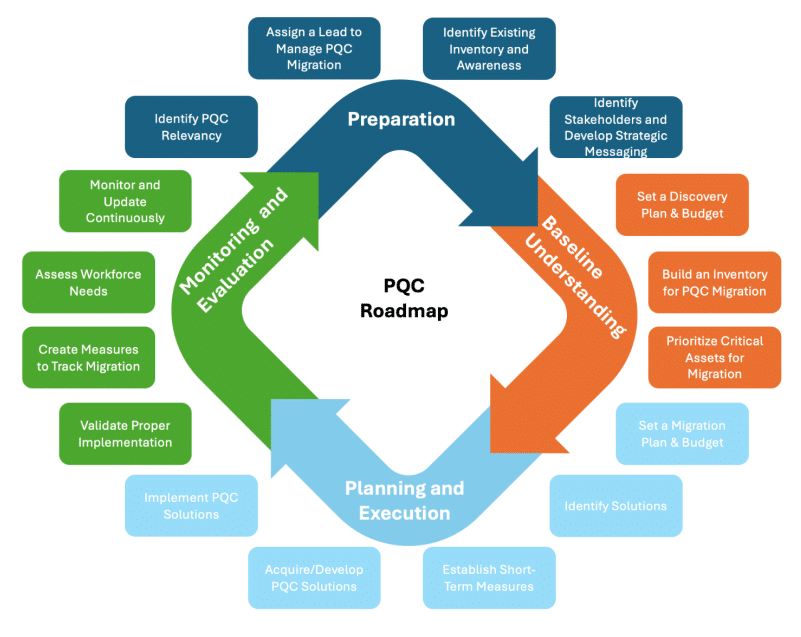
The global push toward post-quantum cryptography (PQC) is accelerating — but for crypto, the migration challenge is unique given decentralized governance.
The Road to Post-Quantum Crypto: A Race Against Time
Google has been preparing for this moment since 2016 and has set a formal 2029 migration target for its own systems. The US National Institute of Standards and Technology (NIST) has already standardized a set of post-quantum cryptographic algorithms. The tools exist; the challenge lies in their implementation within decentralized ecosystems.
Bitcoin’s Governance Problem: BIP 360
For Bitcoin, advocates like Eli Ben-Sasson are pushing for BIP 360, a proposal to introduce quantum-resistant address types. However, Bitcoin upgrades demand near-consensus among a diverse and decentralized community of developers, miners, exchanges, and wallet providers. The very properties that make Bitcoin censorship-resistant also make it slow to adapt. Aligning these parties for a hard fork with a five-year runway presents a significant political and technical challenge.
Ethereum’s Head Start
The Ethereum Foundation appears to be further along in its preparations. It launched a post-quantum research portal (pq.ethereum.org) backed by eight years of work, with test networks shipping weekly and a multi-fork upgrade roadmap targeting quantum-resistant cryptography by 2029. Ethereum’s 12-second block time also offers a slight advantage against real-time transaction theft compared to Bitcoin’s 10-minute window. Nevertheless, the legacy smart contract problem remains a genuine existential challenge.
The Bottom Line: This Isn’t FUD, It’s a Countdown
Google’s paper is not a declaration of crypto’s demise. It explicitly states that the time remaining before cryptographically relevant quantum computers arrive still exceeds the time needed to migrate. However, that margin is “increasingly narrow,” and the paper concludes with an unambiguous call to action: the crypto community must begin migrating to post-quantum cryptography without delay.
The threat is no longer theoretical. It has a timeline, a mechanism, and a dollar figure. $600 billion is on the clock. Whether Bitcoin’s notoriously conservative community can organize itself to act before that clock runs out is one of the most consequential governance questions in the history of finance.
For investors, developers, and anyone holding crypto, the message is clear: the time to understand post-quantum risk isn’t when the machines arrive. It’s now.
References
- Google Quantum AI — Safeguarding cryptocurrency by disclosing quantum vulnerabilities responsibly (March 30, 2026): research.google
- CoinDesk — Bitcoin bulls scramble for post-quantum protection as Google drops bombshell paper (March 31, 2026): coindesk.com
- CryptoSlate — Google slashes quantum cracking estimates by 20x, creating $600 billion quantum countdown (March 31, 2026): cryptoslate.com
- CoinDesk — Google warns five quantum attack paths could put $100 billion on Ethereum at risk (March 31, 2026): coindesk.com
- The Block — Google warns quantum computing may break bitcoin earlier than thought (March 31, 2026): theblock.co
- CoinDesk — The first winners of the quantum crypto debate are already clear, some up 50% (April 1, 2026): coindesk.com
- Help Net Security — Crypto industry may be running out of time to prepare for quantum attacks (March 31, 2026): helpnetsecurity.com
- Forbes — Google Finds Quantum Computers Could Break Bitcoin Sooner Than Expected (March 31, 2026): forbes.com
- SecurityWeek — Google Slashes Quantum Resource Requirements for Breaking Cryptocurrency Encryption (March 31, 2026): securityweek.com
- The Quantum Insider — Q-Day Just Got Closer: Three Papers in Three Months Are Rewriting the Quantum Threat Timeline (March 31, 2026): thequantuminsider.com
- BIP 360: Pay-to-Merkle-Root (P2MR): bip360.org
- CoinDesk — Bitcoin’s $1.3 trillion security race: Key initiatives aimed at quantum-proofing the world’s largest blockchain (April 4, 2026): coindesk.com
- PR Newswire — BTQ Technologies Announces First Deployment of BIP 360 on Bitcoin Quantum Testnet v0.3.0 (March 19, 2026): prnewswire.com
- CryptoResearch.Report — Bitcoin Introduces BIP-360 for Quantum Resistance (March 10, 2026): cryptoresearch.report
- GitHub — bips/bip-0360.mediawiki (Bitcoin BIPs repository): github.com
- Post-Quantum Ethereum: pq.ethereum.org
- CoinDesk — Ethereum Foundation launches post-quantum security hub (March 25, 2026): coindesk.com
- Technology.org — Ethereum 2026: The Strategic Post-Quantum Shift (February 4, 2026): technology.org
- Ainvest — Ethereum Rolls Out Post-Quantum Security Plan to Address Quantum Computing Threats by 2029 (March 31, 2026): ainvest.com

 Crypto, IT & Cloud